
The exhilarating Sabotage was one of the Beastie Boys’ most thrilling left-turns. Ironically, it became the genre-juggling trio’s most well-known cut. Driven by its propulsive, distorted bass riff, hammering beat and Ad-Rock's energetic vocal performance, Sabotage revitalised the rap trailblazers for a new decade.
Emerging during the organic sessions for the group’s beloved 1994 fourth studio album, Ill Communication, Sabotage was quite the rockiest track the Beasties’ had written in a long time.
The single would spearhead the release of said triple platinum LP, putting no short supply of boiling hot wind in its sails, and seeing it comfortably coast to the very top of the Billboard Top 100.
But though it underlined a significant stylistic pivot, the hallmarks of the blazing live-band arrangement of Sabotage pulled on threads that were present within the Beastie Boys from the very beginning.
First finding each other on the New York punk scene back in the early 1980s. Adam Horovitz (Ad-Rock), Adam Yauch (MCA) and Michael Diamond (Mike D) were clearly on the same page when it came to shared musical touchpoints. Beginning life as The Young Aborigines, the Beastie Boys would later fully crystallise after a fateful meeting with a future production heavyweight.

It was creative warlock Rick Rubin who fulfilled the troupe’s genre-blurring ambitions. Signing to Rubin and Russell Simmons’ new label, Def Jam Recordings, the Rubin-produced 1986 debut Licensed to Ill saw the three youngsters swiftly become a cultural phenomenon.
Selling over nine million copies, the trio’s characterful fusion of heavy rock guitars and deftly spat bars - best illustrated by (You Gotta) Fight For Your Right (To Party!) - would do much to seed an alliance between the two warring genres, prefiguring the following decade’s inrush of nu-metal.
By 1989, the three had split from Def Jam and were signed to Capitol. Things seemed to be looking up, but the three men were at a creative impasse.
Derided by some as one-hit wonders, the Beastie Boys' next move would be to hook up with sampling polymaths, The Dust Brothers. Together, they concocted the critically-revered Paul’s Boutique. Despite its fascinating, textured production, which would later be widely acclaimed, the record was a sales flop. It seemed that, on a commercial level at least, their moment in the sun had passed.
“When the record came out it was crickets,” Adam Horovitz told Rolling Stone. “Like, I went to Tower Records and they didn’t even have it. I thought that was a little weird. And [Capitol] gave us money; I’d assume they wanted their money back.”
It's no surprise that third album, 1992's Check Your Head, found the three making something of a retreat back toward their rockier origins. Throwing off the sample-laden aesthetics of its predecessor, the trio sonically landed on a more refined version of the rock/rap hybrid sound of their debut, albeit with one foot still in the experimental camp. The record featured some more extensive forays into jazz and funk-informed fare (Lighten Up and Something’s Got to Give).
Produced by new producer (and Paul's Boutique engineer) Mario Caldato Jr., real instruments were back in hand, as the three re-positioned themselves as a more digestible outfit.
This time, it sold. Check Your Head peaked at number 10 on the Billboard Top 200.
A lengthy tour, mainly at smaller venues, would solidify the direction. “John Silva was our new manager and he sent us out on tour for a year playing everywhere. Last time we’d done that, we were the Fight For Your Right to Party guys, and so now we’re in these clubs, and it’s way more fun,” Horovitz recalled in an interview at South by Southwest (as reported by The Austin Chronicle). “We didn’t expect that. So now we were a band.”
On the back of the Check Your Head tour’s success, the galvanised Beasties opted to continue on this instrument-driven path for album four.

Once again Mario Caldato Jr. was back in the producer’s chair, overseeing a process whereby the three would relentlessly jam out new ideas in-studio. New York’s Tin Pan Alley was the primary venue for these sessions.
“We set up all of the band stuff in this one little room where there was, I think, an API type of vintage console,” Caldato recalled in an interview with Sound on Sound. “The EQ had a low-end filter cut/boost and high-end filter cut/boost, and they also had these really old custom valve preamps and an Otari 24-track tape machine.”
By this time, the Beasties were more than comfortable with their fixed band-roles. Mike D was behind the drums, Ad-Rock was on guitar duties, (namely a Gibson Les Paul) while MCA toted a Fender Jazz bass.
Joining them was incoming key contributor Money Mark on keys and synths while additional percussionist Eric ‘Bobo’ Correa was also on hand to enhance the rhythmic landscape.
Mario would track the sessions to be worked on later. Riffs and grooves typically led the way, with numerous blind alleys being followed fruitlessly. Some, however, would birth tracks such as the wah-wah funk of Sabrosa, the vibey Ricky’s Theme and the surrounding structure of the loop-driven Sure Shot.
During this process, Yauch was experimenting with his bass routed through a Superfuzz pedal, when he hit upon the semi-strummed opening riff that would define Sabotage by accident.
A pulsating movement that throbbed between the notes of Ab and Gb on the 11th fret of the A string and G string respectively (with an occasional pentatonic scale fill). Yauch just couldn’t stop playing it.
Soon, this repetitive bass riff started building real momentum. The other instrumentalists - one-by-one - began to jam along with Yauch’s explosive new idea. Ad-Rock conjured a droning chord with his guitar, while Bobo accented and explored different rhythmic patterns to propel and punctuate the arrangement.

“Within a couple of minutes it became this heavy thing with one chord and some hits. We kept working on it a little bit to form a quick arrangement and just recorded it. Then boom, it was done, and we were like, 'Oh, that was fun!’,” Mario told Sound on Sound.
Hastily tracked by Mario, this instrumental construction was initially named ‘Chris Rock’ after the studio’s owner (allegedly a long-haired rocker named Chris) heard the track and said ‘Now that’s what I’m talking about!’
As the sessions progressed, a few vocal ideas were trialled for the instrumental, but none of them really worked or stuck. In fact, the Beastie Boys themselves were dubious about this overtly hard rock-leaning idea even being on the album.
Months passed, and many other tracks for the album were developed, but the song that would ultimately become the Beasties' biggest sat on the shelf right until the very end of the Ill Communication sessions.
“[It was] kind of our favourite instrumental,” Horovitz recalled. “But for whatever reason, it just sat around for months and months with no vocals.”
Caldato was frustrated, he knew that ‘Chris Rock’ - and many other unfinished ideas - were highly promising. The problem was, trying to get his errant charges to knuckle-down and finalise their arrangements was often met with hostility. Basketball, it seemed, was a more compelling diversion.
Soon, things became more intense, as an exasperated Mario demanded that the group finish the project they’d started.
“We were totally indecisive about what, when, why and how to complete songs. Mario was getting frustrated,” Horovitz recalled in 2018’s The Beastie Boys Book. “That’s a really calm way of saying that he would blow a fuse and get pissed off at us and scream that we just needed to finish something, anything, a song. He would push awful instrumental tracks we made just to have something moving toward completion.”

In the ultimate example of ‘be careful what you nag for’, Horovitz decided the song should be squarely aimed at his irate producer. “I decided it would be funny to write a song about how he was holding us all down, how he was trying to mess it all up, sabotaging our great works of art.”
But it came as a big relief to the oblivious Mario, when he received a giddy phone call from Adam saying that he’d - at long last - been struck with a strong vocal and lyrical idea for ‘Chris Rock’.
However, Horovitz stipulated that he didn’t want to record it at the studio. He wanted, instead, to track it at Mario’s own home.
Regrouping at Caldato’s home studio, Adam recorded his fierce vocal idea on a Sennheiser 421. Mario was stunned. He was also blissfully unaware that he himself was the subject of the ire.
“He nailed it in one or two takes and I was like, 'Oh, my God, that's it! You did it!' It was perfect. He had done his homework and he was screaming it with the exact amount of energy and attitude needed.” the producer recalled in Sound on Sound.
Delivered with boiling rage by Horovitz, Sabotage’s lyric was suitably barbed.
I can’t stand rocking when I’m in here
‘Cause your crystal ball ain’t so crystal clear
So while you sit back and wonder why
I got this f*****g thorn in my side
Although it might feel like there's legitimate anger coursing through Sabotage, it seems that no hard feelings were genuinely meant by the song’s Mario-directed fury. In retrospect, it's more likely that this trigger-point for creativity was borne more out of the gnawing indecision and rising tension around completing the record as a whole, Adam had simply pointed it, in a stylised way, upon one person.
“I decided, ‘I’m going to Mario’s house to record vocals,’” Horowitz told South by Southwest. “‘And the lyrics are all going to be about how Mario is the worst person in the world and he’s holding all of us back.’ He’s not. He’s a wonderful person and has always been encouraging.”

With additional vocals and turntable scratches overdubbed at their G-Son studio in L.A., it was clear that Sabotage was an incredible track, and soon became a firm favourite of the Beastie Boys’ inner circle.
The feeling that the song was something quite special was proved when it was chosen as the lead single from the album on May 9th 1994. Soon after, Sabotage became an inescapable phenomenon.
A large factor in its success was its iconic Spike Jonze-directed video, which soon came into regular rotation on MTV.
A self-consciously low-budget parody of 1970s cop dramas, the three Beastie Boys were decked out in comedically large wigs, shades and moustaches to portray different actors playing characters on a fictitious TV show called ‘Sabotage.’ Jonze’s guerrilla style here would prefigure his street-prank 2000 co-creation, Jackass.
To emphasise the purposefully DIY nature of the video, Spike ran the production of the video from a van.
“We just ran around L.A. without any permits and made everything up as we went along,” Yauch told New York Magazine. Car chases, stunt work and fake fights were captured, we assume, with the most minimal of health and safety checks.
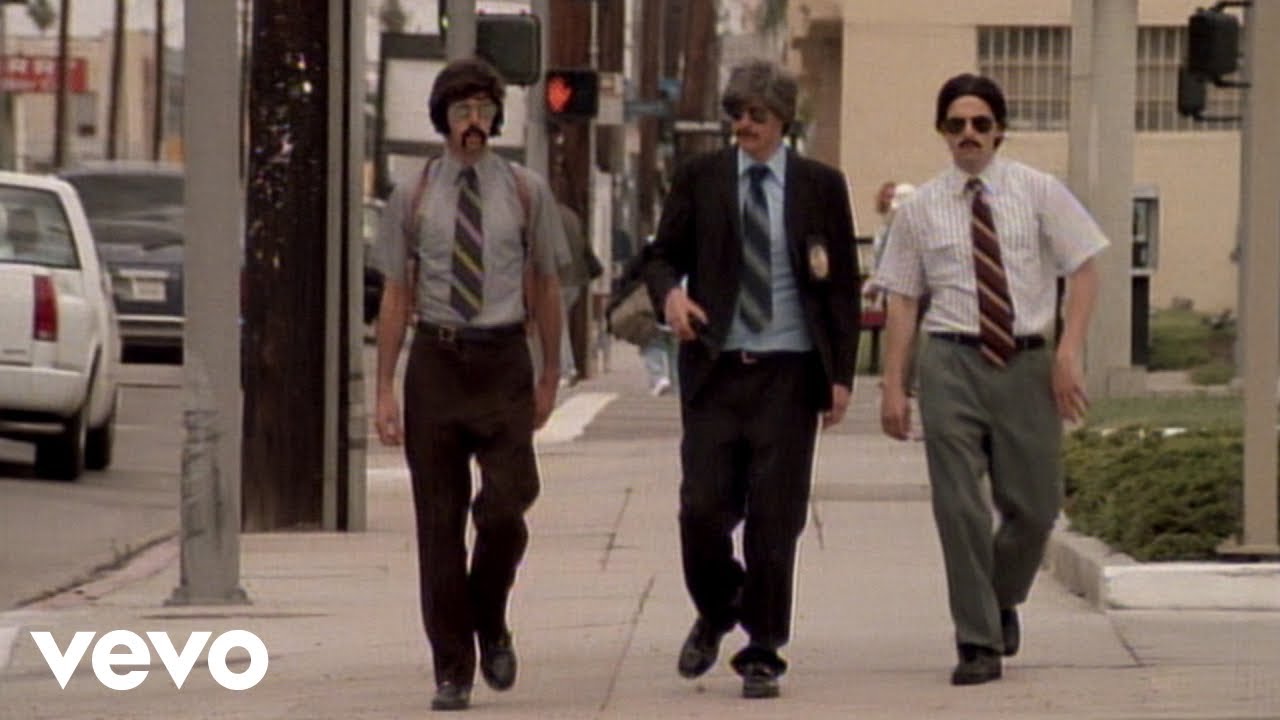
“We all watched video tapes of Streets of San Francisco and other shows and we were like, ‘Ok, that would be awesome if we could actually pull off our own version of that',” said Mike D in an interview with Vanity Fair. “We bought a car that was about to die, and we had some kind of, like, loose shooting permits, but it’s not like we had fire-department [permits] or any of the stuff we should have had with the car. And we just drove the car ourselves.”
The end result was a thrilling double-whammy of explosive rock/rap banger and a genuinely funny comedy mini-movie. It would be nominated for five MTV Video Music Awards.
Despite (ridiculously!) winning none, Yauch had the last laugh as he stormed the stage as his Swiss alter-ego, Nathanial Hornblower to protest the video’s lack of recognition. Much to the then-onstage R.E.M’s chagrin.
Although not recognised that night, the Sabotage video has been widely credited as being influential by a huge array of creatives. Notably, its freeze-framed character introductions were directly cited as the inspiration for the opening of Danny Boyle’s 1996 Trainspotting, and Jonze’s cut-to-music directing and editing would plant seeds in the minds of a new generation.
As comedian Amy Poehler reflected in The Beastie Boys Book; “There would be no Anchorman, no Wes Anderson, no Lonely Island, and no channel called Adult Swim if this video did not exist.”
The video and single’s success catapulted the parent album to the very summit of the Billboard Top 100. The Beastie Boys were back, and they would never really ever go away. Sabotage would, over time, come to be regarded as the band’s greatest (and most streamed) song.
In 2018, Horovitz reflected on the song’s enduring popularity, and the Beastie Boys’ place in the firmament of popular culture with no little bemusement. “I don’t know why we sold a lot of records, or why so many people came to see us,” He told Rolling Stone. “Like Sabotage - would you put that song on, like, ‘I’m gonna listen to that right now’? It’s a weird choice.”
