
Speak to any experienced player, and they’ll likely tell you that getting the best guitar cable you can afford is always a good idea. While it’s not as exciting as a new pedal, amp, or guitar, it’s a really crucial part of your rig.
You’re only as strong as your weakest link, so if you’re spending money, time, and effort on your setup, then it’s only fair that you invest in one of the best guitar cables to enjoy everything to its fullest. There’s no point having a Custom Shop Gibson Les Paul through a hardwired Fender Princeton if your cheap, old cable is making a load of unwanted noise!
If you want the very best, my top pick is the Mogami Gold Series Guitar Cable. It stands out for its exceptional build quality, reliability, and clean signal transmission, making it ideal for both stage and studio use. If you're shopping on a budget, the Fender Professional Series Instrument Cable offers great performance and durability at a more affordable price, making it a solid choice for beginners and gigging musicians alike.

To make your buying decision even easier, you'll find a helpful FAQ section at the end, plus a glossary of key terms to help you understand the world of guitar cables better.
Best overall

The Mogami Gold Series Guitar Cable is already used throughout the world for professional audio work in recording and broadcast studios, so it’s unsurprising that its range of guitar cables is pro standard.
Manufactured in Nagano, Japan, the company publishes the Gold Series’ capacitance rating at a reassuring 39.7pF/Ft – and its build continues that quality.
A conductive PVC layer is placed under the shield conductor to drain away high impedance voltage and to reduce unwanted microphonic noise dramatically. It’s also available in shorter lengths with right-angled connectors for patch cable use.
Best budget

A cost-effective solution for your cabling needs, the Fender Professional Series Instrument Cable is manufactured to exacting standards. Coming in a variety of size options, they’re perfect if you need to wire your pedalboard or expand your reach onstage.
It’s a nice and fat gauge cable, lending it a feel that’s more premium than the price tag would suggest. It’s wrapped in a PVC casing that’s been specially formulated to have no ‘physical memory’, preventing it from getting into a tangled mess no matter how quick your changeover is.
The interior of the cable reduces unwanted noise thanks to the 95% OFC spiral shielding, helping to transparently transport your guitar’s signal. They’re handily available everywhere too, so you won’t have to look too far if you decide you want one as a backup.
Best patch cable

Pedalboard real estate is precious – every inch counts in a pursuit to add more stompboxes. That means we need patch cables to be… less! Ernie Ball clearly understands this because the flat-angled ends of this patch cable help move your pedals closer together if needed.
They're a real godsend if you have a stacked pedalboard and come available in a wide variety of lengths, giving you plenty of flexibility with your signal chain. Some flat patch cables actually end up being two wide if you have a stereo pedal with the sockets close to one another, but we found no such issue with these.
We’ve had good experiences gigging with these great value patch cables, and Ernie Ball even makes the Flat Patch Cable in white as well as the ubiquitous black. As you'd expect from Ernie Ball, they're fantastic quality too.
Best durability

Boss has always been the benchmark of durability and reliability in the world of effects and accessories. At the end of the day, we all need to know that our cables are going to last a while and won’t die on us mid-gig.
Boss’ instrument cable comes in various lengths with various jack combinations, to ensure that you get the cable to suit your needs. Constructed with care and attention, the oxygen-free cable and corrosion-resistant 24k gold-plated connectors ensure minimum signal degradation - keeping your tone sounding bright, lively, and precisely as you like it.
A highly durable braided cable jacket completes this crucial element of your setup, delivering strength that is surprisingly impressive for a cable of this price point. There is plenty of competition from other brands in this sub £/$25 corner of the market, but Boss has just as much of a right to be here as anyone else.
Best solderless

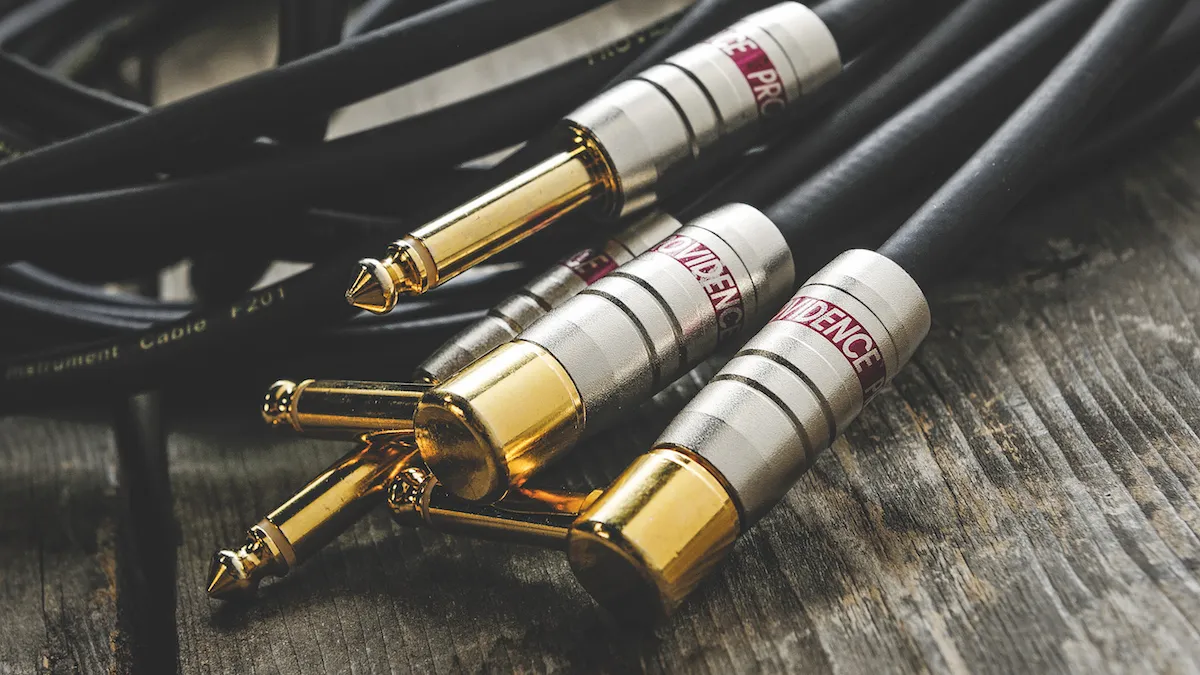
If you need custom lengths for your pedalboard, a solderless kit is an easy, accessible option that won’t require an electrician’s skills. And if you’re skeptical about how Evidence gets around the lack of soldering on the connections here, rest assured that it’s all about precision for a connection Evidence confidently claims is ‘better-than-soldered’.
The inside of the tips of the brass SIS right-angled plugs (eight are included with the 5ft kit) are precision machined to have threads. These threads cut and reshape the soft IGL copper conductor of the Monorail cable when turned around it several times. Need more convincing? David Gilmour, Noel Gallagher, Graham Coxon, Guthrie Govan, and Radiohead’s Ed O’Brien all use them.
Best mid-priced

Some guitarists prefer a woven guitar cable casing because it’s less likely to tangle. Let’s be honest, it also looks more exciting than the usual black, that’s for sure.
Though black is available, funkier choices of Neon Pink and Orange will ensure you can see your guitar cable on low-lit stages, though we’re rather partial to the red, blue, and white design ourselves.
Crips highs and rich harmonics ensue with this cable thanks to the dual conductors. You're also assured of a low-noise floor thanks to the well-shielded construction.
Best coiled cable

Pedalboard real estate is precious – every inch counts in a pursuit to add more stompboxes. That means we need patch cables to be… less! Ernie Ball clearly understands this because the flat-angled ends of this patch cable help move your pedals closer together if needed.
They're a real godsend if you have a stacked pedalboard and come available in a wide variety of lengths, giving you plenty of flexibility with your signal chain.
We’ve had good experiences gigging with these great value patch cables, and Ernie Ball even makes the Flat Patch Cable in white as well as the ubiquitous black. As you'd expect from Ernie Ball, they're fantastic quality too.
How to choose

Picking a guitar cable doesn’t have to be complicated, but the wrong one can seriously mess with your tone. Here’s what to keep in mind.
Length matters
Longer cables are convenient, but they can suck out high-end frequencies. If you’re not moving around much, stick to 10–15 feet. If you’re a pacer, go for 20 feet max and look for a cable built to handle the extra run.
Go for quality connectors
The ends of your cable take the most abuse. Brands like Neutrik and Switchcraft make connectors that are tough, reliable, and easy to re-solder if something goes wrong down the road.
Check the shielding
A well-shielded cable cuts down on hum and interference, especially important if you play near lights or other electronics. Braided shielding is generally better than spiral shielding for noise rejection.
Don’t obsess over price
You don’t need to spend a fortune. A solid mid-range cable, around £20–£40, will serve most players just fine. Save the boutique stuff for when you’re really dialling in your rig.
Guitar cable glossary
- Braided shielding: A woven metal layer that blocks unwanted noise and interference.
- Capacitance: A cable’s tendency to absorb high frequencies, affecting your tone.
- Coiled cable: A spring-style cable that stretches out and snaps back when you move.
- Connector: The metal plug at each end that slots into your guitar or amp.
- Ground: The part of the circuit that prevents hum and electrical buzz.
- Impedance: Resistance to signal flow; mismatches can cause tone loss.
- Instrument cable: An unbalanced cable designed specifically for guitars and basses.
- Oxygen-free copper (OFC): High-purity wire that carries your signal cleanly.
- Patch cable: A short cable used to connect pedals on a pedalboard.
- Spiral shielding: A simpler, cheaper shield wrap; decent but noisier than braided.
FAQs
Will a better guitar cable improve my tone?
The simple answer is: not really. However, a low-quality cable can make your tone worse. Cables don’t really add anything to your sound, but they can take away, as a result of their high capacitance. Bad shielding can also mean you pick up unwanted noise.
We always recommend getting the best cable you can afford. The old adage ‘buy cheap, buy twice’ rings incredibly true to guitar cables. Cheap cables are more likely to break, degrade your tone, or even pick up external electronic interference.
A good-quality cable keeps your signal true to the source and, if you look after it, will last you for years to come. So spend an extra $30 or so now, and you’ll probably save in the long run.
What is cable capacitance?
It’s hard to talk about guitar cables without talking about capacitance. When in use, guitar cables hold a small amount of charge - they have capacitance. Given that the primary goal of a cable is to transfer the signal created by your guitar to your amp, you don’t want it to hold too much charge, which is why you’ll see some cables marketed as having ‘low capacitance.’
A capacitor is formed between two electrical conductors that are in close proximity. The larger the surface area of these conductors (in your guitar cable), the larger the capacitance. Large amounts of capacitance are measured in units of farads, so named after 19th-century English physicist Michael Faraday.
Electric guitar cables contain smaller amounts of capacitance, which are measured in picofarads (pf); each one million-millionth of a farad. A decent quality audio cable should offer 40pf per foot with the highest quality offering around half that.
Does this actually matter? Yes - the higher the capacitance a cable has, the narrower the frequency range you’ll get. Usually, you’ll start to hear some roll-off in the top treble frequencies. So, if you want all the brightness that your pickups generate, you’ll want a low-capacitance cable. On the other hand, some players like to tame a naturally bright instrument with a higher capacitance cable.
As a general rule of thumb, the longer your cable length, or the more capacitance the cable itself has for its given length, the more loss of high-end you’ll notice.
You may even want this, but if you’re lacking some high-end brightness, a low-capacitance guitar cable could make a positive difference to your sound.
What is cable impedance?
Impedance (Z) is the measure of the total opposition to current flow in an alternating current circuit. It is made up of the sum of two components, resistance (R) and reactance (X). The output from most electronic audio devices is usually low impedance (around 150 ohms), but it can be much higher for passive guitar pickups.
Active pickups contain a preamp that offsets any issues with impedance by converting it to low impedance, and it can drive a cable without any loss of high frequency.
And this means it is more adversely affected by capacitance from a cable to create a filter on your sound – as capacitance and impedance increase, this filter comes into effect more. In theory, the ideal setup for wide frequency response in your tone is a low-impedance pickup and low-capacitance cable.
When it comes to smaller patch cables between your pedals, their capacitance isn’t as important as the cable that goes between the guitar and the first pedal in your chain. That’s because pedals have low impedance outputs, though if your pedals are true bypass, they’ll have more effect on the overall capacitance in your signal.
Does the length of a cable matter?
Of course, when shopping for the best guitar cables, you need to get the one that is either as long or longer than you need it to be. You don’t want to be limiting yourself on stage in terms of movement. However, the length also corresponds to capacitance. The longer the cable, the more capacitance it will inherently have. So, if you don’t want to experience the dulling of those treble frequencies, then you don’t want to get a cable that’s far too long - it’s all about balance!
Are guitar cables balanced?
Guitar cables are unbalanced, which means they’re prone to interference. This is part of the reason we’d always advise getting a good quality cable, as you won’t be opening yourself up to more potential noise, particularly useful in complex setups with loads of pedals.
An unbalanced cable is mono, so only sends one copy of the signal which is what makes them likely to pick up extraneous interference. A balanced cable sends two copies of the signal, one inverted, which cancels out any noise or interference.
Despite a balanced cable being objectively better, unfortunately, as guitarists, we cannot use them with our setups due to the way our pickups work. They can also present issues when plugging into our amplifiers, as some amps won’t be compatible with the TRS-style connector on a balanced cable.
Can guitar cables cause buzz?
This is actually quite a complex question, purely because there are so many components in your signal chain that could potentially cause buzzing. Whilst a bad cable certainly can cause a buzz, it wouldn’t necessarily be our first port of call when looking to get rid of a noise issue.
The truth is buzz is far more likely to be caused by your pickups, or interference from electric devices in your home - particularly true with single coil equipped guitars. A faulty cable usually results in your whole signal cutting out, rather than just noise by itself. Of course, this isn’t a solution for every potential problem, but if you fear your cable is faulty, try it on a different amplifier or guitar and see if you can recreate the issue.
Do gold connectors make a difference?
So, does the material of your connectors make a difference? You may have noticed that many high-end cables feature gold plating, but is that just for show? In short, no. Gold connectors are highly conductive, allowing for the most accurate signal transfer. While laboratory tests confirm the superior conductivity of gold over nickel, hearing the difference in real-world situations might be more subtle. However, gold has a significant advantage in durability – it's far less prone to corrosion than nickel. So, if you’re careful with your cables, gold connectors will likely last much longer.
How we choose

Guitar cables are a relatively simple bit of gear but they're an essential part of any guitarist's arsenal. When choosing the best guitar cables for our guides we take into a lot of different factors to determine what makes the cut.
First of all, we'll look at our real-world experience. Many of the cables in these guides will have been used by our writing team for gigging and recording. Our own experiences with these cables in particular will inform whether or not we feel they are adequate for the guide.
If we haven't tested a cable firsthand, then we'll be relying on factors like user reviews and word of mouth from other musicians we're connected with, backing these up with lengthy discussions with our editorial colleagues to determine its suitability.
As guitarists ourselves we only want to recommend products we think are actually good. For that reason, we'll carefully consider the cost and feature set of each product we recommend to ensure it meets the demands of every kind of guitar player.
Find out more about how we test music gear and services at MusicRadar.
Why trust us?
✔️More than 9,500 reviews on-site
✔️Over 17 years of product testing
✔️ 2.9 million monthly users globally
With more than 17 years of experience, MusicRadar is the premier music-making website in the world. Run by musicians for musicians, we offer expertly written gear round-ups and high-quality, authoritative reviews by an extensive team of highly experienced industry professionals.
We also interview world-renowned musicians and stars about their creative processes and the nuts and bolts of their gear and technique. This gives fans an insight into the actual craft of music-making that no other music website can.
But that's not all. We also provide excellent tuition, from bite-sized tips to advanced techniques and guidance from recognised musicians.
As well as delivering high-quality written reviews and features, we also produce a wealth of video content on YouTube. MusicRadarTV is where you'll find all of our access-all-areas interviews, hot gear demos and exclusive video lessons.
Related buyer's guides
MusicRadar's got your back Our team of expert musicians and producers spends hours testing products to help you choose the best music-making gear for you. Find out more about how we test.
- Start a new project with the best DIY guitar kits
- When it comes to essentials, check out the best guitar tuners
- Beef up your sound with the best chorus pedals
- Why not check out our pick of the best compressor pedals too?
- Explore our pick of the best looper pedals for every budget
- Kick off your playing career with the best beginner guitar amps
- Channel your inner Hendrix with the best fuzz pedals
- Metalhead, get your stomp on with the best distortion pedals
- Protect your axe with the best guitar cases and gig bags
- Check out these gifts for guitarists
