


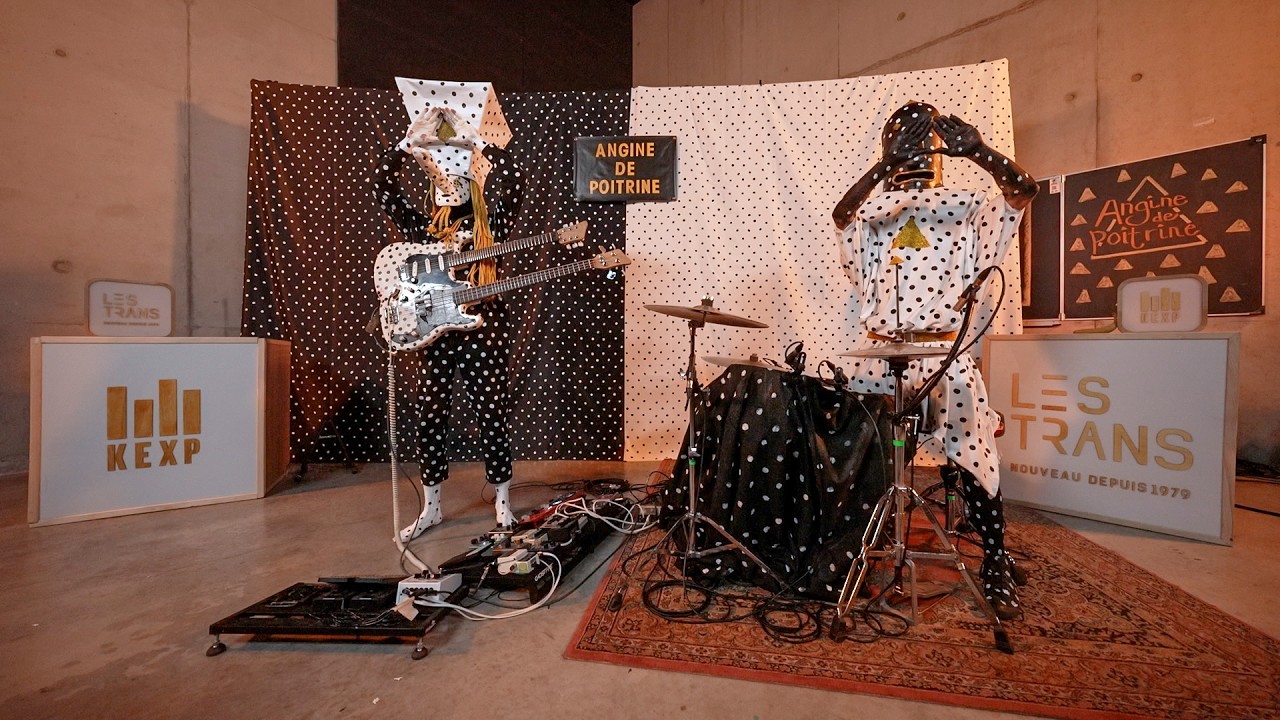
This unclassifiable Quebecois duo is having a viral moment after their performance on KEXP. Angine de Poitrine were already saturating my social media feeds before Rick Beato shone a spotlight on them. My students at NYU are already tired of the video, but I am very much not.
So – who exactly are these people? Drummer Klek de Poitrine and guitarist/bassist Khn de Poitrine have been playing together for more than twenty years, mostly as a duo. They describe Angine de Poitrine as a “Mantra-Rock Dada Pythago-Cubist Orchestra”, and the band name translates to “angina of the chest”.
What about their distinctive look? In an interview with Noize Magazine, the band explains that the costumes started out as a joke. They wanted to play the same venue twice in the same week, but the venue didn’t think anyone would show up for a second show, so they disguised themselves as a different band to get the booking. They found that they liked the concept and ran with it.
For their influences, Klek and Khn cite Frank Zappa, Miles Davis, John Scofield, the obscure ‘70s prog band Gentle Giant, acid house and techno, and mainstream pop like Calvin Harris and Dua Lipa. For the microtonal aspect, they point to various kinds of Asian and Arabic music; more on this below.

Angine de Poitrine’s grooves are immediately distinctive. Sarniezz is in regular old 4/4 with a triplet-y 12/8 feel, but it has peculiar accents. Mata Zylek is in 10/4. Fabienk is either in very strangely-grouped 7/4 or conventionally-grouped 28/4. Finally, Sherpa is in 17/4.
The band constructs these wonky grooves using a loop pedal. Khn plays both the bass and all of the guitar parts on a Stratocaster-style double-neck guitar that’s half electric guitar and half bass, and he can only do that by layering them with the looper. This creates serious restrictions in song structures and arrangement choices. Once the loop is going, the only change you can make is to either add layers or mute them.
The drums aren’t looped, so they are independent, but Klek mostly plays steady grooves anyway. Khn explains that the looper “inevitably leads us into an aesthetic territory somewhat reminiscent of techno music.”
Because every song has to have essentially the same structure, it forces the band to be creative with the details
The loops’ constraints have several musical benefits. The songs have to focus tightly on a single idea, rather than wandering aimlessly. Because every song has to have essentially the same structure, it forces the band to be creative with the details. The loops also make the songs somewhat predictable, and that is a big help for listeners struggling to parse the odd time signatures and unusual tuning.
By the way, Khn’s painted bare feet look cool, but they may also serve a practical purpose: he can probably manipulate his various pedals more accurately with his toes than he can with shoes on.
Khn’s doublenecked guitar/bass combo has twice as many frets per octave as a normal guitar or bass. This produces a tuning system called 24-tone equal temperament (24-TET), meaning that each octave is divided into 24 logarithmically equal-sized parts. Normally, Western instruments are designed to play 12-TET, dividing the octave into 12 logarithmically equal-sized parts. In 24-TET, you get a new note in between every piano-key pitch, built on intervals called quarter tones.
Klek initially converted a regular guitar into a microtonal one by sawing new frets into it himself. He loved the result and urged Khn to try it. At first, they thought they would explore Arabic-sounding ideas. But Khn explains that he would have fallen into shallow stereotypes, and he wanted to play in an idiom that he was more at home in. So in spite of the exotic tuning, his musical vocabulary is based on prog rock and modal jazz.
Khn describes his use of quarter tones as “cubist”, because he can make his chromatic approaches twice as long as usual, and build more tension. However, this is all taking place against static modal backdrops that Khn compares to Miles Davis’ So What, and more obviously, Überjam by John Scofield.
They don’t seem to belong to any specific style at all except for their own
Listeners have compared Angine de Poitrine to Flying Microtonal Banana by King Gizzard and the Lizard Wizard, which also uses instruments tuned in 24-TET. However, King Gizzard is specifically basing their microtonal ideas on Turkish music, and they use lyrics. Angine de Poitrine songs don’t have any lyrics aside from a few heavily distorted one-shot samples, and they don’t seem to belong to any specific style at all except for their own.
Quarter tones have been described in Arabic music for centuries, but they are an abstraction or simplification of a more complex and nuanced approach to tuning, rather than the literal 24-TET used by Angine de Poitrine and King Gizzard. There are a few supposed quarter tones in Anglo-American pop music, including the bass intro to “These Boots Are Made For Walkin’” by Nancy Sinatra and the chorus to “Good in Bed” by Dua Lipa. However, these songs use arbitrary points along continuous pitch slides, not specific 24-TET intervals.
What is microtonal music?
Microtonal music is the very definition of artsy and experimental, but the idea has slowly been creeping into the mainstream over the past decade. This is due more to synthesizers and digital audio workstations than guitars or other physical instruments.
Adding frets to a guitar or moving the existing ones around is difficult, but retuning a digital synth is effortless if you use a plugin like Oddsound’s MTS-ESP. Ableton Live recently introduced a variety of alternative tuning systems as a native feature, and Logic Pro offers adaptive just intonation.

How to create microtonal music using Ableton Live's Microtuner
Mainstream listeners have also been unintentionally preparing for alternative tuning systems due to a quirk of sample-based production in early hip-hop and techno. In the 1980s and 1990s, there was no way to control the pitch and tempo of a digital sample independently. If you wanted your sample to be faster, then it had to be sharper, and if you wanted it to be slower, then it had to be flatter.
When you are producing dance music, rhythmic alignment is a higher priority than pitch alignment, so electronic music of that era is full of out-of-tune samples. For an example, listen to “Clint Eastwood” by Gorillaz. Now you can timestretch and pitchshift your audio however you want, but people still detune their samples as an aesthetic choice.
While the 12-TET system is standard in the Western world, it is far from universal. Other cultures have their own tuning systems and practices. Even within Anglo-American music, you have been hearing more music outside of 12-TET than you might expect.
This is because 12-TET is actually pretty badly out of tune. Skilled singers and players of continuous-pitch instruments like violin and trumpet adjust their tuning on the fly, intentionally or not, to make it smoother. It’s really just players of keyboard and fretted instruments who are locked into 12-TET, as are most digital instruments by default.
If 12-TET is out of tune, why did our entire civilization embrace it as its tuning standard?
If 12-TET is out of tune, why did our entire civilization embrace it as its tuning standard? The full explanation is beyond the scope of this article, but the bottom line is this: if you want in-tune intervals, you are going to need an awful lot of keys or frets per octave. People tried that! Western Europe based its tuning systems on in-tune just intonation intervals for centuries, and they ran into a lot of headaches.
For example: when tuned “correctly”, F-sharp and G-flat are actually two different pitches that are almost a quarter tone apart. To play them in tune, you need separate keys or frets for F-sharp and G-flat in every octave. The same goes for C-sharp and D-flat, D-sharp and E-flat, and the rest of the black key notes.
You will also need two different keys or frets for A, and two different keys or frets for D, because those notes can each be tuned two different ways, neither of which is in tune with every other note. As you get further from the key of C, you will start needing separate keys for E-sharp and F-flat, and for B-sharp and C-flat, and it only gets worse from there.
There were a few attempts to build keyboard instruments with split black keys to play the sharps and flats separately. Here is one such organ, built in Italy in the 16th century:
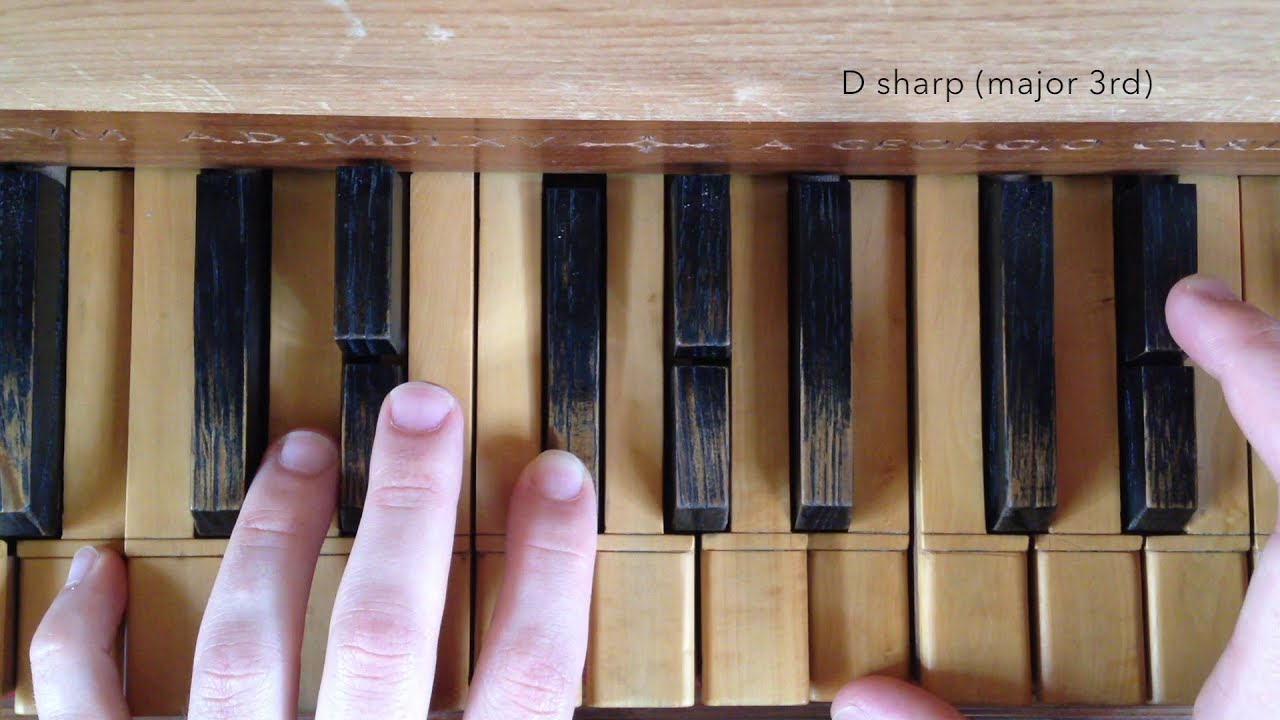
In the 1700s, Europeans started to adopt compromise tuning systems that averaged out (tempered) all the close-but-slightly-different notes. The details are tedious, and the bottom line is that by the 20th century, 12-TET won out for its convenience: it offers twelve uniform semitones that fit together with LEGO-like modularity. On a modern piano, you use the same key for both F-sharp and G-flat, and neither note is in tune, but they are both (supposedly) close enough.
This might all seem academic, but if you have ever tried to tune a guitar, you have first-hand experience of how practically important the math turns out to be. It’s actually impossible for all six strings on a guitar to be in tune with each other! For example, if the G string is in tune, then the B string can’t be, and vice versa. If you use a digital tuner, it will put both strings in 12-TET, so neither will be in tune, so, uh, problem solved, I guess.
The composer Terry Riley quips that “Western music is fast because it’s not in tune.” We have bought ourselves convenience at the expense of consonance. Angine de Poitrine’s solution to the Terry Riley problem is to say, well, let’s play even faster and further out of tune!
Dividing all the 12-TET semitones in half solves none of the system’s problems, but it does give you twice as many out-of-tune intervals to choose from. And what does “out of tune” even really mean, anyway? Your experience of “good” tuning is heavily informed by your cultural exposure, and can easily change. You can get used to 24-TET if you listen to enough of it.
Or maybe you can’t! Either way, Angine de Poitrine makes it work because their aesthetic is intentionally harsh and disorienting, so the ugliness of 24-TET suits their intentionally awkward rhythms and distorted timbres. Also, the music is so repetitive that you have plenty of time to equilibrate to what you’re hearing.
If you are a guitarist and you want to explore microtones yourself, there are easier ways to do it than buying or making a 24-TET guitar. Blues, rock and country guitarists already play microtones without realizing it every time they bend their strings. You can get even more microtonal by playing with a slide, or with a fretless bass (fretless guitars exist too, but they are a pain.)
If you are going to leave the familiarity of 12-TET and 4/4 time behind entirely, though, you might as well go all the way and wear a freaky costume.
