


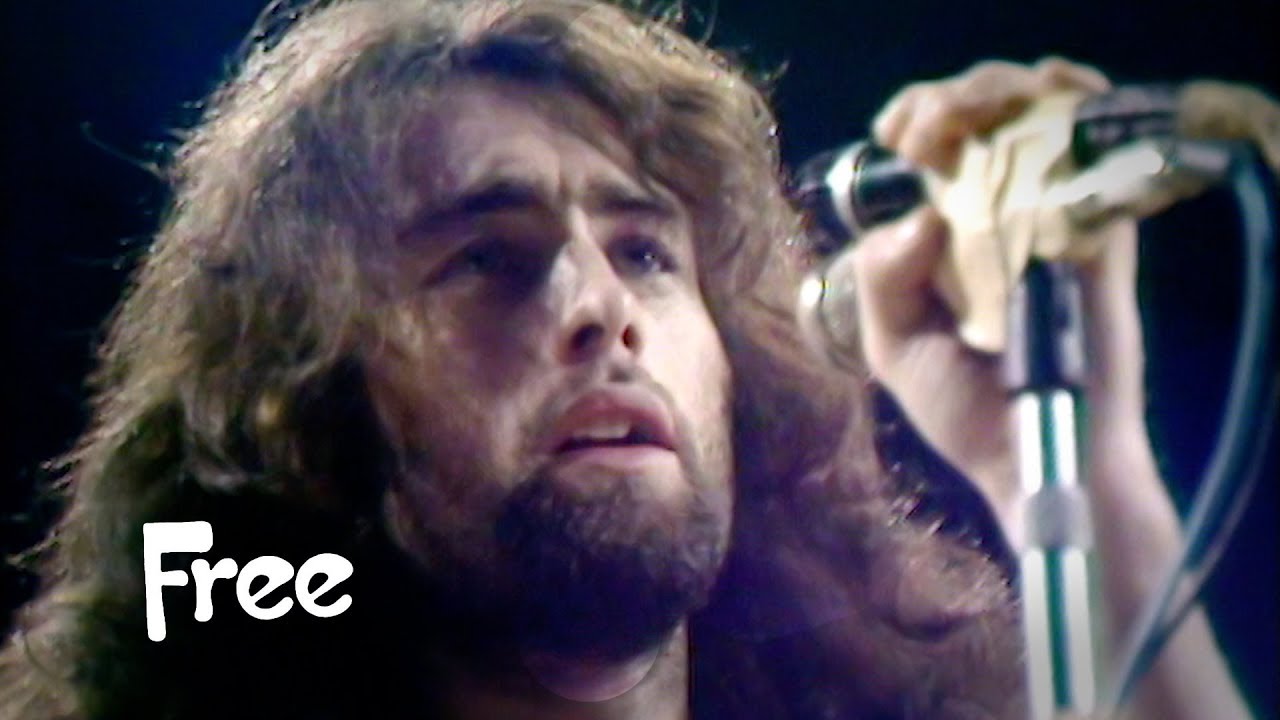
It was the song that gave the four members of Free their first taste of international stardom in the summer of 1970 – but the rock classic All Right Now was in fact inspired by one of the worst gigs the band ever played.
The song was written by bassist Andy Fraser and singer Paul Rodgers, and as Fraser recalled, the words in the title came to him after a “terrible” show at a college in Durham – on a “rainy Tuesday” that was “cold and miserable” with the band arriving at the venue in a “pretty foul mood”.
Things got worse from there, as the musicians realised that they would be playing to an audience of 30 (“too out of it to even notice”) in a room that could have held 2000. The performance that followed “absolutely sucked” with the band describing the experience as unsurprisingly “depressing”.
Drummer Simon Kirke went as far as admitting that the group “walked off the stage to the sound of our own footsteps”.
Fraser recalled to Songwriting Magazine in 2013: “Afterwards, in the dressing room, there was just this horrible silence… a really bad atmosphere. So to try and alleviate the tension, I just started singing, ‘All right now, baby, it’s all right now,’ over and over, kind of like a parent trying to gee their kids along! But it worked. The rest of the band started tapping along and so I thought, ‘We’re onto something here.’”
He was definitely onto something. This light-bulb moment would go on to change their lives and cement Free’s stature as one of the most important rock bands of the early ’70s alongside fellow trailblazers Led Zeppelin, Deep Purple and Black Sabbath.

Fraser went on to explain how most of the music was composed within the space of 10 minutes, with a little help from guitarist Paul Kossoff.
“The chords of the song were basically me trying to do my Pete Townshend impression,” Fraser said. “I actually wrote the riff on piano and then Kossoff transposed the chords to guitar. And he did a helluva job because that’s not always easy.
“Basically the chorus wrote itself, the chords took me about ten to fifteen minutes and then Paul [Rodgers] came up with the verses while he was waiting for a lift to a gig the next day.”
Ask Paul Rodgers how the song came to be, though, and you’ll get a very different answer.
His version of events is that the song took form after he spotted “a beautiful woman in the sunlight” – a chance meeting that gifted him “the chorus after 20 yards”. By the time his bandmates had picked him up in the van he was “nearly there” having written it “from the chorus backwards”.
Either way, though he wasn’t responsible for writing any of the music, it’s Paul Kossoff who steals the show in this song.
The chord voicings during the verse sections contribute heavily to the music’s overall thickness – Kossoff often using almost all of the strings on his guitar, whether fretted or left open.
He then chose to do the opposite during the choruses, sticking with dyads and single notes played higher up, purposefully leaving a lot of sonic room for Rodgers’ iconic vocal hook.
This slightly unorthodox approach to chords ended up becoming a big part of Kossoff’s musical identity – which, along with his signature vibrato, ended up inspiring many generations of players to follow, including Joe Bonamassa.
“His chords – that’s the first time I learned those chords,” Bonamassa said in 2016, when asked about what he’d learned from Free’s legendary six-stringer, who tragically passed away six years after the song was released. “The A chord with the five and the octave on top – he just squeezed the notes out of the thing.
"Another Kossoff thing I nicked just watching him were his E chords, the way he would mute strings inadvertently. I think it was intrinsically in his DNA. Instead of playing an E chord [Joe sounds all six strings], he’d play an E chord [plays the same chord with the major 3rd muted].”
He continued: “Now, the second time it’s the same but you eliminate the major 3rd. With your ring finger, you’re muting that G-string so it’s nothing but root-five-root-five-root-five. And the power of those chords… between Andy Fraser and Paul Kossoff they were just brilliantly in tune. The bass added the root-five on the lower side. It was this gigantic sound!”
In 2023, Black Stone Cherry singer/guitarist Chris Robertson told this writer how he was inspired by Kossoff’s pure and minimalist approach to tone.
He admitted: “When we started, I just wanted to be Paul Kossoff – a Les Paul with a wah into a Marshall and nothing else.”

Kossoff also delivered in All Right Now one of the most memorable solos of that era, played on his 1959 Gibson Les Paul Standard most likely going into a Marshall Plexi, though some have suggested a Selmer T&B 50 amp – which has a similar circuit to the Fender 5B6 Bassman – may have also been used.
For what would end up becoming his masterpiece, Kossoff went for a song-within-a-song approach, holding onto one note and adding vibrato before gently building speed and climbing up the neck of his ’Burst. It’s played mainly from an A Major Pentatonic perspective, though some of the notes towards the end are actually from the A Minor Pentatonic family, which is ultimately what gives this section a Mixolydian flavour.
The track ended up storming top tens around the world, peaking at No 2 in the UK charts and No 4 in the Billboard Hot 100.
It has since been covered by a number of artists, from Christina Aguilera and Ali Campbell to Mike Oldfield and The Runaways.
In 2004 it was announced that Rodgers was joining forces with remaining Queen members Brian May and Roger Taylor, billed as Queen + Paul Rodgers out of respect to the late Freddie Mercury.
All Right Now was one of the most performed tracks on the subsequent tours which came to an end in 2009, with Queen eventually moving forward with American Idol contestant Adam Lambert.
Looking back on Kossoff’s legacy in a 2000 interview with Experience Hendrix magazine, Rodgers said: “In the very early days I used to tell him, ‘Man, you could be up there with Clapton and the guitar heroes, gods, if you will. You just gotta believe in yourself.’”
In real life, however, Kossoff was never as self-assured as the guitar player heard on the records.
“I think that was a little bit of his problem,” Rodgers said. “But it seems to me his mystique has grown, if anything, since those days, and he’s more acknowledged now, in some respects, than he was then.”
