


They say that a week is a long time in politics, but for Angine de Poitrine, a couple of months must feel like a lifetime!
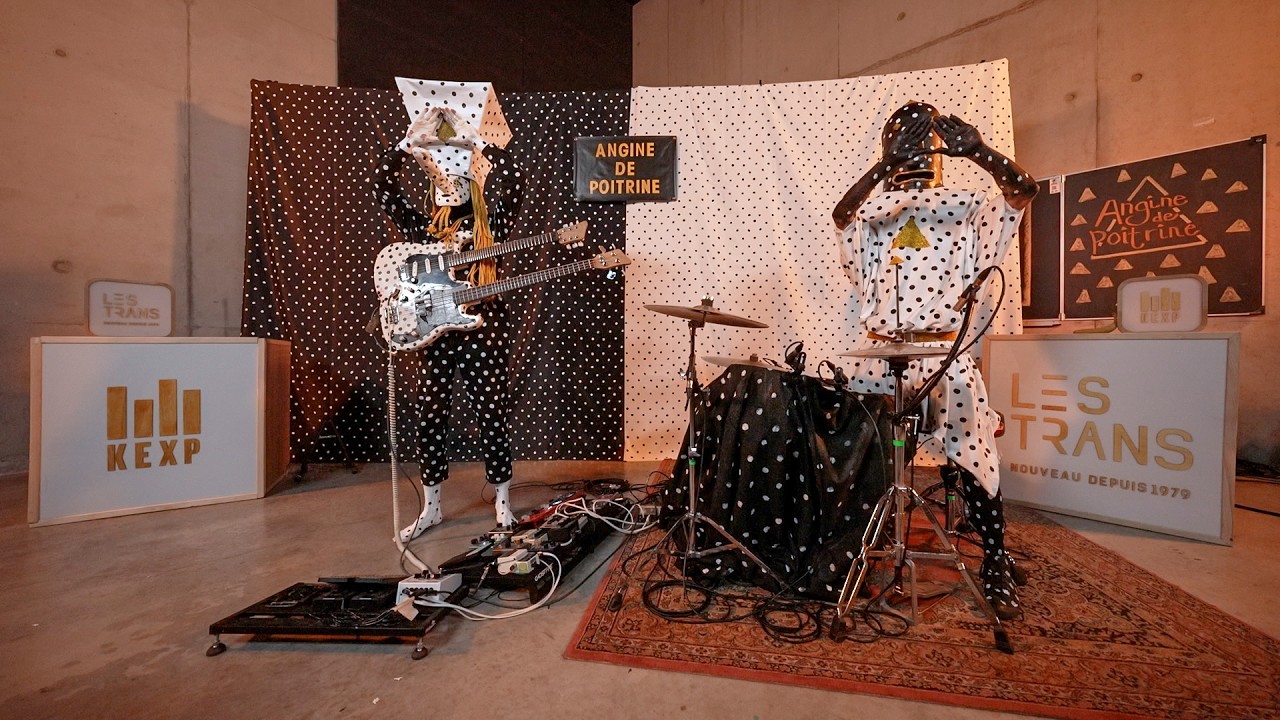
Despite first entering Earth's consciousness back in 2024, the French Canadian duo found themselves at the centre of a viral internet moment throughout early 2026 as a result of their truly mind-blowing live set which they recorded for KEXP. Widely shared, the performance has been viewed over 15 million times to date, after just three months, on YouTube.
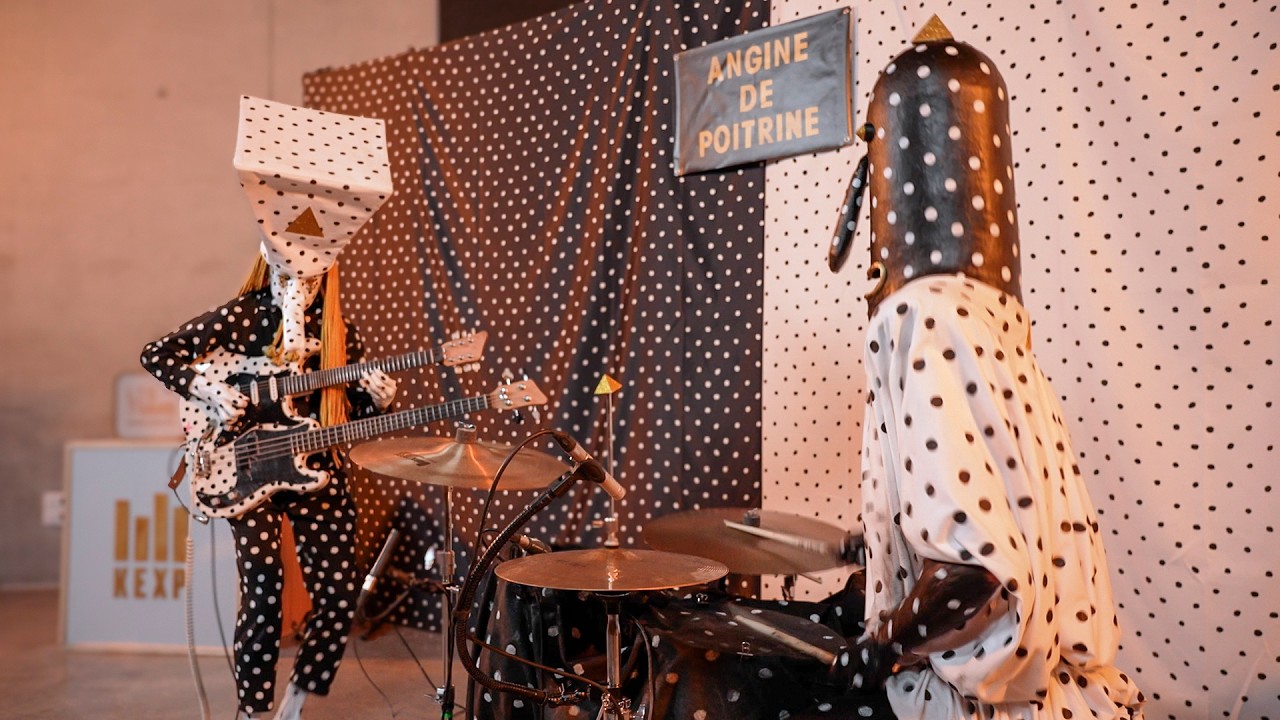
Although the novelty of their bizarre, DIY-alien outfits (complete with papier-mâché headgear) was certainly the initial lure, most viewers stayed for the ultra-compelling (and ultra-weird) music. It was clear that these guys could really play.
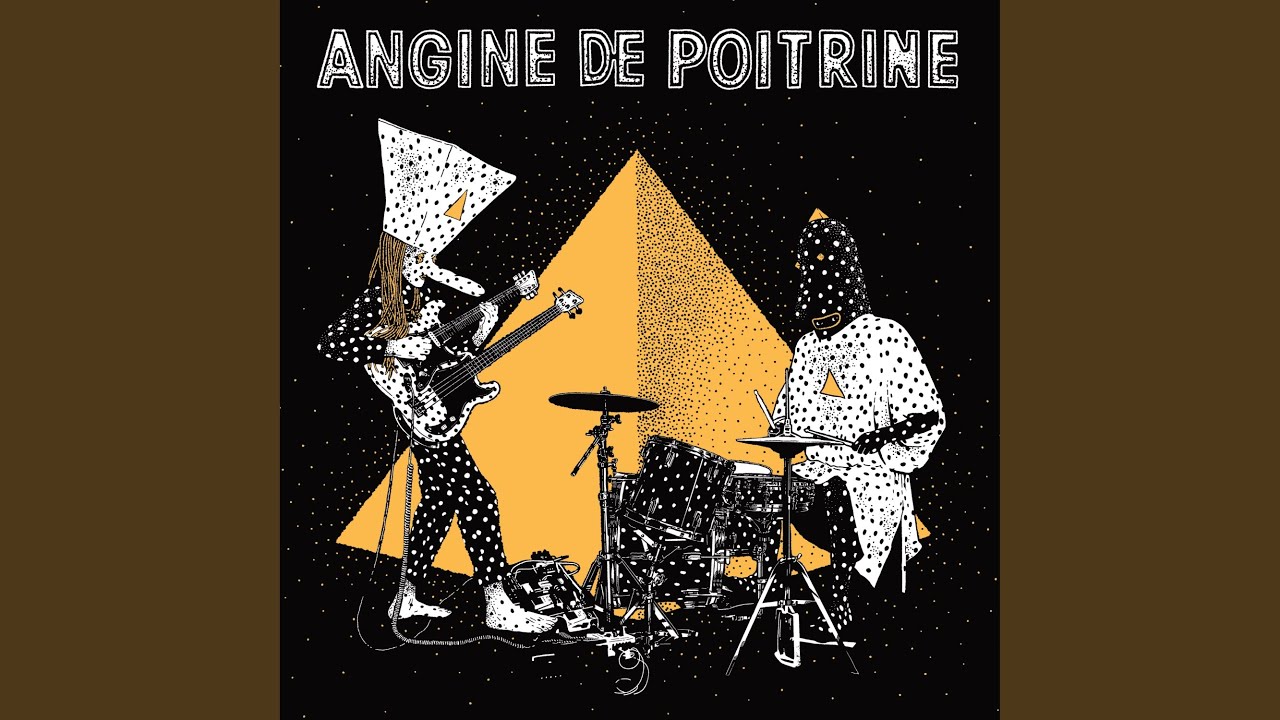
Yes, the two hyper-talented human musicians under the masks - who go under the stage names Khn (microtonal guitar/bass) and Klek (drums) - have crafted a uniquely singular flavour of music. It’s so unlike anything else in this corner of the cosmos. Or is it?
One thing's for sure, the pair have amassed a sizeable audience in record speed.
The comment section of the band's KEXP performance is a particular goldmine of hilarious - and devoted - responses, which have already entered into a somewhat legendary status of their own. “I cant believe I was alive to witness the release of music 2” said one commenter, while another said “When they announce a world tour, I hope they clarify which world”.
It seemed that many became attached to ADP instantly, despite their music being a massive affront to the norm.
“It’s only music. I’m not saving people’s lives,” an overwhelmed Klek said to The Guardian. “I’m just playing drums. One comment on KEXP said: ‘Now there’s a reason to live.’ I was like: calm down, man. Go kiss your mother or something - that’s a reason to live.”
The duo themselves (when rarely not communicating in their native alien sounds) describe their style as a ‘mantra-rock dada Pythago-cubist orchestra’, which is easy for them to say. However, what ADP are doing on a musical level isn’t entirely extraterrestrial once you lean in and listen a little closer…
Their fusion of microtonality, polyrhythmic and metric modulation grooves with heavy rock, jazz, funk and Middle Eastern influences might be idiosyncratic, but it explores niches previously carved by a plethora of progressive, exploratory artists.

The best track to spotlight in our view is their most streamed, and most popular live - Fabienk, from their recently-released second EP, Vol. II.
You know the one - it’s the piece that is built around dual sections, a salvo of incredible kinetic riffs, and features the now iconic arm-wavey vocal break, 'See-baast-ieenn'.
By looking closely at this superlative piece, we can actually distill many of their musical tricks-of-the-trade down to a few lesser known musical devices, which takes nothing away from the extraordinary musicianship displayed by this pair of skilled instrumentalists.
Before we get into the music itself, we have to consider the technical process behind the band’s working environment.
Bizarrely, at a basic level, Angine de Poitrine have a fair amount in common with Ed Sheeran! (You are probably shouting at your screen right now, but hear us out!)
At the very heart of the ADP setup is a complex looping pedal - the Boss RC-600.
Their layering-up concept was first made popular in a mainstream live setting by Sheeran, who would literally perform to an audience of tens of thousands of people, armed only with a vocal mic, acoustic guitar and a simple looper pedal.
The concept actually goes back far further than that, and could even be linked to the looping exploits of electronic bands such as Underworld and Orbital. Both of whom used loops in a live setting before looping pedals existed, so the loops would be computer-based, and often pre-prepared.
Where Khn de Poitrine takes the concept far further is with an extensive collection of additional pedals. Firstly there’s a Boss DB-80 which is used as the central metronome (driven by the RC-600 as the source clock) As well as a range of further pedals modulating the guitar sound in both timbre and pitch. In Khn’s signal chain sits the Mad Professor Supreme Drive, a WarmAudio RingerBringer (harmoniser and octaver), a Boss DD-8 digital delay and a Fender Engager Boost. But most notably, are those pedals that Khn has personally customised for his own unique results.

Beyond the pedals themselves, it’s Khn’s bare-footwork and ballet-like operation of the guitar pedal system that is almost part of the ADP performance in itself. The bare-footed Khn tweaks settings with his toes and stomps the looper pedal to start and stop loops on the fly. We can only imagine how sore his feet are following a gig.
Whether playing live or tracking in the studio, their concept for performance remains constant, with any guitar or bass overdubbing carried out instantly via the Boss RC-600. It certainly cuts down the cost of studio time, but that’s also testimony to the quality of their playing.
But what of Khn’s custom guitar and bass itself? This double-necked instrument is based on a Fender Strat and Precision bass, with a fairly major modification on the tuning front; the fretboards of both instruments have been modified to accommodate microtonal notes. But, what does that mean?
We are used to the concept of tones and semitones, but imagine cutting semitones into smaller intervals? That's what Khn is doing here, and while Western classical music has toyed with the microtonal concept for many years, it is still a slightly jarring, alien sound for our western-tempered ears initially.
But, as ADP have proved, the more we listen the more it makes sense…

It’s no surprise to learn that Khn was influenced by Middle Eastern music, which embraces microtonal tuning through alternative tuning systems.
“At first, you know, my idea was definitely to see how to get that kind of slightly Arabic-sounding colour,” Khn said to Noize Magazine. “But I quickly moved towards a more modal approach, to try and exploit the potential for dissonance it offers, without falling into things that are very stereotypical and reminiscent of a culture that, ultimately, isn't mine,” Khn said.
“My musical background, personally, is very much rooted in progressive rock, modern jazz, and contemporary music. It's just natural for me to use quarter tones in a language that's more cubist, let's say, more Zappa-esque in its phrasing. The way I use quarter tones allows me to explore chromatic approaches that are twice as long and then build more tension. But ultimately, most of the tunes we make could be harmonically compared to something along the lines of the tunes on John Scofield’s Überjam or Miles Davis's So What.
Without wishing to undermine Klek's interplanetary abilities, the drum element of this tight combo is far simpler - with a beautifully dampened and close-miked drum sound, which is straight out of funk playbook.
Our track in focus, then, Fabienk, begins its musical journey in 7/8 - seven quavers (aka 1/8th notes) to each bar. It also adopts that wonderful musical trait of beginning with a heavily modulated/tremeloed riff which has the listener questioning where beat 1 is. This is because the first guitar note enters on an offbeat, which throws us off the timing scent immediately!
There’s little help supplied by the additional bass and picked guitar riffs, which are gradually layered, creating a spiralling nexus of riffs as a texture. There are firmly centred around the key of E major, albeit with relentless and continual doses of melodic microtonality.
When the drums join the guitar, they beat out the rhythmic element of the original riff - a solid rhythmic unison. The drums finally break cover, along with the bass, with a full-on 7/8 drum pattern.

In case you’re wondering how to approach this less obvious time signature, many musicians will break it down to equal units, counting ‘1,2, 1,2 ,1,2,3’ before looping back to start the bar again.
The feel and groove changes after the first minute and a half, as the guitar and bass lock in to the same riff, but importantly the drums shift to a four-square groove, but all is not quite as it seems…
Khn’s bass and guitar riffs remain in lock-step (and in 7/8) but the drums employ a great trick which is known as 'metric modulation'. This is where a rhythmic unit remains constant, but in doing so, creates a new mathematically-equivalent timing.
In this instance, the quaver (1/8th note) within the loop remains the constant, while the drums play a traditional kick (on beats 1 and 3) and snare on (on 2 and 4) pattern, resulting in a polyrhythmic construct.
In actual fact, it’s pure maths; as the guitar/bass loop remains in 7/8, the drums play three bars of 4/4, with an added bar of 2/4 at the end of each cycle. This creates a 14-beat crotchet cycle, which is the same length as four bars of 7/8. Clever stuff.
Accentuating this section even further, you can hear the cymbal crashes which cement the beginning of each new 4-bar section. The incredibly lyrical guitar lead floats over the top, but interestingly, it falls into rhythmic line with the drums at this point.
Of course, there is also that aforementioned odd signature vocal wailing ('See-baast-ieenn'), a lovely bit of ornamentation that makes for an inviting crowd-singalong trigger.
The second section which leads to the song’s thundering conclusion is pretty much the same length as all of the previous elements put together. What's different here is that the rhythmic structure maintains the 14-beat format, alternating between three bars of 4/4, and the additional bar of 2/4.
There is no real hint of the original 7/8 time signature at this point, although it's echoed through the use of their metric modulation gag!
With a 4-to-the-floor kick drum and bass combination, this section slowly builds, with continual vocal wailings and guitar looper overdubs of what is quite simply an exceptional (and constantly moving) riff.
The background picked guitar riff is doubled in thirds, but played as single lines, which sounds vaguely familiar. It's arguably slightly reminiscent of 70’s Steely Dan (maybe Reelin’ in the Years) or Thin Lizzy. This kinetic spine in place, Khn swerves into the next layer - a lead guitar which sprays some extensively melodic material over the top.
With so many riffs in play, and also the use of looping technology, much of what we hear throughout this track seems to passingly acknowledge recognisable keys.
This final section is a case in point, where clues are supplied predominantly by the bass. This section feels centred in E major, with continual shifts to a harmony of G major, with the passing use of A major at the point of each turnaround, but this theoretical information is never represented by traditional guitar chords.
Beyond what many first assumed to be the daft appeal of the costumes and surrounding pseudo-lore, there is a lot to respect about Angine De Poitrine.
Their ability to boldly push their music into uncomfortable new frontiers is admirable in today's industry. The fact that they do it with such flair and obvious fun is testament to their confidence in their abilities. They really have found an interesting niche, which is challenging established perceptions of mainstream rock in 2026.
It's a long time since we've seen and heard anything as innovative on purely musical terms as this. So, thank you Khn and Klek!

