


Whether it's from your childhood favourite film, or from memories of your own children sat spellbound in front of the TV screen, chances are you're already familiar with the music of Alan Menken.
Menken has been composing professionally for over 50 years, and has written for a multitude of Broadway musicals and classic films, including box office hits like The Little Mermaid, Beauty and The Beast, Tangled and Aladdin.
He has won more than 25 awards, including eight Oscars and 11 Grammys, and is also one of just 21 people on the planet to be an EGOT winner (achieved by earning at least one Emmy, Grammy, Oscar and Tony award). But, arguably, he is best known for his work on his iconic soundtracks for Disney.
Like many of those who've heard his work, Menken has plenty of fond memories of his extensive back catalogue. And speaking with People magazine, he sat at the piano to run through some of the highlights of his career.
"I love the process of writing songs," he says of working. "I love the process of collaborating. I think I'm a very boring person because every day all I want to do is sit at the piano and play with the possibilities of music."
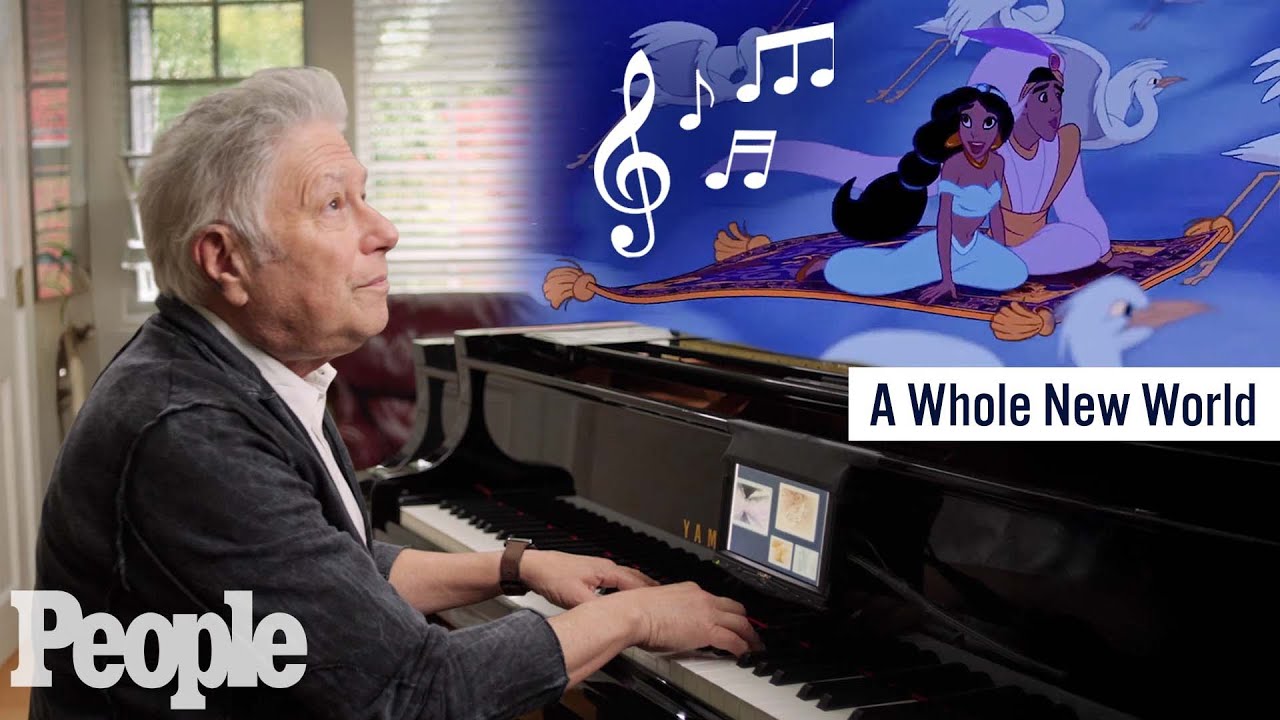
After the success of the 1979 musical, Little Shop Of Horrors (and subsequent film adaptation in 1986), Menken's first job with Disney came in 1989, when he was asked to write the score for the studio's adaptation of the Little Mermaid and worked closely with lyricist Howard Ashman.
Part Of Your World, the emotional centrepiece of the film, was derived as what Menken calls the 'I want' song, designed to show viewers what the film's titular Little Mermaid was dreaming of. "Ariel is just a teenage girl that wanted to be out of the ocean," he says. "Every note [of that song] is a reach upward to the surface. This sequence of notes is supposed to capture the essence of moving water."
His next Disney film was the 1991 adaptation of Beauty and The Beast, which would sadly mark his last collaboration with Ashman, who died after being diagnosed with AIDS before the film was completed. The film's lead song (of the same name) was all about "a mother singing a comforting lullaby to her son about the enduring power of love," he says. "Besides that," explains Menken as he plays a steady repeating part on the piano, "you have a sense of time passing... like a clock ticking".
The following year, Menken would begin working with lyricist Tim Rice, writing the score for Disney's 1992 hit adaptation of Aladdin. One of the film's earliest songs, Proud Of Your Boy, was originally written before it was decided that Aladdin was an orphan, and was "supposed to be a kid shrugging going 'Well mom, I wasn't born perfect like you but I want to make you proud.'"
Remembering the process he and Rice undertook whilst writing, Menken says: "We basically mapped out three songs we were going to write and prime amongst them was the magic carpet ride. I gave [Tim] a dummy lyric - the world at my feet... Tim in his wisdom thought 'Maybe the word feet is not best in the title of a love song'... so, A Whole New World."
Throughout the interview, Menken mentions the use of a sense of movement and narrative progression in his music, and A Whole New World was no exception. "You want a sense of flight. Structurally, he's drawing a picture for her about where he's taking her and then she's joining on the journey," he says. "They're on this magic carpet ride and we know it's taking them to a point where they're coming together."
According to Menken, finding a film's central song is a key moment in soundtrack writing, giving Colours of the Wind - written composer with Stephen Schwarz for Pocahontas (1995) - as a prime example. "I remember when we wrote it, there was a huge amount of excitement. It gives such a lift to the whole project, to give that vocabulary, basically saying 'That's the DNA we're going to be build from'."
As with all creative endeavours, although artists may prefer to write in a certain way, ideas sometimes come from unexpected places, which Menken shows an example of in Out There (from 1996's The Hunchback of Notre Dame). "That was one of the few times a piece of music came first without a dramatic inception," he remembers. "That piece of music existed and then Stephen put the lyrics onto it."
Likewise, songs can sometimes seem like the centrepiece of a project, only to be pushed aside later in the wake of a newer, revelatory idea that reshapes the entire direction, which Menken remembers was the case for Disney's 1997 adaptation of the myth of Hercules.
"Hercules wants to be a hero, so we started with a song called Shooting Star about how he just didn't fit in. It was too soft. We wanted something that's about this kid who's so strong." Eventually, this led to the penning of Go The Distance, the first song sung by Hercules in the film.
Looking back on all that he's achieved, it might seem that Menken was always destined for success, but he remembers it differently. "I was a terrible student," he laughs. "Hated school, couldn't concentrate. I just wanted to do this," he explains, gesturing at the piano.
Feeling lost and looking for sage advice? Menken voices a sunny but sound outlook on purpose towards the end of the interview, which makes for solid counsel if you're in need of wisdom as we get into the new year: "The thing you do every day is what you should be doing with your life."
Having composed some of the most beloved film soundtracks of the last few decades, this likely isn't the first time Menken has reflected on his dizzying array of career achievements, so how does he feel about his most iconic pieces years on down the line?
"In a way, I feel tethered to my legacy, but of course legacy is also where my life meets other composers and other artists who have influenced me or who I have influenced," he muses. "In a sense, we're part of a joint legacy".
