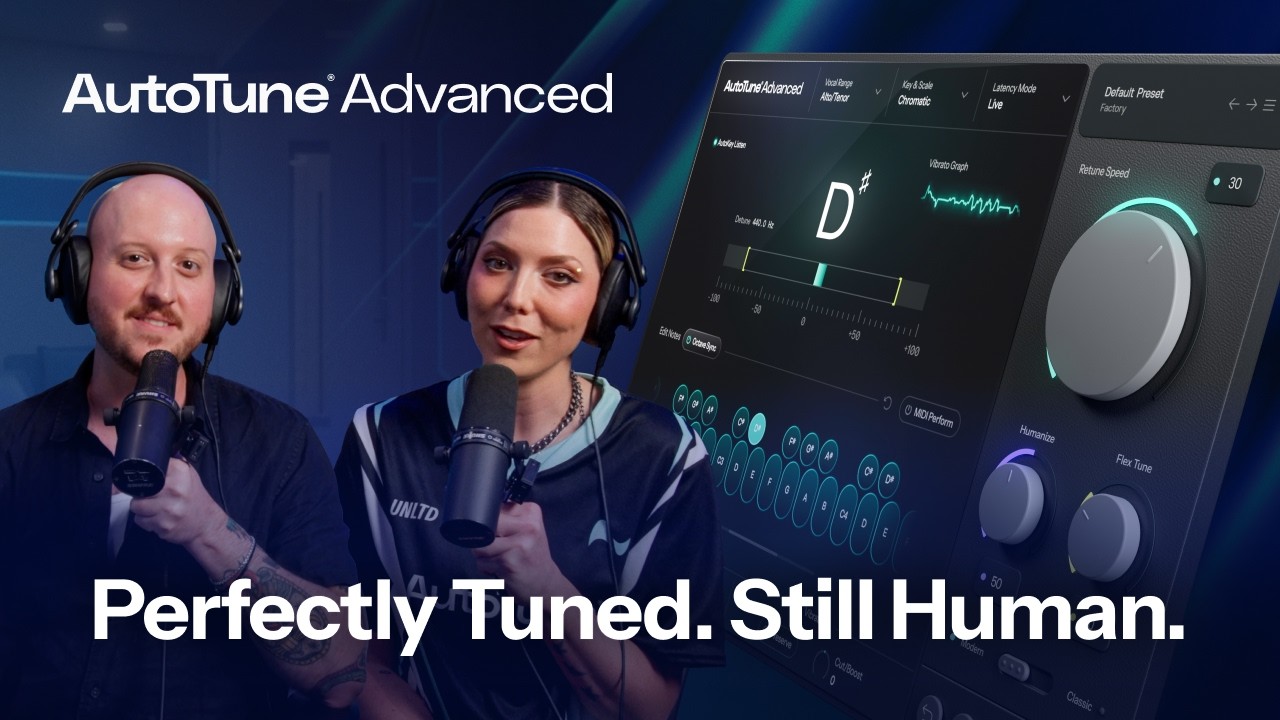
Antares has announced the release of AutoTune® Advanced, a new edition of the vocal tuning plugin based on a ground-up rebuild of the Auto-Mode pitch algorithm and equipped with a newly-developed DVA™ vibrato detection and preservation engine.
The new flagship product in the AutoTune range for producers working in Auto-Mode, AutoTune Advanced promises to address an issue that has plagued producers and engineers working with pitch correction tools since their inception. When applying tuning to a vocal recording – particularly at tighter or more aggressive settings – a singer’s natural vibrato can often be flattened or altered, taking away from the character of the performance.
Advanced tackles this with DVA, a feature that identifies a vocalist’s vibrato and preserves it so that the natural rise and fall of a singer’s pitch remains intact. Not only preserving vibrato, DVA also gives users the ability to cut it, boost it or generate artificial vibrato using a number of different waveshapes in the Creative Vibrato FX panel, with precise control over timing and expression. There’s also a visualiser onboard to track the vibrato-shaping in real time.

Antares tells us that the work the company has done on its updated tuning algorithm represents the “largest engineering investment” since its introduction, producing the most clear and accurate pitch correction found in an AutoTune product to date. This is complemented by a new Live Mode designed for “ultra-fast” real-time monitoring, which is joined by two more latency modes: High Quality is for final mixes and bounces and Low Latency is suitable for general studio work.
AutoTune Advanced also updates a number of features familiar to existing users. The Formant Designer has been given a refresh, there’s a new workflow for inputting custom scales, and a 78-note Visual Keyboard makes dialling in per-note behaviour more intuitive. The plugin’s MIDI Perform feature gives you hands-on control over tuning and Vibrato FX via your MIDI controller.
AutoTune Advanced arrives with a collection of presets designed by Grammy-winning producers, engineers and artists, including Julian Marley, Ann Mincieli, Jess Jackson, David "Yungin" Kim, and more.

“I've been using AutoTune for over 15 years, so I know it inside and out,” Kim said in a press release. “Advanced feels like a real upgrade. Live mode is crazy fast and keeps the artist locked into the performance. The formant designer gives me more ways to shape a vocal without losing the person behind it, and the modern UI gives an old friend a much needed fresh look."
“Since 1997, the complaint about pitch correction has been the same: it takes the singer out of the singing," adds Jeff Wright, CEO of Antares Audio Technologies. "That's the problem DVA was built to solve. It can tell the difference between a pitch error and a decision the vocalist made, and it leaves the decision alone."
In other AutoTune news, Image-Line recently announced that all FL Studio users will now be able to access AutoTune Go, a stripped-back version of the pitch correction tool that’s bundled with FL Cloud Free.
AutoTune Advanced runs on macOS 13 or higher and Windows 10 and 11 in AAX, AU and VST3 formats. A perpetual licence is $450 USD or $17.50 a month as part of an AutoTune Unlimited subscription. A free trial is available now.
Visit the Antares website to find out more.