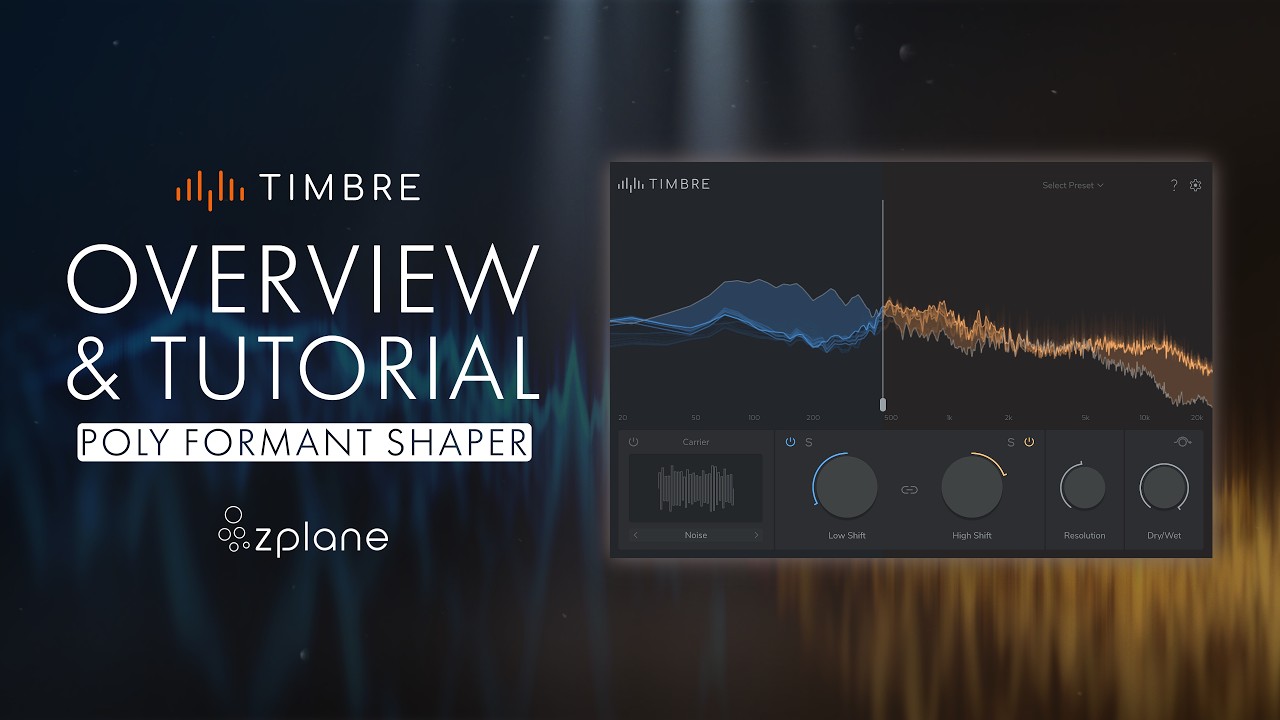
Zplane has announced the release of TIMBRE, a real-time formant-shifting plugin designed to transform the character of vocals, drums, instruments and mixes without altering their pitch.
Like all formant-shifting plugins, Timbre shifts the formants that make up a sound’s timbral characteristics while leaving its fundamental pitch intact, a process that unlocks all kinds of possibilities for creative sound design. Zplane says Timbre is built on an expanded version of the engine from its Elastique Pitch plugin.
At the core of the plugin are two independently adjustable frequency bands, each offering up to ±36 semitones of timbral shift with their own solo and mute controls, split by an adjustable crossover. Link the two and you get one-knob control across the whole spectrum; unlink them and you can push the low-end one way and the high-end the other, or process just a single band.
The Carrier section is where things get more experimental. It replaces the carrier signal while maintaining the input's modulation envelope, using either a built-in white-noise generator, which can turn vocals into breathy “whisper-like textures”, or an external sidechain, which allows for vocoder-style processing where the envelope of one signal is imprinted onto another.
If you’re not familiar with formant-shifting, the technique is best explained in terms of the human voice. A typical vocal signal, like all signals with inherent musical pitch, comprises a fundamental frequency (the root pitch) and mathematically-related harmonic overtones.
Traditional pitch-shifting will transpose the fundamental and related harmonics up or down while maintaining their relationship, resulting in an obvious transposition of musical key.
A vocal’s formants, on the other hand, are resonant peaks in the spectrum - unrelated to the fundamental pitch - produced by the vocalist’s vocal tract, mouth shape and other resonant characteristics. It’s why, for example, one singer singing a C3 will sound completely different to another vocalist singing the same note. In broader terminology, we usually refer to this as ‘timbre’.
Formant-shifting enables you to manipulate these formants (and therefore the timbre) while maintaining its pitch. In recent years, the technique has become increasingly common in vocal production, with everyone from Frank Ocean to Kanye West getting in on the action and using formant-shifting to add a new dimension to their vocals.
Timbre is available now for macOS and Windows in VST3/AU/AAX formats. It's priced at €79, but reduced to €53 until the end of September.
Find out more on Zplane's website.