


JHS Pedals has unveiled the Fumble, a clean boost pedal with a simple two-knob layout that will serve a variety of useful purposes on your pedalboard and it is only $89. Simple.
But how this guitar effects pedal came to be, and the very story behind the Fumble’s design, is a little harder to explain. Indeed, some of you might already have got your hands on this circuit before, because Josh Scott accidentally released it as the boost on v1 of JHS Pedals NOTADÜMBLË solderless DIY drive pedal kit.
From the layperson’s perspective, this seems like an easy mistake to make. Just picture the scene at a pedal company. You have all these schematics lying around. Some of them must start to look the same after a while, especially after a long day.
Anyway, JHS Pedals’ supremo Josh Scott was in the fever of creation. One side of the NOTADÜMBLË was the quintessential “boutique” overdrive pedal sound, a circuit inspired by the Dumble amps used by cats such as Robben Ford, Joe Bonamassa and Kenny Wayne Shepherd. The other was meant to be a buffered effects loop circuit that he cloned for John Mayer, a doofer built by Alexander "Howard" Dumble some time in the ‘80s that went by the name of A Box Later (Scott’s version was called Box It Later).
What Scott actually put in the original NOTADÜMBLË was something else entirely, a Dumble preamp box that coincidentally JHS had also built for Mayer.
Scott duly issuing a mea culpa on YouTube, offering refunds and hastily putting together v2 as he originally intended.
“I made a video. I told everyone,” says Scott. “We sold through the remaining inventory, discontinued the NOTADÜMBLË V1 after our batch of 15,000 sold out, and refunded anyone who asked to return their unit.”
It would be interesting to see how many people asked for a refund; in pedal culture, this mistake has a certain appeal, as though this new pedal that was designed by someone else and built by your own fair hands was itself something secret. Still, it wasn’t what Scott had intended. This Dumble-inspired, built-for-Mayer circuit laid around.

And if that seemed like a bit of a bit of a waste, then in time Scott would come to agree, hence we have the Fumble. This is a clean boost based on the Dumble BBC-1, a JFET preamp that Dumble made for his most-valued customers and then applied inside his own guitar amp designs for “the FET Mode”.
It was only when researching the BBC-1 that Scott had the epiphany. The BBC-1 was not a Dumble original; the late tube amp guru had cloned his circuit from a ‘70s acoustic guitar preamp.
“Which means the legendary Dumble FET sound – the one inside $200,000 to $400,000 amps – is a clone of a 1970s piezo preamp,” writes Scott.
Which makes the Fumble a clone of a clone of a clone. And if all this confuses you then you are not alone. But rest assured, the Fumble is easy to use, and could be a hard-working little stompbox, capable of pushing an already driven amp further, for pushing your drive pedals further, for playing the role of always-on tone sweetener or buffer at the start of your chain or simply as an end-of-chain boost for extra oomph.
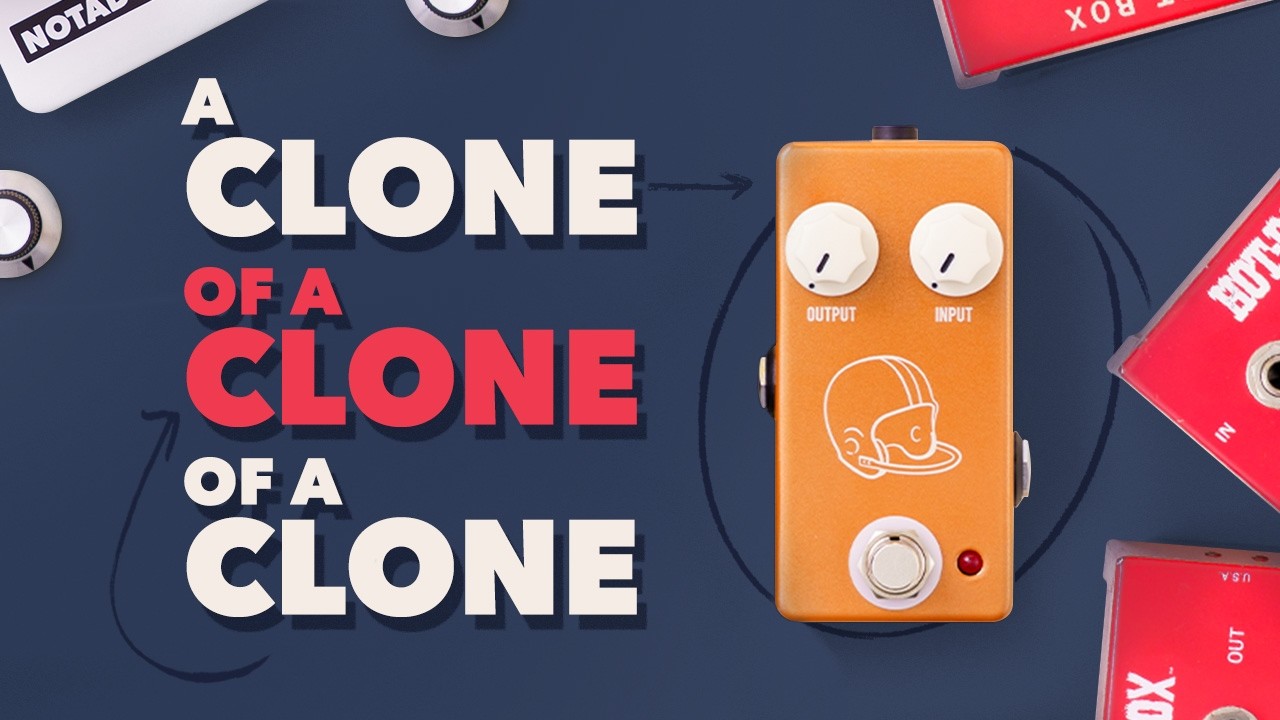
The Output dial adjusts master volume. The Input dial is weird. Fully clockwise, it is bypassed but as you pull it back it rolls off the input gain and, crucially, the bass, making for a “thinner, tighter” sound.
This, says, JHS Pedals, is pretty unique, a unique feature on a pedal with a really strange history. The Fumble is available now, priced $89.
See JHS Pedals for more details.
