


Catalinbread has launched the CB Paint, a reverb pedal that will be just the ticket for aficionados of cult ‘90s rack-mounted units.
The CB paint is inspired by the Alesis Microverb, a unit that has fans across the musical spectrum, including Neil Young, Daft Punk and Trey Anastasio, and it presents players with eight different modes from the Microverb – and some cool/practical modern updates.
The Microverb kinda got everywhere. Most studios in the late ‘90s would have had one kicking around. Those Alesis reverb rack units would be an essential for the heavy reverb user. It’s the sound you hear all over Interpol’s 2002 long-player, Turn On The Bright Lights (precisely because it excels at dialling in a darker sound).
Catalinbread says the CB Paint blurs “the line between yesterday and yesteryear” and is created in a similar spirit to the Microverb, which, in its own way, was quite a groundbreaking device for digital effects technologies, effectively democratising digital reverb for all.
Sure, the OG vintage Microverb was a relatively compact half-rack unit that could sit on a desktop – but in a compact guitar effects pedal, with six room sizes, a two-pole low-pass filter and the all-essential gated reverb mode, the CB Paint might just be the most convenient solution for any player looking for those electric guitar sounds today.

There are some new features to make it an even more practical proposition for guitar (and bass guitar) players, with the all-important Mix control for dialling in the wet/dry blend. The Onset knob controls the pre-delay response time, i.e. how long it takes for the reverb to start once you play a note.
Fully counterclockwise, the reverb starts immediately, just like your regular email, but as you turn up this dial a lag is introduced, and maxed out it will take 200ms before the reverb tail begins. In Gated and Reverse modes, the Onset dial controls the gate time and the amount of “smearing” respectively.

As for the modes, the aforementioned Gated was cutting-edge at the time of the Microverb’s release, and sounds a bit like a reverb that’s silenced mid-breath.
Think Phil Collen’s drum sound on In The Air Tonight, or in the world of guitar it’s the kind of thing you’d hear on Bruce Springsteen records, in the post-punk of that era – and it is an effect Catalinbread has offered before, notably as a mode in its CBX Gated Reverb. It might sound niche but it can be a very useful always-on reverb mode for adding that box-office studio sheen.
Reverse is a little different to what we might think. It approaches your signal in the same fashion as the original Alesis program, which makes it a little weird. “Rather than read the signal in reverse, the Microverb uses math to reverse the signal by reducing the reverb state’s reflective properties,” explains Catalinbread. “The result is a ‘rushing’ sound that is somewhat unique to the Microverb.”
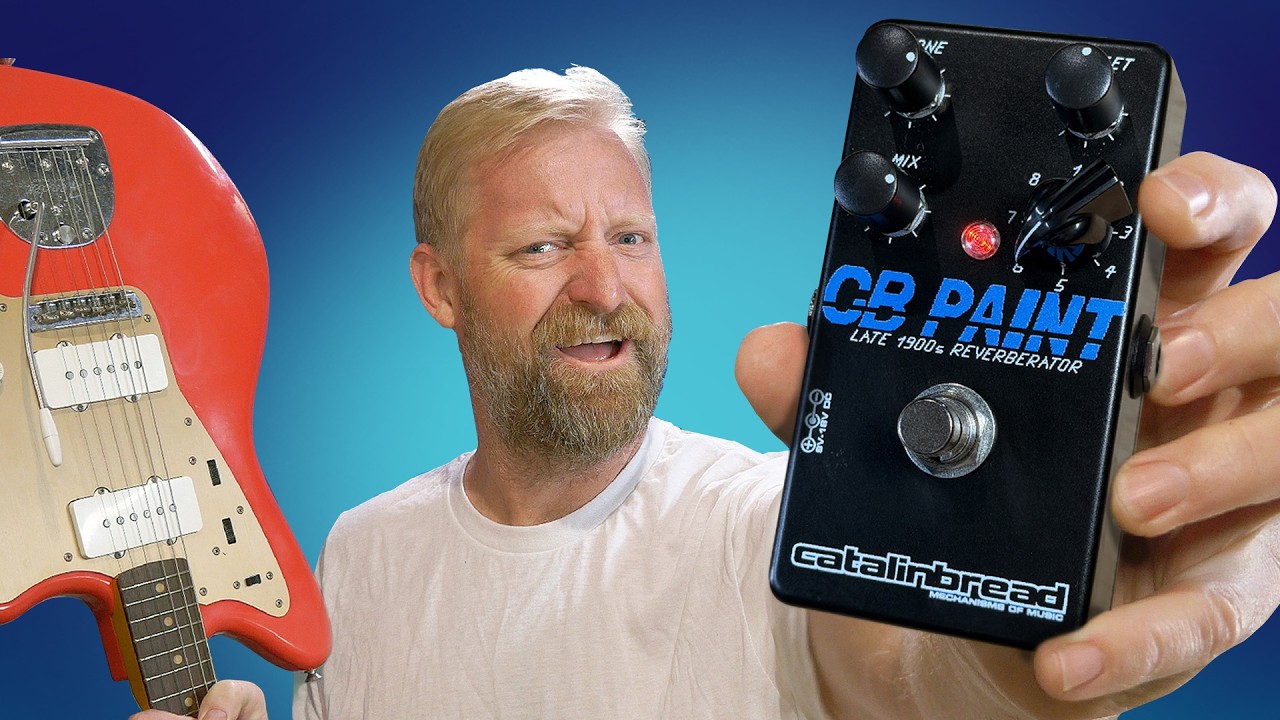
Elsewhere, modes 1 to 6 are the original room reverbs and range in size from a studio apartment (Mode 1) to storage unit, two-car garage, small venue, large venue and warehouse. These are selected via a pleasingly retro chickenhead dial.
Tone adjusts the low-pass filter and behaves like a regular tone control. And that’s that. Run it on 9V DC from a pedalboard power supply and you’re good to go. The CB Paint is available now, priced $209. See Catalinbread for more.
