
Sound is an easy thing to take for granted, especially when you’re surrounded by it. Capturing that it, too, is an easy thing to take for granted – despite the fact that recording out in the field has only been easy for the last four decades. That's where the best field recorders come in.
Early field recording equipment was tape-based, often bulky, and invariably prone to mechanical (or, indeed, human) error. By these undeniably fussy 20th-century standards, we are, today, extremely lucky – lucky to each have a field recorder in our pockets, nestled alongside our smartphone. But even in this highly convenient modern day, smartphone recording apps aren’t the reliable tool we might actually need.
Dedicated field recorders are highly useful things, and much more capable of capturing high-quality audio than our basic smartphone apps. The technology held within today’s field recorders makes fidelity, definition and dynamic range trifling concerns, and makes it easier than ever for you to get location audio that passes muster.

Of course, we all have different reasons for recording audio in the field. Some of you might be after grabbing nature sounds and textures for music production purposes; others might be after recording podcasts on location. For each of you, there is an ideal field recorder – and you’re very likely to find it in this list of the best field recorders on the market today.
If you’d like to know my top pick, I've given that to the Tascam DR-40XP thanks to its next-level recording capabilities. For more, check out the full product list below, along with our how to choose section and glossary of key terms.
Best overall

✅ Buy if you want a field recorder for any situation: This is an ideal mid-range field recorder with some top-shelf recording capabilities. Its size makes impromptu recordings easy, while its I/O makes more involved recordings a breeze – and all at 32-bit float too.
❌ Avoid if you’re stretching your budget: Even though this feature-set is a steal, it is still a £/$200+ field recorder – and if you don’t need extra mic inputs, you don’t need to spend this much.
The lowdown: Tascam is one of the frontrunner names in field recording, built on the back of its prior successes in the world of four-track tape and early digital multitracking. It has a huge range of handheld and user-friendly field recorders, each of which get better with every iteration. This, the Tascam DR-40XP is a direct successor to the DR-40X, which previously held this very spot in this very guide. But the DR-40XP is more than an incrementally-improved model; the changes here are groundbreaking for the form and for the price.
Features: The Tascam DR-40XP is a four-channel multitrack field recorder, in a familiar handheld format. It is equipped with a stereo set of condenser mics, which can be arranged in either XY or AB array; it is also furnished with two combi XLR/TRS ports, each capable of supplying phantom power to any mics that may need it. There’s a loudspeaker for easy auditioning, and some posh on-board capabilities for overdubbing, overwriting and even applying reverb (of which there are six different preset flavours).
So far, so familiar – but under the hood is where the real improvements are found. The DR-40XP is capable of 32-bit float recordings up to 96kHz for crystal-clear captures with huge dynamic range. Each of those combi inputs are in possession of Tascam’s whisper-quiet HDDA preamps, as well as a line-level input mode that enabling the routing of external sound sources into the device without major gain-stage compensation.
The DR-40XP has a dramatically improved 30-hour battery life, and takes microSDs up to 512GB for hitherto unseen capacity. It’s quieter, it’s more accurate, it lives for longer and it has, thankfully and at long last, jettisoned the micro-USB standard in favour of a USB-C port. It’s better.
Build quality: There isn’t much, if anything, to complain about on the robustness front. The chassis is plastic, to be expected, but the device has a comforting rigidity to it – and could certainly take an accidental drop or two. The buttons are firm and easily accessed, and the mic swivels feel solid too. As with any piece of field recording equipment, the DR-40XP perhaps isn’t to be trusted uncovered in wet or dusty conditions.
Performance: Tascam crams a great deal into a small, near pocket-friendly body. This is one of the most practical field recorders on the market, accordingly – via an intuitive and deep interface that enables recording, punch-ins overwrites and more. Those HDDA preamps are worth singing about too, being incredibly low-noise – alongside the low self-noise of the unit itself, and the high dynamic range of which it is capable. It applies itself well everywhere, from quick performance captures to multi-mic setups.
If I were to name any gripe about the DR-40XP, it would have to be that its USB-C port is still only USB 2.0 compliant. This is all I could come up with. That faster connectivity and file transfer speeds are out there. Practically speaking, this is as nothing-y as it gets – which speaks volumes as to the wider brilliance of this field recorder.
Best budget

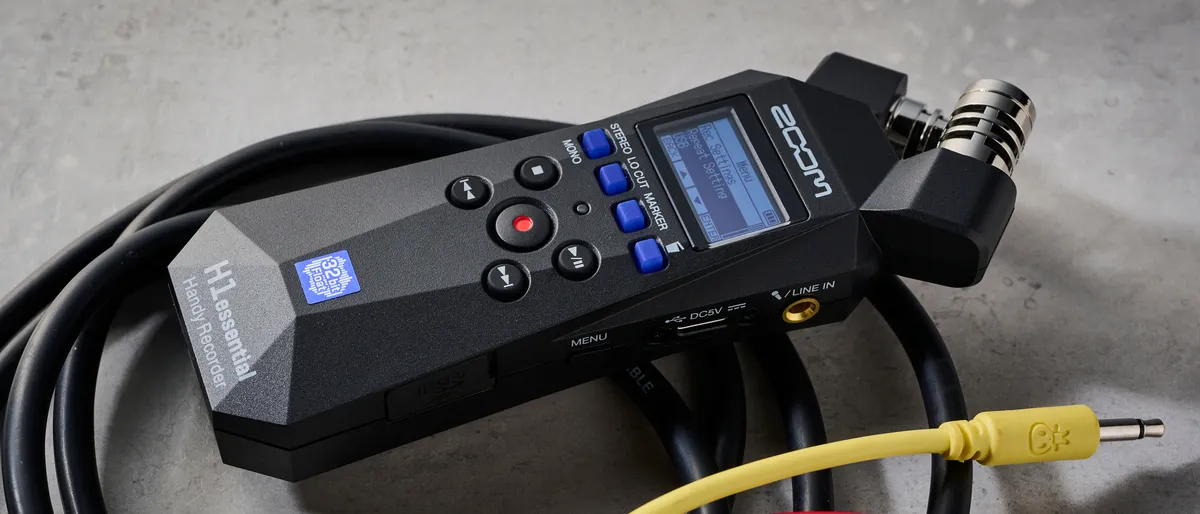
✅ Buy if you’re budget-conscious: For the price, you can’t do much better than the Zoom H1 Essential. 32-bit float recording is the real marvel here, but there’s plenty of smarts held within too.
❌ Avoid if you want options: Great as the H1e is for its price, the immovable on-board mics and single mic input make it less suitable for wide-ranging utility.
The lowdown: Zoom is another mainstay brand in the field recorder space, and responsible for some of the most practically viable portable recorders on the market – from battery-powered multitrack recorders to professional field recording rigs to… this miniscule, sub-£100 handheld recorder with ‘handy’ printed right there on the body.
Features: The Zoom H1essential is the latest version of Zoom’s entry-level field recorder, and boasts the sharp new techno-serious geometry to prove it. It also brings new practical utility to the cash-strapped field-recordist in the form of 32-bit float recording at up to 96kHz.
This is the major selling point for the H1essential, being once the reserve of field recorders ten times the price - but it is a selling point backed up by clever recording and playback bells and whistles, from smart pitch control to easy auto-record settings. It can also be used as a USB microphone, courtesy of the USB-C connector which otherwise enables the transfer of data between device and computer. Coupled with an optional line input, this is a great little box of tricks.
Build quality: The H1essential is extremely light in-hand, at just 92g – and that’s with batteries in it too. This could even be considered disconcertingly light in some circles, but it does make for easy transporting and handheld audio capture. The body is clearly an affordable plastic, but a hardwearing one; between the light weight and rugged body, there’s little reason to worry here.
Performance: The Zoom H1essential is a great performer for its price, thanks to a wide variety of clever controls that make the most of its minimal construction. The 32-bit float recording is a godsend at this sub-£100/$100-ish price point, and gratifyingly easy to set up; the onboard mics are fairly sensitive, but still in possession of some decent dynamic range of their own. It’s a shame you can’t adjust them for AB-array functionality, but such functionality would understandably raise the price.
Of all the little feature flourishes I enjoyed – including the on-board high-pass filtering, auto-start recording and overdub capabilities – my favourite is possibly that you can use the USB-C output to turn the H1e into a USB microphone. If it suits, you can skip the SD-card middleman and record straight to a device or DAW of your choosing.

"Zoom’s most affordable Handy Recorder may not be as feature rich as some of its siblings but it gets the basics right, is impressively compact and is very easy to use."
Read our full Zoom H1essential review
Best budget multitrack

✅ Buy it if you want cheap multitrack audio: The Behringer Flow 4V has 10 tracks on offer alone, and StageConnect compatibility for cheap I/O expansion – ideal for low-cost location recording.
❌ Avoid it if you’re a beginner: This unit is full of features you won’t want or need, while other multitrack recorders keep things simple for similar prices.
The lowdown: Behringer is a sprawling audio-tech brand, with a low-budget answer for everything. Whether it’s making legally-distinct near-clones of unobtanium vintage synths or pushing the envelope for back-of-house mixer interfaces, it’s Behringer’s bag – and now, the brand has turned its eye to field recorders, with the impressive (and impressively cheap) Flow 4V.
Features: The Behringer Flow 4V is a multitrack field recorder designed with professional shoots and location-recording sessions firmly in mind – and with an incredibly impressive feature-set for its list price. It a 10-channel multitrack recorder, with four MIDAS preamplifier-equipped mic/line inputs, all of which offer switchable phantom power. They’re also equipped with two-stage A/D converters, allowing for an excellent dynamic range of 138 dB – all the better to service the 32-bit float recording of which the Flow 4V is capable.
Two XLR ports on the side service Behringer’s StageConnect standard, enabling connectivity with expansion devices like the companion-piece Behringer Flow 4VIO (which expands the number of mic/line inputs to eight, and the number of headphone monitor outs to three).
Throw in a HDMI-CEC input for auto-syncing with cameras, SMPTE generation, auto-backup to USB flash drives and a dedicated app for remote control, and you have a serious piece of location-recording kit – without mentioning the on-board channel processing and auto-mixing.
Build quality: All of that circuitry doesn’t make for much in the way of weight; at 800g, it’s light enough to be easily portable between locations or projects. The chassis is well-designed to protect the I/O from drops, bumps and scrapes, but Behringer’s track record for robustness is not the most impressive besides.
Performance: It’s hard to knock Behringer here; there’s some clever tech happening inside the Flow 4V. The need for extra equipment to access more individual channels is a small shame, but more-than justified by the other I/O on the device enabling backup redundancy, digital audio inputs and HDMI-CEC input.
The touchscreen is on the small side but still very useful, as is the Bluetooth app that controls the Flow 4V’s innards. It might be a touch inscrutable for the beginner, but the learning curve is not steep – and the results are bell-clear.
Best for podcasting

✅ Buy if you want a highly portable podcasting rig: The Tascam FR-AV4 is a small-format multitrack field recorder with some crystal-clear inputs and deep video integration, making multi-mic, multimedia content creation a breeze.
❌ Avoid if you’re not also shooting video: The strong video-sync and audio-embed functionality held in the FR-AV4 may not be something you’ll benefit from, if you’re purely looking to get great audio captures.
The lowdown: Tascam’s pedigree with standalone recording equipment extends into professional field recording equipment, too – as proven by a new range of field recorders designed especially for combining with video shoots for easy on-site capture. Of the two released in the new FR range, this is the larger – and a strong contender for best-in-class when it comes to content creation on location.
Features: The Tascam FR-AV4 is a comprehensive multitrack field recorder, harbouring some video-friendly integrations and a deep well of clever features – all of which point to an ideal piece of equipment for multimedia, on-the-road podcast recording. There are four combi XLR/TRS inputs for mic and line feeds – each of which benefit from Tascam’s Ultra HDDA preamp technology, and a 133dB dynamic range. This huge range benefits the FR-AV4’s 32-bit float recording capabilities, which also come with a lofty 192kHz max sample rate. Each track can be recorded individually, alongside a stereo master for a total of six tracks.
Courtesy of an additional stereo aux in and USB-C connectivity, the FR-AV4 can also act as a 6-in/2-out audio interface for studio applications. On top of all this, there’s healthy I/O for video sync and integration, including three different varieties of timecode I/O, and HDMI ins and outs for 4K/8K video pass-through and audio embedding.
Build quality: The Tascam FR-AV4 is a rugged little piece of kit, with plenty of bump-proofing and a reassuringly solid build – despite a slight abundance of plastic. The inputs are solid too, particularly the locking XLR and HDMI ins. Coming in under 800g, it’s a light field recorder, and small to boot, making it an easy thing to stich in to a portable working environment.
Performance: In situ, the Tascam FR-AV4 is a near-faultless field recorder. The I/O is a real blessing, particularly on more complex sessions. That massive dynamic range, coupled with 32-bit float recording, makes gain-staging the very least of your worries, especially with dedicated preamp gains.
Everything else is so easy to put together that setup and breakdown is of no concern. The touchscreen is a touch small, but easy enough to navigate – particularly in tandem with the rotary encoder right next to it. On top of that, separate onboard buttons for file navigation and recording make it more tactile than other multitrack recorders (though a Bluetooth-connectible app is also handily available for remote control).
Best for versatility

✅ Buy it if you want an versatile bit of kit: The H6 Essential lends itself well to a wide variety of recording situations, environments and disciplines. The I/O is useful as-is, but the swappable mic capsules are the icing on the cake.
❌ Avoid it if you’re long-sighted: The screen might be a little hard to navigate if you want easy-to-manage multitrack recording; the sparse controls can make settings tricky.
The lowdown: The Zoom H6 Essential is a newer iteration on a tried-and-tested range of rugged recorders – and one which builds well on Zoom’s phenomenal reputation in the field recorder field.
Features: The Zoom H6essential is a familiar form, taking after the many handheld, mic-imbued field recorders you’ll find on the market. This one, though, hides some truly impressive I/O. On top of the stereo XY array atop the H6e, there are four further combo XLR/TRS inputs, two each side – making six tracks of recording, bumped up to eight with a stereo mixdown recording too. Through the USB-C input, the I/O can be put to use as part of a 6 in/2 out audio interface too.
There is, of course, 32-bit float recording on offer here, up to 96kHz. The on-board mic capsules are capable of capturing up to 136dB SPL, making them bombproof for practically every recording situation. This versatility is yet further improved by the fact you can swap out the mic capsules, to benefit from different arrays or even an extra two combi XLR/TRS inputs.
Build quality: Zoom aren’t necessarily king of the castle when it comes to literal bombproofness, though; the chassis is unsurprisingly plasticky, though there’s no concerns of brittleness here. The combo inputs are reliable enough, though, with locking XLR mechanisms for interruption-free recording. The H6essential has some comforting weight to it too.
Performance: This is a great field recorder already, just on account of being practically prepared for anything. Whatever you encounter, the H6 Essential will have the means and the beans to handle it. The removable mic capsule makes it a chameleon device, at least if you have other attachments to benefit from; the device can be Bluetooth controlled with the right proprietary adapter; and the 32-bit recording makes managing sound captures far simpler. The screen’s a little small to navigate, but so too is the whole device.
"Zoom’s well-equipped H6 is a highly flexible yet portable unit that is easy to use but can also be configured to taste via the add-on modules and accessories."
Read our full Zoom H6 Essential review
Best pro multitrack

✅ Buy if you want a pro piece of field-recording kit: There's loads going on under the hood including the ability to turn the unit into a portable multitrack studio.
❌ Avoid if you're looking for a no-frills device: With so many options available at your fingertips, it could overwhelm those looking for a more basic field recorder.
The lowdown: Sound Devices is an iconic brand in the world of film and TV. Its pricey 800 and 600 series recorders are simply legendary, widely regarded as go-to devices for capturing location audio for Hollywood blockbusters, such as Oscar winner The Revenant. The recently launched MixPre II range is more wallet-friendly – ideal for sound designers, podcasters and musicians nervous at the prospect of having to sell a kidney to buy into the brand.
Features: The MixPre-6 II is primarily a professional field recorder, but can also be used as a fully-fledged mixer and an 8-in, 4-out USB interface. Four quality Kashmir preamps deliver pristine, pro-grade, noise-free audio to a 32-bit float-capable ADC, making the MixPre-6 II an ideal partner for ambient location recordings.
The optional Musician Plugin turns the MixPre-6 II into a portable multitrack studio, complete with overdubbing and track bouncing, punch in/out, reverb and a metronome. This means you can record and produce a small band without the need for a laptop or DAW.
Build quality: Of all the devices in this guide, the Sound Devices MixPre-6 II is perhaps the most capably rugged. Its trustworthily well-built, with bash protection on all four corners and some high-quality locking Neutrik connectors too. Anti-slip surfaces and standard screw-mount connectors make it a pro standard for location shoots and recordings, too.
Performance: The MixPre-6 II is an extremely gratifying device to use, even if you have to do a little menu-diving to get your record settings where you want them. The preamps are practical and impressively clear, particularly for the significant amount of gain they each offer. If ambisonics are your bag, the MixPre-6 II has some of the best implementation I’ve seen, too. Even if there’s a little menu diving involved, basic functionality is simple as can be with the on-board tactile controls, with dedicated buttons and a multi-function rotary encoder. Pro gear isn’t usually this easy.
Best compact

✅ Buy if you value good design: The TP-7 is a visually sleek field recorder, yes, but its design smarts go much deeper – into its ergonomics, tactility, and playfulness. It’s a useful device, but it’s also a deeply fun one.
❌ Avoid it if you simply want a recording tool: A four-figure price is difficult enough to justify for anything, let alone what could be uncharitably described as a palm-sized memo-taking device. There are cheaper field recorders with better specs, if you want a tool as opposed to a companion.
The lowdown: Teenage Engineering has become famous for two key things: its playful, tactile approach to audio equipment design, and the near-exclusionary upper-range price points that most of its designs possess. Both are on display here, with this precision-engineered handheld recorder that brings new meaning to the term ‘hands-on’.
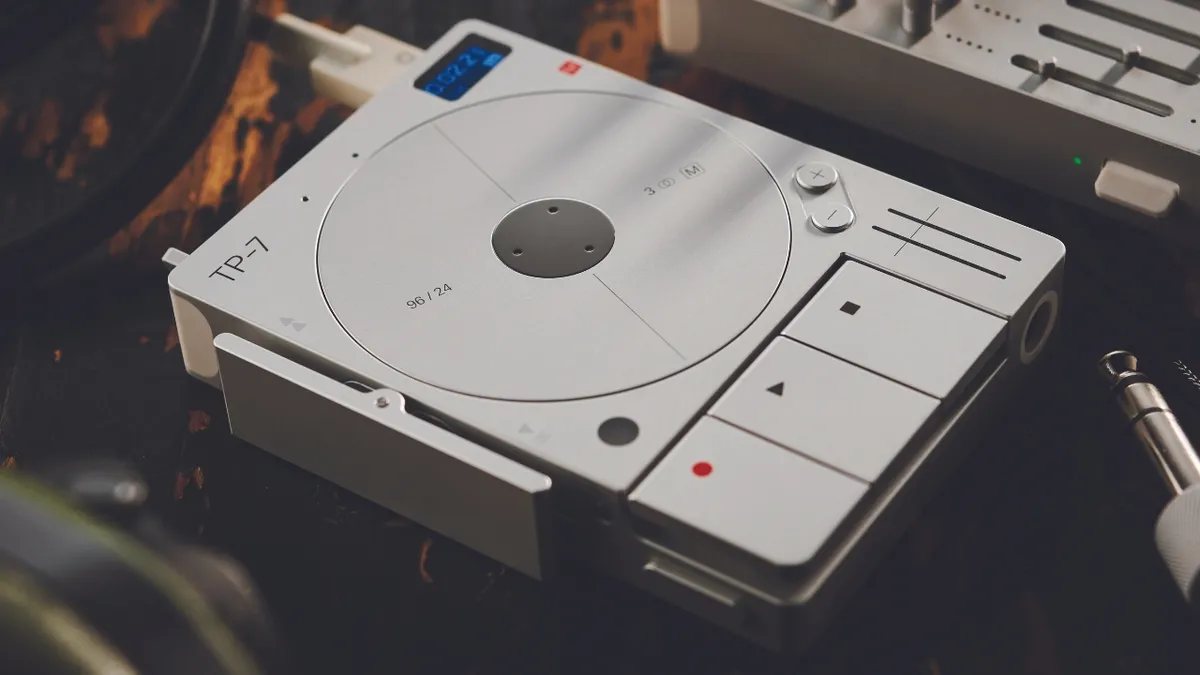
Features: The TP-7 is a diminutive voice recorder device, with some hugely fun elements – most striking of which is the rotating disc that dominates its front face. This disc is a jog wheel for navigating your recordings, letting you scrub back and forth or even pause recordings in progress. The fast-forward/rewind rocker switch on one side – and the hold-to-record memo button on the other – resemble handheld cassette recorder controls of old, while the face controls beneath the motorised reel resemble desktop recorders of the same.
These skeuomorphic controls belie the power beneath the hood, where the TP-7 can record six stereo channels of 96khz/24-bit audio. It’s extremely connectable, has 128GB of storage, and lends itself to a wide variety of potential use cases. And it’ll fit very comfortably in your trouser pocket.
Build quality: Teenage Engineering is almost more renowned for its product design than its technological successes, and the TP-7 acts as a great justification for this. It’s just sleek. Seamless and stylish from top to bottom, with careful thought put into every button, rocker and motorised rotary encoder. The quality of construction doesn’t mean it’s immune to bashing-around though; indeed, I’d be inclined to think the opposite, and handle it carefully as a result.
Performance: Field recorders are usually practical pieces of recording equipment, there to sit and quietly perform an essential function. This isn’t the case with the TP-7, which has the rare accolade of being described as a joy to use. No other field recorder can stake that same claim – and certainly not when the TP-7 revels so clearly in its ergonomics.
The button on the side immediately accesses a memo function, even when the thing is turned off; you can live you techno-future Dale Cooper fantasies at all hours. The motorised jog wheel provides tactile engagement with your recordings, and can even be a creative wellspring when paired with other aspects of Teenage Engineering’s ‘Field Kit’ range. It’s an expandable device with multiple use cases and a gratifying feel to it – which is to say yes, it’s useful, but it’s also fun.

"There are more rugged field recorders out there, but few do it with such style. Not to mention the impressive integration with Field Kit."
Read our full Teenage Engineering TP-7 review
Best for beginners

✅ Buy if you want a basic handheld field recorder: The familiar handheld form and simple functionality makes this a great starter field recorder.
❌ Avoid if you want to record other sources: The only option for audio inputs with the Zoom M2 MicTrak comes from the built-in mic array, limiting you in your field-recording capabilities..
The lowdown: Zoom’s field recorders are ubiquitous devices of practical utility, and all the more ubiquitous for the success of its core H range. But even the H range can be a little impenetrable from the outside. For those that want a simple solution to a simple field-recording problem, there’s a simple set of products – among which, the Zoom M2 MicTrak.
Features: The Zoom M2 MicTrak is, on the face of things, a fairly bare-bones stereo field recorder. It seeks to demonstrate its purpose through some familiar design signposting; rather than adopting the same slab-with-stereo-capsules standard of other field recorders, the M2 MicTrak houses its tech in a chassis that looks reassuringly like a microphone. It features a stereo set of condenser mics in XY array, caged in a familiar vocal mic-style basket, and capable of handling up to 13SdB SPL. A good thing, too, since the MicTrak is a 32-bit float recorder, with all the headroom-y benefits that come with.
Build quality: The Zoom M2 MicTrak is a cleverly-designed handheld field recorder, so designed to minimise the impacts of handling noise on any recordings. The mic array basket is partially set-dressing, but does offer some welcome protection to those otherwise-exposed capsules; the body, meanwhile, is plasticky but still solid in-hand.
Performance: There’s not much to turn one’s nose up at here; the M2 MicTrak is an easy-to-use and surprisingly versatile stereo field recorder, whether you’re holding it for vox-pop voice recordings, setting it down for room recordings or mounting it on its proprietary mic clip for performances.
The battery life is near day-long at the lower end of the battery-life spectrum, and the screen makes it easy to visually monitor recordings – with a post-recording ‘normalise’ function making it singularly easy to edit material. The downside is that there’s no line input for alternate means of recording – but, given the form of this field recorder, that functionality is low on the list anyway.
Best pocket-size

✅ Buy if you want a simple, pocket-sized field recorder: If you need something small and easy to record voices with, the PR-2 is the device for you.
❌ Avoid if you want more on-board features: The PR-2 is geared strictly towards capturing clean recordings – no deep on-board editing or processing tools here, past some essential low-cut and limiting options.
The lowdown: Deity is a brand that specialises in audio gear for the AV world. It is a cornucopia of pro-grade shotgun mics, lavalier mics and on-set sound accessories – between which you’ll find a quietly excellent up-and-coming range of field recorders. The flagship of this range is the Deity PR-2, a miniature field-recorder designed for discreetness, but with a feature-set that outstrips its size.
Features: The Deity PR-2 is a stereo field recorder unit designed for discreet location recording. It’s a clip-on affair, smaller than a drinks coaster and with the recording capabilities of gear three times the size. The clear purpose of the PR-2 is to enable easy capture of voices through lavalier mics.
The bundling of a lav mic in the box is one clue, but the connectibility of up to 48 PR-2s to a single device via Deity’s Bitconnectify 2.0 app is the real demonstration of potential here; presenters and guests on location shoots can all be captured locally via remote control. And what’s being captured is of note too, being full 32-bit float audio courtesy of a multi-stage ADC. Each PR-2 can run for up to 30 hours on a single pair of AA batteries, and a USB-C output allows you to turn it into an audio interface for USB-mic functionality too.
Build quality: The PR-2 is a well-engineered clip-on field recorder, though not the most robust when compared to other styles of lavalier mic pack. I wouldn’t trust it under the heel of a boot, but it’ll carry the rigours of everyday wear with consummate ease. The control surface is minimal, and there’s been some smart moves to make it robust from a practical usage standpoint too – including locking jack I/O.
Performance: The Deity PR-2 is exactly as out-of-the-way as you want it to be when using it. Recording and stopping recording is as easy as a long press – and the whole device can be locked with three short clicks to prevent accidental menu inputs. Everything’s contained to a single push-button and knurled control wheel, and a switch for pre- or post-device monitoring. There’s even timecode functionality for syncing recordings.
How to choose a field recorder
The field recorder niche is not a small one, as evidenced by the sheer breadth of devices featured right here in this guide. Picking between them is no easy task – so let’s make it easier, by drilling down into the key factors that should guide your thinking.
What do you want to record?
Your intentions for your field recorder are, obviously, key to picking the right one, so let’s start here. Simple tasks like voice recording or impromptu audio captures – whether for note-taking or grabbing interesting sound samples to make music with – don’t require cutting-edge technology, so a basic pocket-friendly field recorder with a built-in mic will absolutely suffice.
The more specific or complex your field-recording needs get, the more discerning you need to be about your choice of field recorder. If you want to present to a camera on location, a pocket field recorder paired with a lav mic is your best bet. If you want to record a podcast, then you’ll benefit more from additional mic inputs and multitrack recording. If you want to record high-fidelity ambient sound in rural locations, a low noise floor is a necessity – meaning a field recorder that records in 32-bit float.
This also speaks to how easy a certain type of field recorder can make your recording practice. Someone grabbing samples to chop, change and manipulate for music or sound design will find it easier to grab a smaller field recorder and go – and to grab relevant files from an SD card while working on their project. For video shoots, having timecode inputs enables quick lining-up of audio and video in the edit – and having a field recorder double as an audio interface can simplify things even further.
Where do you want to record?
Where you want to take recordings can also have serious implications for your choice of field recorder. All field recorders can record in all environments, by virtue of being battery-powered, but that doesn’t mean all field recorders will excel in all environments. Podcast studio setups require a multitude of inputs, but tend to be easier to control with respect to background noise; this is less the case for location recording outside, where ambient noises can more readily impact your capture (and where more headroom can be more useful).
Likewise, recording out in the wild opens you up to environmental risks like poor weather conditions; if you want to go out into nature for recording and sampling purposes, you want a field recorder capable of withstanding rain, dust and the occasional accidental dunk in a nearby puddle. You also don’t want your field recorder to be too heavy if you’re travelling with it – whereas, in controlled environments and standalone projects like a podcast, weight is far less of a concern.
Where do you want to use your recordings?
A small addendum to the first question, but a valuable question to interrogate: what are your intentions with your recordings? A hobbyist recording some friends for a laid-back podcast-format hangout is a very different reality to a professional podcast session or video shoot; likewise, messing around with self-recorded samples for song demos is not the same as using samples for pro sound design or in client production gigs.
This speaks to the quality of sound recordings you achieve, which relies partly on your recording skills but also on the capabilities of your field-recording hardware. A basic, budget field recorder with a built-in mic is fine for most casual applications, but pro results demand pro equipment – with independent inputs, low self-noise and the capability of recording at higher sample rates and bit depths at the very least.
What’s your budget?
This is the perennial question when it comes to picking out audio equipment, and no less prescient when looking at field recorders: how much are you willing to spend on one? It should go without saying that the higher you’re willing to go on price, the more features you’re likely to benefit from – and the higher the quality of construction you can expect, largely, too. But it isn’t just a case of “more money equals more inputs”.
The Teenage Engineering TP-7 is a true break-the-bank field recorder, and yet designed primarily for taking impromptu recordings or voice notes. Of course, there’s more to it than this – from the clever cramming of user-friendly tools to the motorised jog wheel that defines its design. On the other side of the spectrum, the Behringer Flow 4V is a multitrack field recorder that undercuts its competition significantly, being cheaper even than a majority of handheld field recorders. Naturally, this comes with some build-quality and feature-set compromises.
Will you want to upgrade?
Finally, a question that touches on your future: are you likely to need more from a field recorder in the future? Buying for right now can be tempting, especially if it means coming in under budget. But one day, you might have greater designs for your live-performance video shoots than a simple stereo mixdown from a field recorder with a built-in X/Y mic array. You might invest in some proper studio microphones, and might want the option to multitrack record live performances on location.
If you think you’re likely to develop your practice in some way, it may be worth future-proofing your practice now by investing in something slightly above your current requirements. This might mean a few spare inputs, or audio-interface functionality you don’t currently have a use for – but future you, working on something bigger and better, could very well thank you.
Glossary
44.1/48/96/192kHz: Refers to the sample rate of an audio capture, as measured in Hertz (cycles per second).
32-bit floating point: A high bit-depth format for recording, with a correspondingly high dynamic range. Captures recorded in 32-bit float do not need to be gain-staged or limited, as the dynamic range of the format greatly exceeds the ceiling for the loudest possible sounds.
AB: Refers to a form of stereo microphone arrangement in which two identical microphones point outwards, forming a 90-degree angle between themselves. Field recorders with built-in microphones will often fix those microphones in X/Y or AB arrangement, or enable you to pivot them into either.
Bit depth: The fidelity of an audio capture with respect to volume. Low bit-depth audio formats have less gradations with which to realise differences in volume – meaning higher noise floors and less headroom.
Condenser: An active microphone that uses fluctuating capacitance to detect and interpret sound. Condenser microphones are highly detailed, but require phantom power to function.
Downsampling: The reduction of an audio file’s sample rate, by removing samples from the file. Downsampling is a lossy process, and a form of audio file compression.
Dynamic range: The ratio between the loudest aspect of an audio file and its quietest aspect. Bit depth defines the potential dynamic range of audio captures, while environmental factors like background noise can impact the real dynamic range of a captured sound.
Headroom: The ‘height’ between an average sound’s volume and the ‘ceiling’ of the field recorder’s input stage or recording format. Low headroom means the volume of a sound could exceed the capacity of the medium, resulting in clipping. High headroom ensures the full range of a sound is recorded without colouration.
Lavalier: A type of omnidirectional microphone, typically worn on one’s person to capture speech.
Noise floor: The ambient sound that makes up ‘background noise’ in field recordings – comprising environmental sounds and self-noise generated by field-recording hardware.
Phantom power: A steady 48VDC charge, supplied to an active microphone, i.e.: a condenser microphone, via an XLR input in order to power it.
Sample rate: The fidelity of an audio capture, as it relates to time; this is the number of ‘slices’ of information in a given second of audio, measured in Hertz (cycles per second).
Signal-to-noise ratio (SNR): The difference between an average volume of sound and the noise floor, as received by a device. Low SNR means the noise floor is loud in relation to sounds, making for a noisy recording. SNR can relate to the self-noise of a field recorder, but also depends on the manner in which a sound is captured.
Timecode: A numerical system that enables the syncing of audio and video files; in audio, timecode tends to be saved to metadata. Some field recorders have dedicated timecode inputs, to enable synchronisation of audio from complex shoots.
WAV: An uncompressed and lossless audio file format, that preserves the full content of an audio capture.
X/Y: A form of stereo microphone arrangement, in which two identical capsules are positioned to point past one another, forming a 90-degree angle. Field recorders with built-in microphones will often fix those microphones in X/Y or AB arrangement, or enable you to pivot them into either.
XLR: A three-pin audio connector format, that enables the passage of balanced audio.
FAQs

What does a field recorder do?
A field recorder is a portable recording device that enables you to capture audio out and about. They are built for mobile and location recording, enabling robust and detailed audio captures outside of controlled studio environments; as such, they tend to be built with durability in mind, as well as fidelity. Field recorders take a variety of forms, from extremely small and simplistic voice-recording devices to large, rugged and feature-rich stand-alone recording systems.
What are the key features of a field recorder?
Every contemporary field recorder is designed to receive audio signals from a microphone or set of microphones, and to convert that audio into a digital audio file or set of files. But there are various types of field recorder, which provide different features and toolsets to enable that audio recording.
A majority of field recorders on the market are plug-and-play devices for easy recording; they will feature a pair of built-in microphones, often pre-set in a stereo array, and a headphone output for you to sound-check and to audition the files you’ve recorded. Some devices even offer a built-in speaker for the same purpose.
The further up the price range you get, the more that field recorders start to resemble audio interfaces. More expensive devices will offer microphone and line inputs, for you to choose your own microphones and sound sources; they start to enable multitrack recording, and, at the more professional end of the spectrum, can also actually function as audio interfaces for ease of file editing and transfer.
Why should I buy a field recorder?
If you’re thinking about buying a field recorder, you probably already have an idea in mind of how you’d use it. Field recorders are extremely versatile things, and even more so for the wide variety of different shapes and sizes in which they come.
Smaller field recorders are lightweight and pocket-friendly, ideal for slinging into a backpack capturing sounds at a moment’s notice; the smallest of the bunch are discreet, too, and, in tandem with a decent lavalier mic, great for voice captures when vlogging or interviewing on location. Bigger field recording devices, meanwhile, are portable professional recording rigs, designed to act almost as a studio-on-wheels.
You might get a field recorder simply to capture your ideas as you have them, whether song demos or the tunes you find yourself humming in the bath. You might be looking to incorporate natural sounds and soundscapes in your electronic music, and hence need a way to catch vibrant natural textures out and about. You might have a podcast or other such digital production, where you need to capture multiple simultaneous recordings and do so on the move. There is a field recorder for each of these needs, and so many more.
How should I choose a field recorder?
So, do you want a device that will easily travel everywhere with you, ready to snatch everyday sonic surprises at the press of a button? Or are you embarking on larger-scale projects requiring high-quality, location-recorded audio? Whatever you’re after, choosing a field recorder should start with your needs.
If you simply want a field recorder to take voice notes and take impromptu captures of intriguing sounds, all you need is a simple field recorder with a built-in microphone and a bare-minimum recording fidelity. For more versatility, you might plump for a field recorder with a built-in stereo mic array – and all the better if you can adjust the mics for different stereo configurations.
The more specific your needs, the more specificities you’ll need from a recording device. If you’re planning on recording something like a podcast out in the field, then you’ll want a multitrack field recorder with a number of mic inputs. This way, you can give each contributor their own microphone, and their own audio channel. This makes mixing and editing your resulting recordings far easier, and ensures no one voice is lost due to their position in the room. This also applies to more involved live music sessions.
For getting decent ambient field recordings, whether for sound design, foley or simply for imbuing your compositions and productions with more tactile life, you’ll want a field recorder with the lowest possible signal-to-noise ratio. With 32-bit float recording effectively a new norm for field recorders, most devices are now capable of capturing high-fidelity audio with once-impossible headroom.
That said, 32-bit float capability does not automatically mean a field recorder can capture quiet ambient sounds without risking ruination by digital noise or unexpected volume spikes. Self-noise and preamp design are crucial, too – besides which, to properly avail of 32-bit float’s dynamic range, you need the har
How do I get the best results from a field recorder?
Getting the best results from your field recordings depends greatly on what results you’re hoping to achieve. With the right field recorder in hand, good results depend more on your execution than on the device itself – meaning, most usually, device or microphone placement.
If recording a guitar and a voice with a mic-equipped field recorder like the Tascam DR-40XP, you might place your recorder three or four feet in front to get a clear snapshot of the instrument, voice and the space they’re in; with an XY mic array, you could turn the recorder so that the voice and guitar are preferred by each microphone respectively, giving more options for mixing in a DAW.
If you want to get clear and crisp captures of natural soundscapes, you want to place your recorder away from any potential sources of noise pollution – yourself included. If you plan to record outside then a fluffy windshield is a must, so check to see if one is thrown in. Some models may also offer a bundled app for your phone, which can be a godsend for checking levels and otherwise controlling your field recorder from afar.
Once you get hooked, your recording sessions will become more ambitious, and you'll be dying to experiment with better-quality external microphones. My advice is to consider recorders with balanced XLR inputs from the start. Then, you're less likely to outgrow your first recorder too quickly.
Multi-channel recorders give you lots of tracks to play with. You can record a whole drum kit, multiple podcast guests, and configure sophisticated mic arrays for nature. Some, like the Zoom H8 and the Sound Devices MixPre-6 II, are so sophisticated that they rival basic DAWs, freeing you from the tyranny of your laptop.
What's the history of field recorders?
Field recorders are the product of immense audio-tech ingenuity, and have evolved from some extremely clever, austere roots. The earliest field recorders were reel-to-reel tape recorders, made smaller and yet smaller, first in the interests of spycraft, and then, by the 1960s, in the interests of location interviews and vox pops carried out by BBC journalists.
By the ’80s, memos and minutes from meetings would be taken via dictaphone; today, digital field recorders run the gamut, from zippo-sized memo-takers to eight-track pro recording rigs.
How we test

When testing a field recorder, we'll take a similar approach to that of a microphone. A field recorder is after all, a microphone you can take on the go with you and record anywhere.
First up we'll look at the overall build quality, examining the unit in detail to make sure it's well put together. A field recorder needs to live both inside and outdoors, often travelling around from place to place. This means rugged build quality is one of the most important features, as you want yours to record no matter what the conditions.
Next up we'll examine the menu systems and features of the recorder in question. We're looking to understand if it's easy enough to use that you can just pick up and record, or if you'll ned to do some menu-diving to get the best out of it. We'll also examine any extra features in depth, such as onboard EQs, external inputs for microphones, and things like a built-in audio interface.
Once these are done, we'll actually get to testing the sound quality. We'll try and capture as many sources as possible, perhaps using it for an interview, and then recording our favorite instruments, as well as taking them outside to capture ambience. Putting it through its paces in as many places as possible ensures we get a good overview of the field recorder's capabilities, allowing us to determine its best possible use case, as well as any pros and cons whilst it is in use.
We try and test any gear we get for as long as possible. Living with a field recorder allows us to get over the honeymoon period and see how it would be to use it for a long period of time. This also allows us to view any potential pitfalls that might occur over time, that otherwise wouldn't be noticeable at a glance.
Find out more about how we test music gear and services at MusicRadar.
Why trust us?

☑️ Established 2007
☑️ 2.9 million monthly users globally
☑️ 9,500+ reviews on-site
MusicRadar has been in operation from 2007 and has been helping people on their musical journey since then. No matter if you're a producer, guitarist, drummer, keyboardist, DJ or general music enthusiast, you'll find useful information across the site, while our team of experts and industry pros regularly put instruments and gear through their paces to help you make an informed decision.
Along with our in-depth buyer's guides, MusicRadar also provides all the latest news, reviews and how-to features to provide as music information on the music world as possible.
Thanks to you, we receive three million visitors per month, making us the one-stop shop for music makers and lovers worldwide - and we also feature content from our magazine titles such as Future Music, Computer Music, and eMusician.
Meet the experts

When Simon's childhood classical guitar teacher boasted he 'enjoyed a challenge', the poor man had no idea how much he'd underestimated the scale of the task ahead. Despite Simon's lack of talent, the experience did spark a lifelong passion for music. His classical guitar was discarded for an electric, then a room full of electrics before Simon discovered the joys of keys. Against all odds, Simon somehow managed to blag a career as a fashion journalist, but he's now more suitably employed writing for Guitar World and MusicRadar.

James Grimshaw is a freelance writer and music obsessive with over a decade of experience in music and audio writing. He's lent his audio-tech opinions (amongst others) to the likes of Guitar World, MusicRadar and the London Evening Standard – before which, he covered everything music and Leeds through his section-editorship of national e-magazine The State Of The Arts. When he isn't blasting esoteric noise-rock around the house, he's playing out with esoteric noise-rock bands in DIY venues across the country.

Matt is a Junior Deals Writer here at MusicRadar. He regularly tests and reviews music gear with a focus on audio interfaces, studio headphones, studio monitors, and pretty much anything else home recording-related. Responsible for over 60 buying guides, a large part of his role is helping musicians find the best deals on gear. Matt worked in music retail for 5 years at Dawsons Music and Northwest Guitars and has written for various music sites, including Guitar World, Guitar Player, Guitar.com, Ultimate Guitar, and Thomann’s t.blog.
Latest updates
14/05/26: The guide has been reworked and rewritten from the ground up and now includes more information across the nine product entries - 5 of which are new to the guide. All "At A Glance" panels have been updated, and we've also slotted in a glossary. The FAQ section has been significantly updated and a section on how to choose a new product is also now included. Finally, we've added a "Meet The Experts" section so you can learn more about the people behind this guide.
Read more
MusicRadar's got your back Our team of expert musicians and producers spends hours testing products to help you choose the best music-making gear for you. Find out more about how we test.
- The 10 best laptops for music production right now
- Or the best budget laptops for cheap home recording
- The best studio headphones for music production
- The best microphones for recording instruments, vocals and podcasts
- The best podcasting microphones: record your first podcast today
