


The traditional image of the DJ is one of someone surrounded by crates and crates of vinyl records; someone who rocks up to a set with a roll-y trolley full of bangers and a pair of battered headphones slung around their neck; an analogue anorak, cool-handedly managing two turntables and (quite possibly) a microphone. The modern DJ is a different thing entirely.
Vinyl remains an important, even central, part of the performance ecosystem, but it’s invariably dwarfed by the sheer breadth of technological enhancements and alternatives, from the skeuomorphic CDJ to the tactile DVS system to the complete in-the-box laptop-based performance rig. If you’re a DJ in this day and age – and even if you’ve got a room in your home to dedicate to a gargantuan yet ever-growing vinyl collection – you need a laptop. Further, you need one of the best laptops for DJs.
What you need that laptop for is variable. You might simply need something to host and organise your digital music library, export to USB sticks, and perform on CDJs. You might need something to host a performance, as the brains behind some digital decks controlled by a MIDI DJ controller. Your performances might have a visual element that you want to control yourself from the stage. You might also be a producer, with a powerful workstation to make edits, reworks, or beats at home and on the move.
Whatever you need, you’ll find the answer in this guide. I’ve collected some favourite laptops for DJs from across the market, including Windows laptops and the latest Apple MacBooks.
For my money, the Apple MacBook Air M4 is the best laptop for DJs on the market at the moment – but your needs might make one of the other listings here a better choice. If you’re not sure how to choose between these top-flight devices, my FAQs section below has plenty of information, including a glossary of terms.
Looking to make a saving? We're tracking all of this season’s biggest music gear bargains on our Black Friday music deals page.
Best overall

✅ Buy it if you want a highly-portable, high-powered all-rounder: The Apple MacBook Air M4 is more capable than most laptops, particularly at its price – and much more friendly to travel, too.
❌ Avoid it if your needs are few: The power and the cost of the MacBook Air M4 are both quite high if you’re just after something on which to manage your music library.
Build quality: ★★★★½
Battery life: ★★★★½
Ease of use: ★★★★½
Overall: ★★★★½
Apple’s been more or less at the top of the consumer computing game for a long, long time – and with each successive leap of its in-house M-series chips, that lead has only grown. The Apple MacBook Air M4 is an extremely compelling application of the M4 chip, that combines some hugely impressive processing power with the kind of portability most laptops can only wish for.
The Air M4 utilises 16GB of unified memory to support the M4’s multifarious processing pursuits, providing much more overall bang for buck than the conventional 16GB RAM non-Apple devices might use. Despite the incredible depth and multitasking breath the Air M4 is capable of, it’s also capable of chugging along unplugged for up to 18 hours – exactly the kind of reassurance you need if you’re relying on your laptop as the brains behind a live DJing setup.
The only pitfall of the MacBook Air M4 is its lack of I/O; with just two Thunderbolt 4/USB-C ports, there’s not much you can do without investing in a third-party I/O expander (which you’ll need anyway if you want to update USBs or use any of your pre-existing MIDI controllers). Aside from this, the Apple MacBook Air M4 is the ideal partner for DJing and producing at home or on the go.

“As far as modern music-making machines go, the Apple MacBook Air M4 is an amazing choice for any kind of musician or producer. It’s got more than enough power to keep you in business for at least the next 10 years, whether you’re crafting EDM in the box with a pair of headphones, or recording a full band with an audio interface and set of monitors.”
Read more: Apple MacBook Air M4 review
Best on a budget

✅ Buy if you want one of the most portable and powerful Ultrabooks around: This is a compact machine to take on the road that delivers a surprising amount of power considering its size.
❌ Avoid if you need battery power: The Swift underperforms in this regard so if this is an important factor for you, there are many here that last longer.
Build quality: ★★★★½
Battery life: ★★★½
Ease of use: ★★★★½
Overall: ★★★★½
Acer's Swift X14 has both a powerful CPU and GPU all squeezed into a slim Ultrabook form. Add a gorgeous OLED screen to this mobility and you have a great laptop DJ option, and it's among the best Ultrabooks you can get.
The price starts very reasonably but can ramp up depending on the spec. However, considering what this laptop can deliver in terms of the power versus size and that price, we think it's a great value contender. Its only downside is the battery life of around eight hours when running at full power, which is among the lowest in this buyer's guide.
The OLED screen is the real star of the show - especially great for environments that aren't well lit. Performance wise there’s little the Acer Swift X14 can’t do, which is not something you can say about all Ultrabooks.
The Acer Swift X14 is by no means perfect, but the pros outweigh the cons, especially for the DJ who doesn't want to lug a heavy laptop around, and we think it is one of the best compact choices out there.
Best pro option

✅ Buy it if you want a comprehensive laptop for every aspect of your creative work: The MacBook Pro M5 Max is easily the most powerful laptop going, and capable of everything you could feasibly conceive.
❌ Avoid it if you have any kind of budget ceiling: The M5 Max can run upwards of £/$10k, depending on which add-ons you, well, add on. It’s pro stuff, with a pro price tag to match.
Build quality: ★★★★½
Battery life: ★★★★★
Ease of use: ★★★★½
Overall: ★★★★½
The Apple MacBook Pro M5 Max is the dictionary definition of ‘overkill’. Even at the cheaper end of the M5 Max’s sliding feature sets, you get an 18-core CPU and 32-core GPU; the no-expense-spared M5 Max boasts 12GB of unified memory (Apple’s communal RAM pool) and a 40-core GPU with 614GB/s of memory bandwidth. Hey, we all know how slow rekordbox can be sometimes. And sometimes you want to throw thousands at the solution.
Of course, the M5 Max has more to do than quickly manage a bulging digital library. It’s a production powerhouse that won’t break a sweat in any conceivable real-world music-making or live-performance scenario. This can be the nerve centre of your studio, the brain behind your multi-room projection-mapped AV set and more. Whether you need all that is a question for you!
The cost is the MacBook Pro M5 Max’s biggest downfall – particularly with respect to SSD memory options. Another less-important but still frustrating shortcoming for DJs is the lack of USB-A ports; you’ll need an expander to plug in your USBs for updates.

“Objectively and on its own terms, the MacBook Pro M5 Max is a faultless, be-all and end-all laptop for professional musicians and producers – strong enough to be the brains behind even the highest-spec studio environments.”
Read more: Apple MacBook Pro M5 Max
Best compact

✅ Buy it if you want a top-flight Windows laptop: Apple rules the roost for powerful portable computing at the minute, but not everyone likes the macOS ecosystem; for the PC fans amongst us, this is the best alternative.
❌ Avoid it if you’re on a budget: The Zenbook Pro 16X OLED is only rivalled by the Apple for price on this guide; better budget options exist for those with less to spend.
Build quality: ★★★★½
Battery life: ★★★½
Ease of use: ★★★★½
Overall: ★★★★½
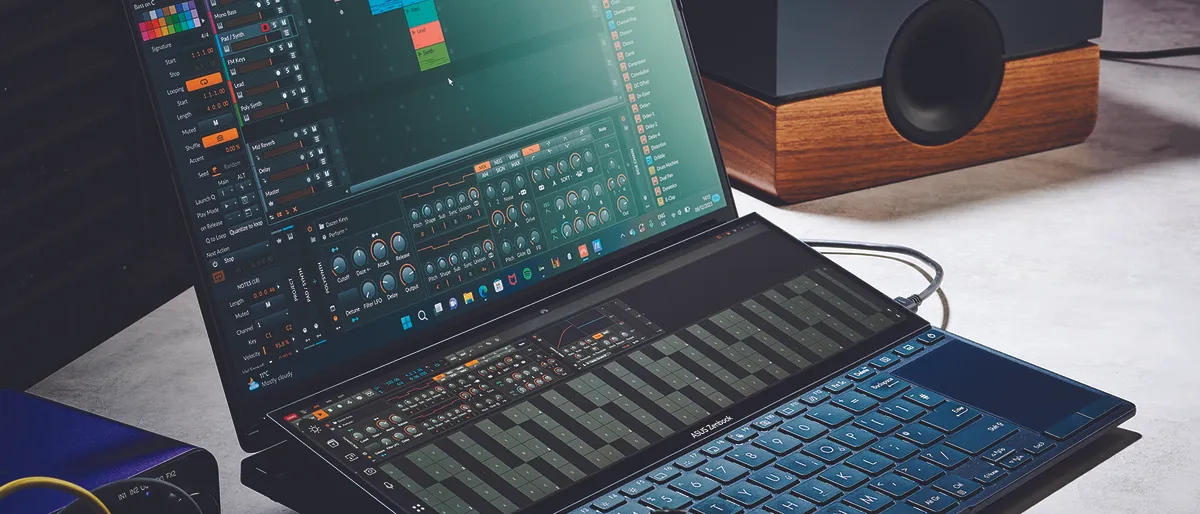
ASUS’s Zenbook Pro 16X OLED is the professional Windows laptop that most non-Apple creatives have dreamt of. Up until relatively recently, it wasn’t easy to get a decent laptop for music-related pursuits – DJing and beatmaking inclusive – without leaning into gaming laptop territory (which still has its merits, as exemplified by the continued existence of the category in this very drive). Now, it’s as easy as getting, well, this.
The Zenbook Pro 16X OLED is a powerful creative workstation with a big, bold 16-inch screen for visual work (and for seeing what’s going on in a dark venue). There’s a lot else to love about the Zenbook Pro 16X OLED hardware-wise, too, from the ergonomic, tilting keyboard to the powerful chipsets tucked beneath it. It also has some hefty I/O for easy peripheral connections.
There are a couple of things that could be better implemented for us audio-folk, chief amongst which is the ASUS Dial – a configurable touch-wheel that works automatically with Adobe applications, but which we struggled to get working with non-Adobe audio software even after some fiddling with mappings. Ultimately, it’s one less feature on an otherwise feature-packed Windows laptop that can be trusted with pretty much everything in production and performance.

“With specs that are comparable to the Apple M3 Max, this is a worthy Windows-based machine for the power-hungry power user on the go.”
Read more: Zenbook Pro 16X OLED review
Best gaming

✅ Buy if you want gaming-level power: There's more grunt than you'll ever need under the hood of the Razer, making it an ideal one-stop-shop for DJing, music production and any other creative pursuit.
❌ Avoid if you purely want a DJ laptop: You won't need such an almighty machine if you need a laptop mainly for DJing.
Build quality: ★★★★
Battery life: ★★★★
Ease of use: ★★★★
Overall: ★★★★
Razer are best known for their gaming laptops, which tend to boast powerful specs and often feature eye-catching RGB lights. The Blade 14 Studio Edition is a slightly classier-looking laptop aimed at crossing over into the creative market.
These Windows machines come in a variety of configurations, but they’re powerful across the board, with an AMD Ryzen 9 8945HS in the 14, and Intel Core i9 chips in the 16 and 18 models, and at least 32GB of RAM, upgradable to 96GB.
The 14, which is the most basic iteration has a 1TB SSD onboard, plus graphics capabilities that outstrip most machines in this round-up.
There’s certainly more here than most standard DJs need – and you certainly pay for that power. However, if you’re after a PC laptop that can handle the DJ booth, studio and also some serious gaming in the green room, then this is the best DJ laptop for you.
Best 2-in-1
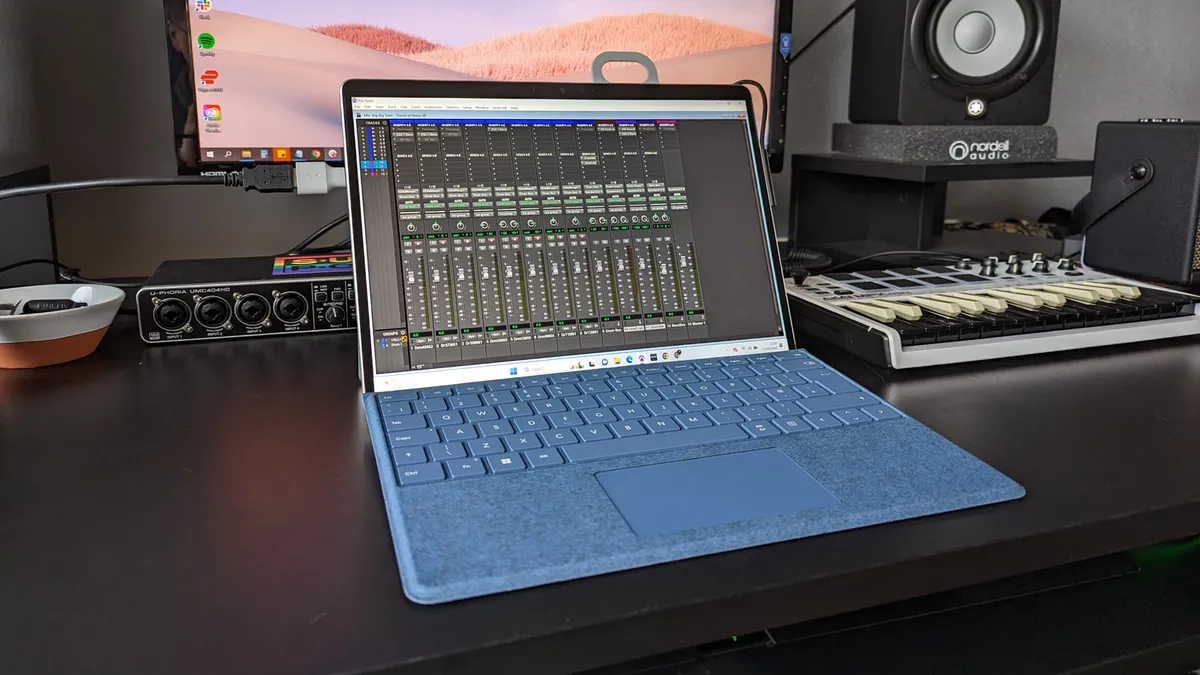
✅ Buy if you want a flexible 2 in 1 machine: The Surface Pro doubles as a tablet so is one of the most flexible devices here, and you can use it for DJing and entertainment.
❌ Avoid if you don't want a touchscreen: You do end up paying a fair bit more for something you might not need.
Build quality: ★★★★½
Battery life: ★★★★
Ease of use: ★★★★
Overall: ★★★★
As one of the most flexible and portable devices in this round-up, the Microsoft Surface Pro 9 is a great option for the mobile DJ, and one that can be used equally well on the road as it can for entertainment on your downtime.
The screen is also great thanks to a 120Hz refresh rate, so you won't be missing anything in those dark clubs, although its size doesn't offer the biggest real estate to run those DJ applications.
The 15.5 hours battery life is also very good compared to most laptop PCs here, although you might expect it given the machine's diminutive size.
Overall, this is probably the most flexible laptop here – given that it doesn't have to be just a laptop! However, you will have to judge whether its small screen might be a hindrance. Otherwise it's a great mobile option.

"The Microsoft Surface Pro 9 is a powerful machine that will make light work of any heavy lifting in your music production workflow."
Read more: Microsoft Surface Pro 9 review
Also consider
How to choose

Picking a laptop for your DJing needs can be a difficult thing, particularly if you don’t know what constitutes the best laptop for DJs. Here are some things for you to think about, so you can make a more informed decision.
1. Use case
First of all, what does ‘laptop for DJs’ mean to you? Some of you will be after a portable device that makes it easier to organise your digital music library and update your USBs for performance on CDJs; others will be after a platform for digital DJing software, that enables live performance at home and at venues using MIDI DJ controllers. The former is much lower-demand than the latter, meaning you can spend less without worrying a huge amount about underpowered CPUs or other such hardware limitations.
Whatever you want from your laptop, weight, build quality and battery life are all important to some extent (and all the more so if you’re intending to perform or tour with your laptop in tow).
2. Software
We’re assuming here that you’re using one of the three most popular DJ software applications – Serato DJ Pro, Traktor Pro or rekordbox DJ. There are of course other options, and you should always check system requirements before committing to buying, but most DJ applications will make similar demands of your laptop’s CPU. This isn’t a huge differentiating factor, then, between the best laptops for DJs. Rather, it’s a good benchmark for the bare minimum.
3. RAM
Which brings us to RAM. At its most basic, RAM dictates how easily your laptop can handle multiple things at once, as well as how complex those things can be – always a good thing to have on tap. Most DJing applications require a minimum of 8GB, but it’s not advisable to run your laptop up to the edge of its capabilities, especially when you’re out playing gigs and reliability and stability are crucial. As such, it’s safe to swing for something with a minimum of 16GB RAM.
DJing software tends to be less processor-hungry than running music production platforms with lots of plugins, so you can get away with a little less power if you’re only going to use your machine for DJing. If you want to also use your laptop as a beatmaking production station, or as the heart of a complex AV set with higher computational demands, you’ll want something with much more on tap – Apple’s MacBooks being a solid shout for their unique unified memory architecture.
FAQs

Do I need my DJ laptop to be portable?
If you’re using your DJ laptop away from a home setup – regularly travelling to bars, clubs or festivals – then portability becomes a significant factor. Weight and durability are naturally important considerations, but battery life plays arguably the most important role here, particularly if you’re likely to spend time in transit preparing for your next set, or simply streaming videos or music to keep yourself entertained on the road.
How much storage and connectivity do I need?
Two other major considerations when choosing the right DJ laptop are storage and connectivity. Streaming is becoming more common in DJ software, but for now, almost all DJs will be travelling to gigs with a hard drive full of downloaded tracks. These will likely be higher quality and therefore larger file formats, so a decent-sized SSD (Solid State Drive) is essential.
If your machine doesn’t have enough built-in memory, then USB or SD card ports for external storage might be the answer, but you need to consider how many connections you’ll require.
Obviously, you’ll need at least one port for your DJ controller, plus another if you want to connect external devices (and maybe another if you want to charge your phone during the gig too).
Which is better for DJing, a PC or a Mac?
If you ask a Mac owner which is better for DJing, they’ll tell you it’s a Mac; if you ask a PC owner the same question, they’ll tell you to choose a PC. The reality is that Serato, rekordbox, Traktor, Ableton and Virtual DJ all run perfectly well on either Mac or PC, and either choice can serve you perfectly well for laptop DJing.
The Apple platform’s famed slick, integrated approach, along with how easily you can step up from DJing to music production, is hard to fault, and its current M-powered processors should cover your foreseeable processing-power needs. However, while the MusicRadar team and I have included a couple of Macs here, they come at a price that will be hard to justify for many.
Windows laptops are the most realistic option for many, and there are plenty of them to choose between, practically all of which are perfectly capable of delivering the same DJing experience as Apple – just with a little more customisability, and with a little bit of a steeper learning curve if you’re new to desktop environments like these.
The user’s experience using any of the leading DJing software platforms on either a PC or Mac will be similar, so your decision may well come down to which operating system, Windows or macOS, works best for you. It’s definitely worth becoming familiar with both so you can make an informed decision.
Glossary of terms
- CDJ: The CDJ is a DJ-friendly media player, that reads and plays digital audio files from a variety of sources. The CDJ is the contemporary standard for modern DJs, with a control interface that
- CPU: CPU stands for Central Processing Unit. Per the name, the CPU is the centre of a laptop’s computational ability. It’s the brain by which software can be interpreted and utilised. The better the CPU, the faster the computer and the more capable of running high-demand apps and programmes.
- DAW: DAW stands for Digital Audio Workstation. DAWs are software applications for music-making, mixing and mastering; the most popular pro DAWs are Pro Tools, Logic and Ableton, but others like Reaper, Bitwig and FL Studio are also commonly used by producers. DJ companies also make DJ/producer-specific DAWs, key examples being Serato Studio and Traktor Pro 4.
- DJ software: DJ software describes applications used by DJs for collecting and managing music libraries, as well as building sets or even producing music. The most popular DJ software is arguably Pioneer/AlphaTheta’s rekordbox, the brand being industry-standard; Serato is another popular software, as is Engine DJ for Denon DJ systems.
- DVS: DVS stands for Digital Vinyl System; DVS is a system that enables the control of digital audio files via a physical vinyl record, or ‘timecode vinyl’. The vinyl is printed with timecode data, which plays through a turntable’s stylus and is interpreted by compatible DJ software on your laptop as control data. The speed, position and movement of the vinyl record is reflected in the timecode, and replicated digitally – hence hybridising vinyl DJing techniques and hardware with digital audio.
- GPU: GPU stands for Graphical Processing Unit. The GPU handles the interpretation and generation of visual information, from the screen display to the rendering of 3D models and beyond.
- HDMI: HDMI stands for High-Definition Multimedia Interface; it’s a connection standard for transmission of AV data from a laptop to an external screen.
- MIDI: MIDI is a language standard that instruments and computers can use to ‘talk’ to one another. It enables the transmission of data relating to notes and note velocity, as well as control messages; DJ controllers are MIDI interfaces, that enable the control of DJ software.
- OLED: OLED stands for Organic Light-Emitting Diode; OLED screens feature on the best laptops for DJs, providing a high-contrast, high-quality picture that’s easy to parse in most conditions.
- Operating system (OS): An operating system is an overarching software architecture for a computer or laptop. Windows is a family of operating systems from Microsoft, and macOS is the same for Apple. Operating systems effectively govern your experience of using a laptop for DJs.
- PC: PC stands for Personal Computer. It’s used as a catch-all term to describe computers and laptops that run Windows or Linux operating systems – i.e.: anything that isn’t part of Apple’s ecosystem.
- RAM: RAM stands for Random Access Memory. RAM is the memory used by a computer’s processors to complete tasks; the more RAM a computer has, the more capable it is of running tasks concurrently.
- SSD: SSD stands for Solid State Drive. SSDs are data storage devices that are capable of saving and retrieving data quickly. This is because, unlike the HDDs that wrote data to a physical, spinning disc, SSDs use transistor arrays to save information.
- Unified memory: Unified memory is Apple’s answer to RAM. Where conventional RAM is allocated to a specific processor (discrete GPUs use their own RAM), unified memory is a pool of memory accessed utilised by all processors.
- USB-A: USB-A is the most familiar form of USB connector – the one that takes three tries to plug in properly. DJs typically interface with CDJs using a USB stick via a USB-A port.
- USB-C: USB-C is a contemporary USB standard; most modern laptops now feature USB-C ports as standard, as opposed to the older USB-A standard.
How we choose the best DJ laptops
Here at MusicRadar, we are experts in our field, with many years of playing, creating and product testing between us. We live and breathe everything music gear related, and we draw on this knowledge and experience of using products in live, recording and rehearsal scenarios when selecting the products for our guides.
When choosing what we believe to be the best DJ laptops available right now, we combine our hands-on experience, user reviews and testimonies and engage in lengthy discussions with our editorial colleagues to reach a consensus about the top products in any given category.
First and foremost, we are musicians, and we want other players to find the right product for them. So we take into careful consideration everything from budget to feature set, ease of use and durability to come up with a list of what we can safely say are the best DJ laptops on the market right now.
Find out more about how we test music gear and services at MusicRadar.
Why you can trust us
☑️ Established 2007
☑️ 2.9 million monthly users globally
☑️ 9,500+ reviews on-site
MusicRadar has been in operation from 2007 and has been helping people on their musical journey since then. No matter if you're a producer, guitarist, drummer, keyboardist, DJ or general music enthusiast, you'll find useful information across the site, while our team of experts and industry pros regularly put instruments and gear through their paces to help you make an informed decision.
Along with our in-depth buyer's guides, MusicRadar also provides all the latest news, reviews and how-to features to provide as music information on the music world as possible.
Thanks to you, we receive three million visitors per month, making us the one-stop shop for music makers and lovers worldwide - and we also feature content from our magazine titles such as Future Music, Computer Music, and eMusician.
Meet the experts
James Grimshaw is a freelance writer and music obsessive with over a decade of experience in music and audio writing. He's lent his audio-tech opinions (amongst others) to the likes of Guitar World, MusicRadar and the London Evening Standard – before which, he covered everything music and Leeds through his section-editorship of national e-magazine The State Of The Arts. When he isn't blasting esoteric noise-rock around the house, he's playing out with esoteric noise-rock bands in DIY venues across the country. James has also been DJing as a side hustle for the past couple of years.

I'm the Managing Editor of Music Technology at MusicRadar and former Editor-in-Chief of Future Music, Computer Music and Electronic Musician. I've been messing around with music tech in various forms for over two decades. I've also spent the last 10 years forgetting how to play guitar. Find me in the chillout room at raves complaining that it's past my bedtime.

Harold Heath is a UK music writer and author. A DJ since the late 80s, Harold also produced a few hundred singles and remixes and two artist albums, and worked as a performer, ghostwriter and music-technology teacher. His first book Long Relationships: My Incredible Journey From Unknown DJ to Smalltime DJ was published in 2021.

Andy has been writing about music production and technology for 30 years having started out on Music Technology magazine back in 1992. He has edited the magazines Future Music, Keyboard Review, MusicTech and Computer Music, which he helped launch back in 1998. He owns way too many synthesizers.
Matt is a Junior Deals Writer here at MusicRadar. He regularly tests and reviews music gear with a focus on audio interfaces, studio headphones, studio monitors, and pretty much anything else home recording-related. Responsible for over 60 buying guides, a large part of his role is helping musicians find the best deals on gear. Matt worked in music retail for 5 years at Dawsons Music and Northwest Guitars and has written for various music sites, including Guitar World, Guitar Player, Guitar.com, Ultimate Guitar, and Thomann’s t.blog.
Latest updates
09/11/26: Updated top product recommendations to Apple MacBook Air M4, Apple MacBook Pro M5 Max, and ASUS Zenbook Pro 16X OLED. 21/08/26: The guide has undergone a top-to-bottom audit, with new labels for the top products that better suit the DJing use case. A new 'Also consider' section has been added with some additional options. A new how-to-choose section has been added to guide readers through the buying process. A fresh introduction and a new header have also been added.
Read more
MusicRadar's got your back Our team of expert musicians and producers spends hours testing products to help you choose the best music-making gear for you. Find out more about how we test.
- Best DJ headphones: step into the booth with confidence
- Upgrade your rig with the best DJ speakers
- Best DJ turntables: top decks for vinyl DJs
- Best DJ mixers for club, home and battle DJs
- Our pick of the best gifts for DJs