


RECORDING WEEK 2026: In-the-box music production is undoubtedly incredible. With endless track counts, plugins covering all manner of instruments and effects and instant recall, modern producers are blessed with the kinds of conveniences that musicians just a few decades ago could only dream of.
One old-school technique, however, that has somewhat fallen out of favour is reamping, the act of running clean a signal out of your DAW and into some speakers, capturing the broadcast audio, and bringing it back into your session.
Guitarists know all about this of course, but the technique can also work a treat on synthesizers and drum machines too.
But why go through all the bother of piping an already captured signal into a speaker, mic’ing it and re-recording it? Bringing a sound into a room, even a small one, can add new life to a recording or performance. Human beings never hear sounds in a vacuum, and yet we record synths, drum machines and other electronic sounds as if we did. You’re going to throw a reverb on them anyway, so why not give them some actual, real-world room treatment?
Distortion is another big benefit from taking things out of box. Famed keyboardist Jan Hammer played his Moog Minimoog through a Marshall stack to achieve a beautiful balance of gain and harmonic distortion. This also allowed him to play around with feedback, something that most keyboardists had never even considered at the time.

Reamping also gives you leave to experiment. Speakers bring all sorts of new sound design possibilities into the equation. Remember: this isn’t about pristine sound but rather creating atmosphere.
Bounce out a keyboard solo, send it to your phone and record its speakers from the other side of the bathroom. That tinny take may be just what the breakdown needs.
Here then, are three different ways to achieve a reamped sound.
1. Reamping with speakers

The most traditional way to reamp synthesizers and drum machines is by piping a pre-recorded section through speakers, capturing that take with a microphone, and then layering it underneath the original.
This is the technique that engineer Gareth Jones pioneered in his work with Depeche Mode on their three breakthrough albums Construction Time Again, Some Great Reward and Black Celebration.

Recorded at Hansa Tonstudio in then East Berlin (the same studio where David Bowie famously recorded “Heroes”), Jones and co-producer Daniel Miller took advantage of the studio’s cavernous interior to positively inflate the output of the group’s synthesizers and samplers into stadium-sized sounds.
By placing a hired PA system in the middle of the three-story-high Studio 2, as well as pressing other rooms into echo chamber-like duty, Jones was able to deliver an album that sounded absolutely huge – because it was, literally.
They didn’t just have a PA system either. Guitar amps dialled into various levels of distortion imparted a patina of grit and filth that you could never get just by plugging into the mixer and hoping for the best.

“With this album (Deadbeat), I was really into electronic drum beats that were recorded in a more organic way,” Kevin Parker of Tame Impala explained on the Tape Notes Podcast “I was really obsessed with putting things through guitar amps and achieving this distorted, blown out drum sound … as a way to give it this sonic personality.”
Another artist known to re-amp is Overmono, who have a space in their studio set up for just this purpose. You can hear this in action on their new album, Pure Devotion. As explained on the same podcast, they recorded a Roland TR-1000 drum machine through both a Marshall stack and an old announcement speaker for a train station. They then brought these two recordings together to create a sound that would be impossible any other way: “You've got the Marshall on the left and the train speaker on the right. (It) gives this really wide stereo image that also feels slightly unusual or unnatural. It gave everything this really nice big sense of space.”
Don’t forget to leave some of the original, dry sound in there as well for clarity. Think of it like parallel compression, except that you’re combining the clean signal with the re-amped one. “We've got a bit of the dry in there as well with the kick,” said Overmono about their reamping techniques on the track Barum.

When studio bods talk about reamping, it’s usually in reference to a single take, but there’s nothing stopping you from recording the monitors for the mixdown. Electronic musician James Holden used a whole array of speakers of various sizes and quality in the final stages of his album, Imagine This Is A High Dimensional Space Of All Possibilities.
“Electronic music exists in this flat, digital, virtual space behind the speakers,” James told us, “It's not like when you listen to an amazing recording of a jazz band on a great hi-fi, and you can hear that goes there, the bass is at the back, the drums are over in that corner… you can hear the room around you. But in electronic music, the only room you hear in it is very often your own. It's all just pushed to the front of the speakers. It’s nice to flip that idea around. The whole thing has this real sense of space, a sense that something happened in a room and I recorded it, rather than some guy with a mouse, which is a different feeling when you listen to it.”
We should also point out that you don’t need some elaborate speaker setup or towering Marshall stack to effectively reamp.
Jan Hammer may have rocked out in front of a big old rock ’n’ roll tower of speakers live, but in the studio his secret weapon was reportedly a Pignose 7-100 portable amp. Instrument retailers are full of inexpensive practice amps just waiting for you to pipe your synth tracks through.
2. Silent reamping

Not all of us have access to a massive space to pile up speakers in. Nor do we have neighbours that will happily ignore the kind of volume necessary to power them. If this sounds like you, you can still take advantage of the hardware thanks to the concept of silent reamping, where you run a signal hot through a tube amp and then back into your DAW without ever hitting a speaker.
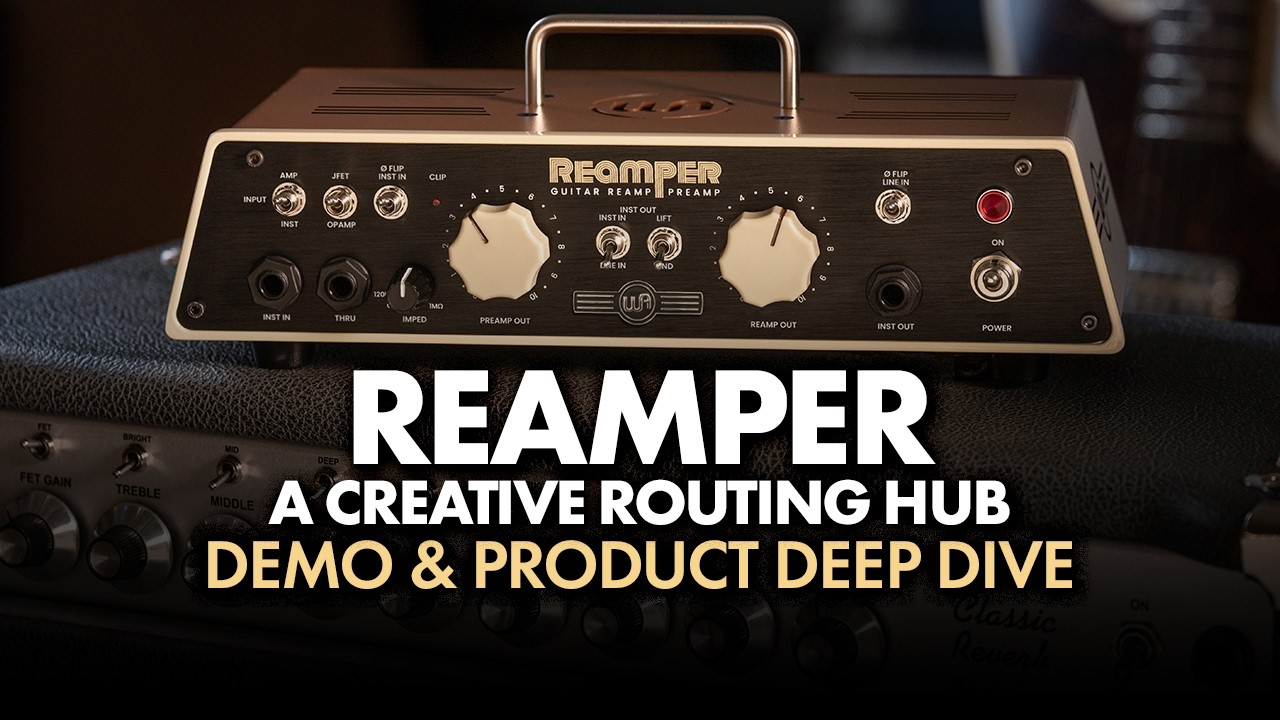
Those of you with a little electrical knowledge are probably getting worried at this point, because all of that cranked up amp energy has to go somewhere. Usually it would go to the cabinet (the speaker). Instead, it goes to a piece of hardware like Warm Audio’s Reamper.
Designed to be the centre of your reamping system, it can take both instrument (guitar) and line level (from your DAW or synthesizer) signals and make them play nice with an amp.
It then brings the hot amp signal back and soaks up the extra juice, so you get the full power of an amplifier without having to annoy the people next door. It will also pad the line level on the way in so it doesn’t hit the amp too hot. Where’s the speaker and room in this situation? That has to happen in your DAW with an impulse response (IR) of a speaker and microphone. Not ideal, but neither is the police knocking on your door with a complaint from an irate neighbour.
If you’d rather avoid the amplifier altogether, a speaker emulator like Universal Audio’s OX Stomp can do the trick. This line-level effects pedal puts the speaker, cab, mic and room tones from the popular OX Amp Top Box into pedal form, plus other effects like 1176 compression, plate reverb, EQ, and stereo delay.
3. Reamping plugin alternatives

If you don’t have the space or budget to experiment with hardware, there are lots of plugins that can add a bit of amplifier saturation and room-derived presence to your tracks. You probably have some in your DAW already.
Klevgrand’s aptly named Reamp is an audio gear modeller with algorithms that recreate what happens when audio passes through hardware. It’s got two guitar-style tube amps, two tube preamps, and cassette and reel-to-reel settings. The separate drive and post knobs let you dial in the amount of saturation across four frequency bands, and there’s a mix knob for instant parallel processing.
Lifeline Expanse from Excite Audio is a multi-effect with a special focus on reamping. You can choose the emulated speaker type from devices like phones and laptops, plus medium-size guitar cabinets and large studio monitors, along with control over microphone placement and tone adjustment. Throw in tape emulation, bit-crushing, delay and reverb and you have a one-stop shop for reamping.
If you don’t play guitar and don’t hang out with anyone who does, you may have not heard of neural amp modelling. Unlike circuit or DSP modelling, which approximate the behaviour of amps, cabinets and microphones, neural modelling is the result of a neural network being trained on recordings of guitars blasting through hardware. This can result in highly accurate digital recreations of gear.
There are plenty of options for experimenting with neural amp modelling, such as Neural DSP’s Quad Cortex and Tonex from IK Multimedia, both of which are also available in hardware formats.

If you’re curious but aren’t ready to part with your cash just yet, TONE3000 is a freeware alternative that is causing big waves on the guitar scene right now.
It allows you to combine NAM (Neural Amp Modeler) captures and impulse responses and works as a plugin and standalone app. There’s an entire library of user-uploaded models, including real-world spaces for adding air and even experimental captures like a vibrating steel bowl and the output stage of a vintage Moog Minimoog.
Of course, there’s nothing stopping you from combining elements from all three of these techniques: amp and microphone, silent reamping, and plugins. Once the audio is in your DAW, go nuts. And most of all, have fun. Modern music making can be too results-focused. Slow down, enjoy the process, and make lots of noise. Just try not to annoy those neighbours too much!
