


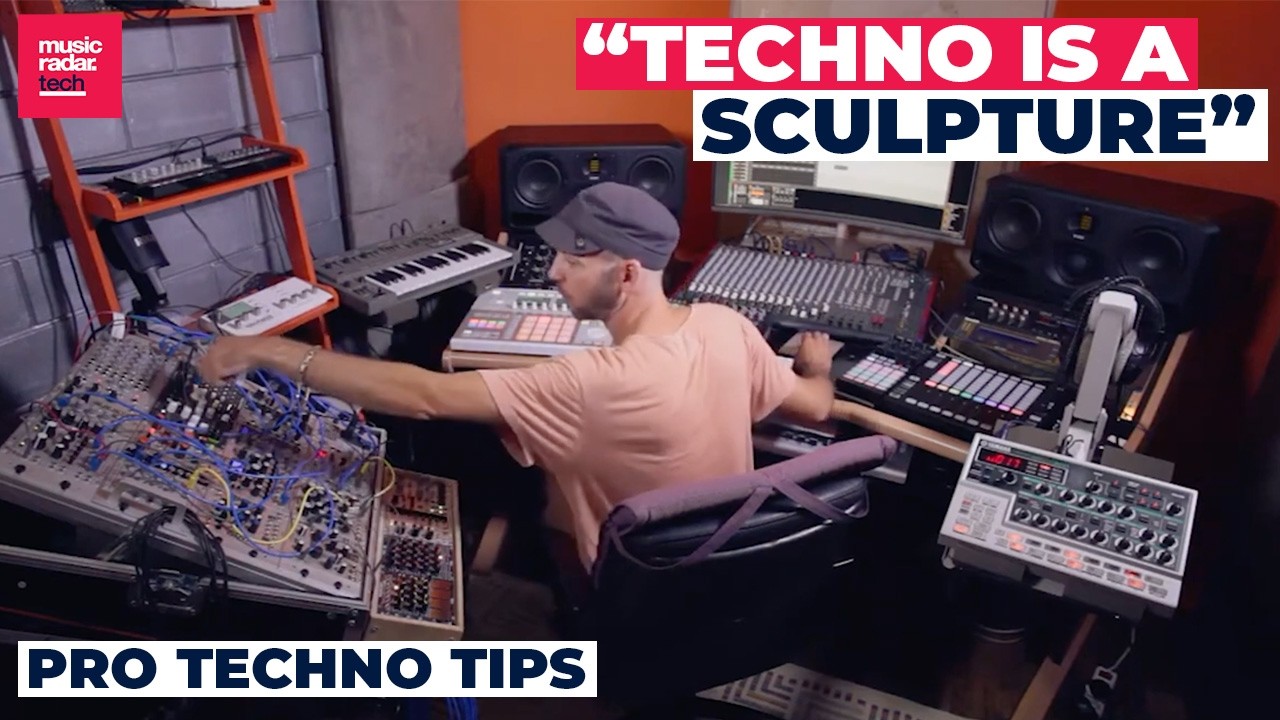
A good techno track can appear incredibly simple, but techno is not necessarily a simple genre to produce. From club-moving subs to subtly shifting percussion, there's a lot of nuance and skill that goes into creating a good techno track.
To help you improve your techno productions and inspire new ideas, we’ve compiled more than 40 minutes of essential techno tips, which you can watch in the video above, all drawn from our In The Studio series.
Between MusicRadar, Future Music and Computer Music, our team has been visiting electronic artists in their studios for decades. These are eight of our most insightful techno-focused sessions from our back catalogue.
How Tom Hades creates techno rumble
Belgian techno maestro Tom Hades has released tracks on labels including Drumcode, Suara and Rhythm Converted. Back in 2018, Computer Music visited him in his studio to watch him build a club-ready track from scratch, resulting in a session packed with techno production knowledge.
Particularly insightful is his approach to creating the genre’s distinctive low end ‘rumble’. The process starts with a solid four-to-the-floor kick, which doubles up as a sub bass using some creative effect processing.
He processes the kick with heavy saturation and compression, bounces it, and then sends it to a return track.
"Afterwards, what I do is I just put a lot of effects on the return track,” he explains. “An overdrive, a convolution reverb, a filter delay, and then I will finish with a simple filter, which gives me the typical techno rumble."
He then uses sidechaining tools to have the sub bass element duck out of the way of the original kick.
"This rumble is very nice because it's not really a character sound,” he says, “but it will give you the power of the kick underneath."
Matador’s drum layering
Irish DJ and producer Matador, aka Gavin Lynch, is known for his stripped-back, hardware-focused take on techno. Future Music visited him in 2015 to watch him break down the making of his track The Enemy featuring Felix Da Housecat.
In the video Lynch demonstrates his approach to creating layered, intricate percussion. He explains that, for him, the secret to thick-sounding drums is to layer multiple hits that occupy different elements of the frequency spectrum.
In his example a tight 909 kick is augmented by claps, hats and percussion lines sitting on top of one another. The clap, for example, is layered with a tambourine, while the hats are thickened with shakers.
To have everything sit together neatly, he runs the sounds through analogue-style processing, using EQ and compression. The effects are merely acting to gel everything together though, rather than reshape specific sounds.
"Instead of loads of EQs on one particular channel, I’ll layer up, say, two or three different hats and work on it that way,” he explains. “You get some original thickness there, so we're not depending on plugins."
Secret Cinema builds tracks with randomisation
From 1991’s hardcore sounds through to his more recent deeper, darker output, Jeroen Verheij has been a key figure of the Netherlands’ techno scene. His formidable discography includes releases on labels as diverse as Rotterdam, Cocoon and Drumcode, under pseudonyms including Meng Syndicate, Point Blank and his most well-known moniker, Secret Cinema.
In 2017, Computer Music magazine met up with Jeroen in his then recently-completed Amsterdam studio to find out how he used a sophisticated combination of software and hardware to create his tracks. In the video, he walks through the process of building a track up from its initial idea, into what would eventually become Ex-Drummer from his Seance EP.
As part of the creative process, he demonstrates how he uses the randomisation tools in Bitwig Studio to create spontaneous melodic ideas and percussion lines.
He does this by sending CV out to a modular synth, driven by a randomised LFO. A scale device is used to control the pitches being sent to the synth.
"If you're a drummer, you will always hit that snare drum on a different setting… which makes that one drum loop so interesting," he explains. “What I want to do is use all these little tricks with LFOs and random step sequencers to make those drum loops humanised again."

Paranoid London's studio jam strategies
When hardware-loving UK acid duo Paranoid London released their album Arseholes, Liars and Electronic Pioneers in 2024, Future Music magazine visited their London studio to catch up with band member Quinn Whalley, and find out how their proudly old-school, raw and analogue take on house and techno comes together.
As Whalley explained during the studio session, the band’s creative process is built around studio jamming and hands-on creativity. Key to making that approach work is having a handful of instruments and effects that the pair know really well – and sticking with that limited setup.
"I'm not a massive fan of using loads and loads of gear,” Whalley explains. “We don't really use a lot, each time we do a track we'll only have a couple of little things."
He also explains that, for Paranoid London, a lot of the magic happens when it’s least expected, and it’s important to capture everything.
"Record everything all the time, and keep it all,” he advises. "You can drag something that you did, like, three years ago, over whatever you’re doing now. When you take a bit of [something old] and put it over something that's in a different tuning or whatever, that's when weird stuff starts happening."
Luke Slater’s (Planetary Assault Systems) outboard effect processes
British techno legend Luke Slater is a man of many aliases. He’s probably best known for his work as Planetary Assault Systems, a moniker under which he’s been releasing tough, drum-machine-focused techno since the mid-’90s.
Slater’s prolific body of work also touches on ambient electronics, acid, house, psychedelic dance music and crossover electro-pop, working as aliases including The 7th Plain, Clementine and LSD, as well as under his own name.
In 2024, Future Music visited him in his hardware-packed studio as he prepared to release a new album under his L.B. Dub Corp alias via Dekmantel.
Among a whole host of production insights, he explained the important role that outboard effects play in shaping his sound.
"Most of this gear is actually made for rock and roll,” he explains. “But I just find it amazing when you put electronic music through it. You can get results that are sometimes amazing."
In the video he demonstrates how he uses things like Pultec EQs to shape his master track, the Overstayer compressor to apply overdrive and tone shaping, and a Culture Vulture to turn a 909 kick drum into a booming techno bass.

Creating rolling techno percussion with Wehbba
In 2017, Future Music paid a visit to Brazil-born techno producer Wehbba in his Barcelona studio, to break down the creation of his track Fake, released on Drumcode.
Tying the track together are lines of rolling percussion, which Wehbba explains are created using heavily processed drum machine rimshots.
"I really love rim shots, and I use them extensively in my production," he says. "This part was from a big jam on the TR‑8. I chopped up the bits I liked and picked different loops out of them.”
Wehbba then demonstrates how he adds body, character and movement to the percussion line. First he applies saturation, reverb and EQ. He then adds ValhallaDSP’s free FreqEcho to create an ensemble-like effect using frequency shifting.
Finally, he tames the sound using limiting and filters.
Less-is-more techno arrangement with BEC
Berlin-based techno producer BEC, real name Rebecca Godfrey, creates hypnotic, groove focused techno. Back in 2021, as she had just released her Pleasure Seeker on Pan-Pot’s Second State, Future Music visited her in the studio to find out how she created the trance-influenced track, Trusting the Mystery.
One particularly distinctive feature of the track is its simplicity.
"It's probably one of my most simple tracks ever,” Godfrey explains. “15 elements, and that's including three kicks, so there's actually 12 separate sounds in here. I think there's beauty in simplicity."
She demonstrates how the arrangement is built using a two-note melody and simple bassline, along with short, looping percussive patterns.
The tension comes from shifts in effects and automation, with reverb added to create space towards the drop, and the synth line’s filter cutoff opening as the track rises.

Tomy DeClerque's techno mastering tricks
In a classic 2012 studio session, Future Music visited Eastern European techno producer and DJ Tomy DeClerque in his studio.
One particularly noteworthy tip shared during that session is DeClerque’s approach to mastering. As the producer explains, he would often do a ‘mastering pass’ on a track at an early stage.
“Everybody else is doing the loop, then they create the song, then create the mix, and then they do the mastering,” he explains. “I prefer to do the mastering early in the stage."
This approach, he explains, helps him identify issues with the mix and production early on, that he can then fix.
"The mastering always brings up some frequencies you don't know,” he says, “so I prefer to do the mastering thing, break everything up, make it loud, and then go back and repair the things that mastering has brought out."
