





MusicRadar Verdict
The Xenodrive offers a somewhat unique approach to distortion (at least in hardware form) via its wavetable-based waveshaper, but a few workflow frustrations and a sonic personality best suited to harder styles may limit its appeal for some users.
Reasons to buy
- +
Wavetable waveshaper is distinctive and offers a huge range of distortion textures.
- +
Solid build quality with well-placed knobs and informative OLED display.
- +
Full MIDI CC control and preset save/recall, with configurable footswitch for live use.
- +
Preset morphing and ‘MAGIC’ random patch generator are nice creative touches.
Reasons to avoid
- -
No front-panel global dry/wet mix control (menu access only).
- -
Input Gain and Volume are excluded from MIDI control and preset recall.
MusicRadar's got your back Our team of expert musicians and producers spends hours testing products to help you choose the best music-making gear for you. Find out more about how we test.
What is it?
Erica Synths has been building an increasingly impressive range of desktop effects processors in collaboration with Dutch DSP developer 112dB. Following the Echolocator delay and Nightverb reverb, the Xenodrive is the third unit from this partnership and takes a rough and rowdy aim at the world of distortion, overdrive and waveshaping.
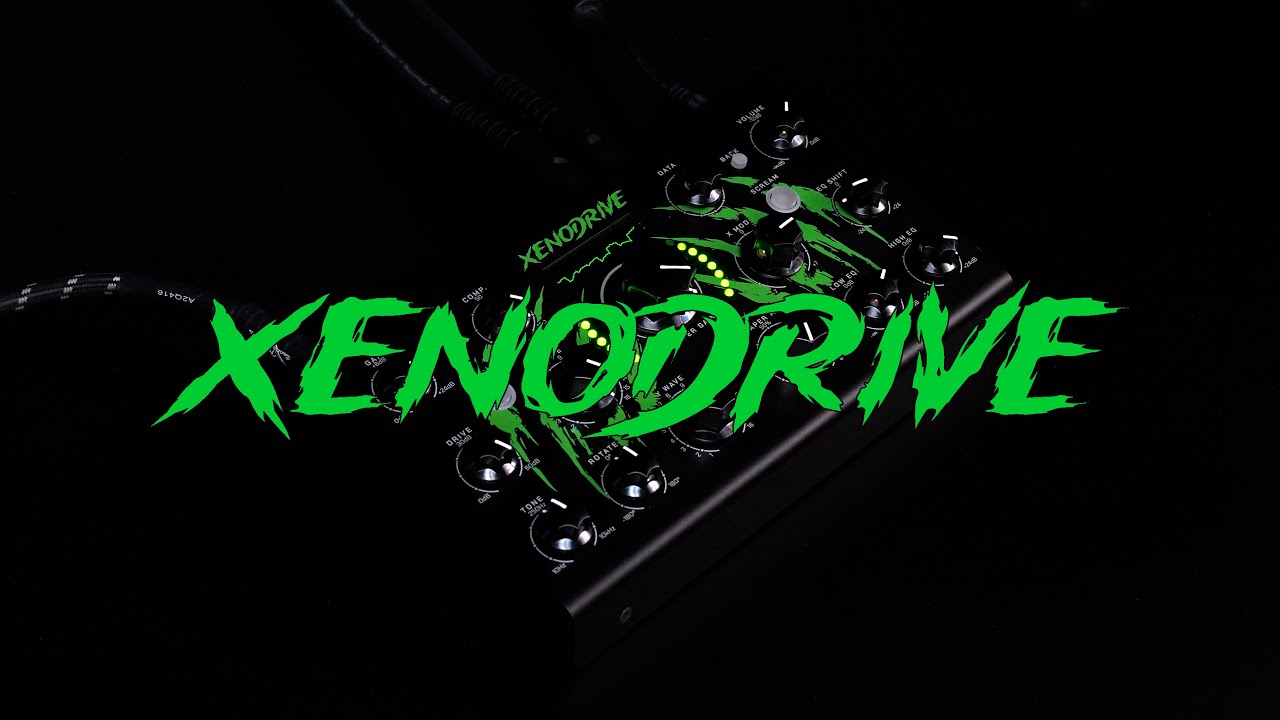
Housed in the same sturdy aluminium enclosure as its siblings, Xenodrive is a stereo effects processor with 15 dedicated knobs, an OLED display and a signal path that combines multiple processing stages.
It starts with an analogue input gain stage capable of boosting up to +24dB – accommodating everything from guitar to line-level signals – before passing through a simple compressor, a germanium diode-style overdrive emulation (with drive and tone controls), and then into the unit's headline feature: a two-axis wavetable-based waveshaper.
Audio waveshapers work by remapping the amplitude of an audio signal through a so-called transfer function. These are essentially curves that determine how the input level translates to the output level. Simple curves produce gentle saturation, while more complex shapes add increasingly gnarly harmonic components.
What sets Xenodrive's implementation apart is its use of a 16×16 grid of carefully selected waveshaper waveforms, navigated via the X Wave and Y Wave knobs. This provides a huge landscape of tonal possibilities, with continuous morphing between grid positions. The Rotate knob shifts the phase of the selected waveshape, and the large central Shaper Gain control determines the intensity.
At higher settings, the signal starts folding back on itself (wavefolding), producing increasingly dense and aggressive harmonics. The envelope follower (X MOD) adds a dynamic dimension, modulating the X-axis wave selection based on the input signal's amplitude, so the distortion character responds to playing dynamics. The Envelope Follower’s Attack and Release times can be tweaked by accessing the relevant menu items via the OLED.

After the waveshaper, the signal passes through a two-band shelving EQ with a shiftable centre frequency and a Scream button that adds resonance (reminiscent of a miced-up guitar cab) to the EQ cutoff. The EQ section is, however, limited to shelving only. The inclusion of switchable high-pass and low-pass filter modes, as found on some competing units, would have added useful flexibility here.
A noise gate sits at the end of the chain – and given the extremities of gain this unit can reach, it is very much a necessity (especially when working with inherently noisy vintage drum machines and synths). Again, additional control is provided in the menus, where the noise gate Threshold can be adjusted.

Performance
The Xenodrive arrives in eco-friendly inner packaging, though, at least in our case, it left a noticeable layer of dust on the unit. Not a biggie, but not the ideal first impression for a product in this price bracket.
In practice, the most notable feature of Xenodrive is its hands-on workflow. Generously sized knobs with decent spacing make sound design immediate and engaging, and the OLED display provides useful visual feedback, including a real-time representation of the waveshaper's effect on the signal. The build quality feels robust and gig-ready.
The waveshaper is where the Xenodrive distinguishes itself from simpler overdrive or distortion boxes. Sweeping through the X and Y wave axes while adjusting the Shaper Gain reveals a wide range of tonal possibilities, with results spanning subtle harmonic thickening, buzzing metallic textures and outright sonic obliteration.
The Scream button adds an extra dose of aggressive resonance, reminiscent of guitar cab/pedal tones that can push things further still. The 42 factory presets provide a good tour of what the unit can do, with categories spanning bass and guitar, drums and percussion, alongside more experimental/textural territory.

However, there are some notable workflow frustrations. The front-panel Shaper Mix knob only adjusts the waveshaper's gain balance – it is not a global dry/wet control. A true dry/wet mix exists, but it is accessed only through the Effect menu. For a unit that invites you to dial in extreme settings, the ability to blend those results with the dry signal from the front panel would have been very useful, particularly for those wanting to use it more subtly. This feels like a missed opportunity given the unit's otherwise excellent tactile design.
Similarly, the Input Gain and Volume controls are excluded from both MIDI control and preset recall. The argument here, perhaps, is that these will both vary with source/context and that once set, they will remain the same when switching presets – there are also some limitations due to where each element sits in the analogue vs digital signal path. Nonetheless, it would be helpful if the front panel clearly indicated which controls are and aren't included in MIDI and preset functionality.

Verdict
The Xenodrive can certainly handle more restrained duties – gentle saturation, subtle harmonic enhancement – but its personality leans firmly toward the aggressive end of the spectrum. This makes it a natural fit for industrial, techno, noise and experimental electronic music, where its ability to completely transform source material is its biggest asset.
There is also the consideration that the Xenodrive's signal path – beyond the analogue gain stage – is entirely digital. For those who work primarily in the box, there are plenty of plugin alternatives that offer distortion, waveshaping and saturation at a fraction of the cost, albeit without the tactile, hands-on control that a hardware unit provides. The Xenodrive's value is therefore strongest for those whose setup centres around hardware sound generators, or who want to break out of the screen-based GUI environment. At this price point, given the digital nature of the processing, potential buyers should also weigh up whether a hardware approach better suits their workflow than the many capable plugin alternatives.

Hands-on demos
Erica Synths
Alternatives
Specifications
Price |
£489 |
Processing |
Stereo distortion/overdrive/waveshaper (digital processing with analogue gain stage) |
Signal Path |
Input Gain (up to +24dB) → Compressor → Germanium diode overdrive emulation → Wavetable waveshaper (with envelope follower → 2-band shelving EQ with Scream resonance → Noise gate → Balanced output |
Controls
|
12 dedicated knobs (Gain, Compressor, Drive, Tone, X Wave, Y Wave, Rotate, Shaper Gain, Shaper Mix, X Mod, Low EQ, High EQ, EQ Shift), plus Bypass and Scream buttons, DATA encoder, OLED display |
Presets
|
42 factory, up to 60 user. Preset morphing (0.1–10 seconds). Magic random generation |
Connectivity |
Balanced 1/4" TRS stereo in/out; configurable footswitch input (TS, non-latching); 5-pin DIN MIDI In + configurable MIDI Out/Thru; USB Type-B (firmware/preset backup) |
MIDI
|
CC control over all DSP parameters (reassignable). Input Gain and Volume excluded |
Power |
12VDC (adapter included) |
Enclosure |
Aluminium desktop chassis |
Contact |