It seems strange to us now, but there was a time when the legality of sampling allowed the legitimate and lawful usage of ‘an unrecognisable portion of a track’, without any need for clearance or declaration.
Thankfully (and quite rightly) this law was overhauled in the 1990s, meaning that any usage of another artist’s work required reporting, so that the original artist could be paid royalties too. No more costly court cases… or so it was hoped.
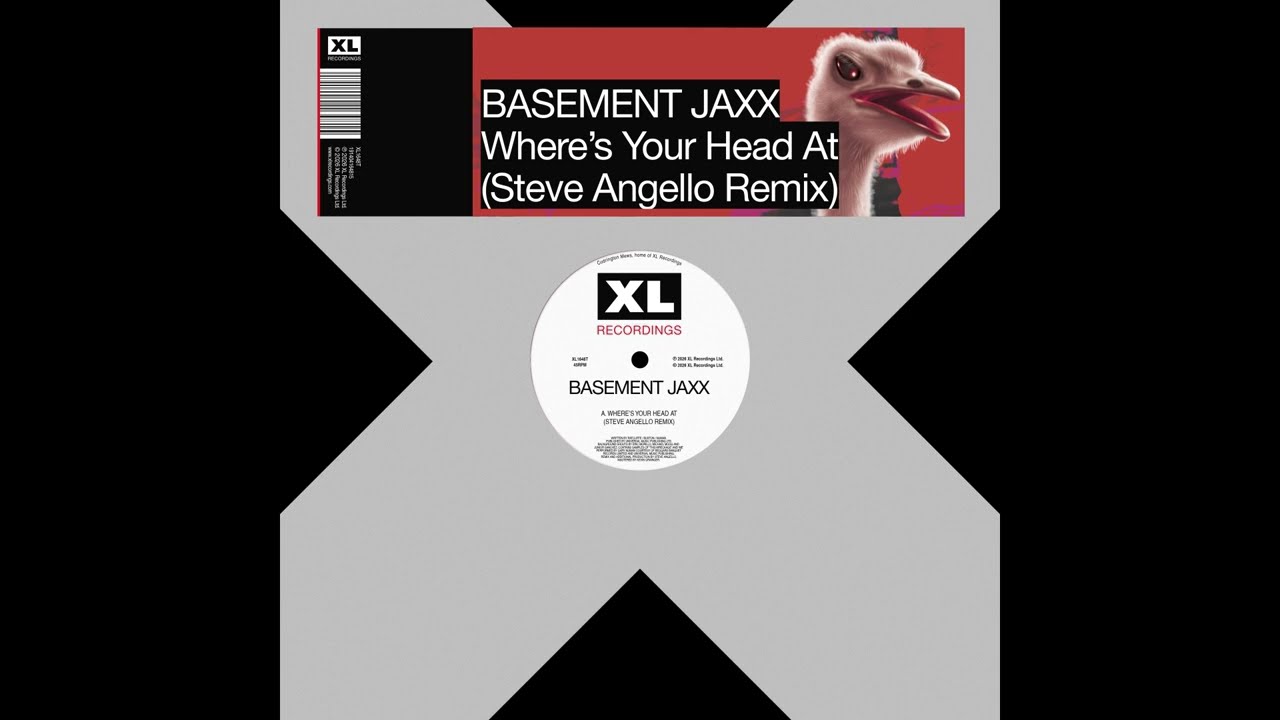
In the case of today's chosen synth sound, the very overt usage of its central sample meant that seeking permissions would have been a prerequisite. However, while the original track from 1979 (M.E. by Gary Numan) was quite well-known to Numan fans, it was undoubtedly made more famous by the British electronic duo Basement Jaxx and their sublime 2001 single Where’s Your Head At.
This pair of Numan-inspired big-beat heavyweights, Felix Buxton and Simon Ratcliffe used M.E.’s spiky bass riff from the original song in repeating two-bar sampled form.
“We have never attached ourselves to one scene,” Simon Ratcliffe explained to The List in 2013. “If you attach yourself to one scene and that scene goes down you go down with it. So we don’t want to be on one ship, we’re pirates really just plundering then moving on."

Whenever we think of the track, we can’t help but mentally picture the incredibly funny (and incredibly disturbing, for that matter) video, directed by Traktor, which depicted a label exec being taken to discover the ‘next big thing in music’.
Cue human-faced monkeys and pandemonium…
Buxton and Ratcliffe kept the original Numan sample in the same key of C, but thanks to emerging sampling technology, were able to speed up the track without affecting pitch.
Gary Numan was well known for his love of Moog synthesizers, and that's exactly where we are going to take our synth-train today, as we re-create the original lead/bass sound from both M.E and Where’s Your Head At, with a little help from some effects along the way.

Step 1 - Synth
Given that the original track M.E. was released in 1979, there were comparatively slim-pickings available when it came to getting your hands on synthesizers.
Gary Numan famously stumbled across the Minimoog in the studio where he was about to make a punk album, being totally absorbed by the sound that a single synth could make.
It's a fairly safe bet to suggest that the bass/lead was created using a Minimoog Model D, and to re-create our example, we are using Cherry Audio’s Miniverse plugin, which is not only a superb reincarnation of the Minimoog, but is also an exceptionally affordable way into classic Moog sounds.
You can of course use other synths, but you will need something with capacity to either modulate a square/pulse wave, or provide fixed alternative pulse width wave forms, and preferably have three oscillators, although you can re-create a good facsimile with only two.

Step 2 - VCOs
Our first destination is the Oscillator Bank. We are going to use all three oscillators, set to the same pitch of 16’. These should be de-tuned slightly, to thicken the texture.
Be aware that if using a Minimoog-style plugin, you may need to adjust Oscillator 3, so that it is not in ‘Lo’ mode, with pitch that tracks the keyboard.
When it comes to selecting the waveforms, we have opted to select one of each from the square/pulse category, although you can also manually create a similar tone by adjusting an oscillator’s PWM manually on other synths.
In essence, we want to mix and match pulse sounds that are all a little bit different. This caters to the ‘reedy’ element of the sound that we can hear on the original.
It's worth noting that you can experiment with the VCO settings, including a saw wave into the mix.
As this sound is doubled by a bass guitar on the original, you could also explore dropping the pitch of Oscillator 1 by an octave (32’), which will offer another very acceptable alternative.

Step 3 - Mixer
We are going to blend the signals together, but to bring out the ‘reedy’ nature of the sound, you can see that we have increased the volume level of Oscillators 2 and 3, over and above the level of Oscillator 1.
Much like the previous step, you can experiment with the levels, to create a timbre that resonates with you and your production or track.

Step 4 - Filter
Adjust the Low Pass Filter’s cutoff frequency, so that the filter is opened by around 60%. This may vary from plugin to plugin, so adjust so that the sound is not too bright. Note that we also add a little bit of Filter Emphasis (AKA resonance).
The filter envelope is redundant in this patch, so ensure that the modulation amount (Amount of Contour) is decreased fully. The position of the filter envelope pots become irrelevant as a consequence.

Step 5 - Envelope
We do, however, want to adjust the amplitude (volume) envelope, beginning with a slightly softer Attack Time, coupled with a relatively quick Decay Time. We have set the Sustain Level fairly high, but by reducing from its maximum setting, a degree of bite and transient can be created at the beginning of each note played.

Step 6 - FX and Notes
That's our synth sound created, but the finishing touches are fairly essential to this patch, and they are applied via a use of effects.
Firstly, apply a flanger to the synth sound. Most DAWs are equipped with some form of flanger, but for similar effects, you could also try a phaser. In our example, we are using the Eventide Instant Flanger Mk II, which provides some excellent vintage style flanging possibilities which are perfect for this 1979-originating sound.
Secondly, add some form of overdrive or distortion. Decapitator from Soundtoys is always a fine example, both in terms of sound, and in terms of ultimate control over amount and colouration.
Finally, you could try adding a small amount of reverb, preferably something similar to a spring or plate reverb.
Once again, most DAWs offer recreations of analog reverbs, but adjust the wet/dry mix, so that the reverb does not swamp the original signal.
The descending bass riff on a musical level is incredibly straightforward, the ominous pattern slides between the notes of F, E and C.
One final point, which relates more heavily to the Basement Jaxx use of the sample, is the application of compression. If you listen closely, you can hear the synth sound pumping slightly, in-chain with the kick on the original track.
You could try to re-create this by sidechaining your own kick track, or go in a different direction, and make something new, original and exciting out of the same sound!

Where's Your Head At, and the work of Basement Jaxx more largely, continues to reach new listeners decades into their career.
Most notably, PinkPanthress has recently switched many a new fan onto the duo via various samples of their work, and by citing them as mentors.
“They were very pivotal in my learning,” she told The Fader. “I went in there to make beats and songs with them, but I ended up leaving by just seeing their creative process and style and picking their brains…I ended up sampling them.”

Most recently, the release of an incredible remix by Swedish House Mafia’s Steve Angello is currently racking up impressive numbers on streaming platforms too, after being a live staple in his DJ sets for years.
“Basement Jaxx were a defining part of my youth,” Angello told DJ Magazine. “This track stayed with me through so many moments and really shaped who I became as an artist.”