


It was a new beginning for Iron Maiden – the band’s first new song with new singer Bruce Dickinson. And it became one of the greatest heavy metal anthems of all time.
Run To The Hills was released on 8 February 1982 as the lead single from Maiden’s third album, The Number Of The Beast. It served as a dramatic entrance for Dickinson and an emphatic statement of intent for a band with world domination in their sights.
Bruce Dickinson was officially announced as Iron Maiden’s new singer in early October 1981, replacing the charismatic but wayward Paul Di’Anno. But when the band set to work on writing for The Number Of The Beast, Dickinson was still under contract to the management of his former band Samson.
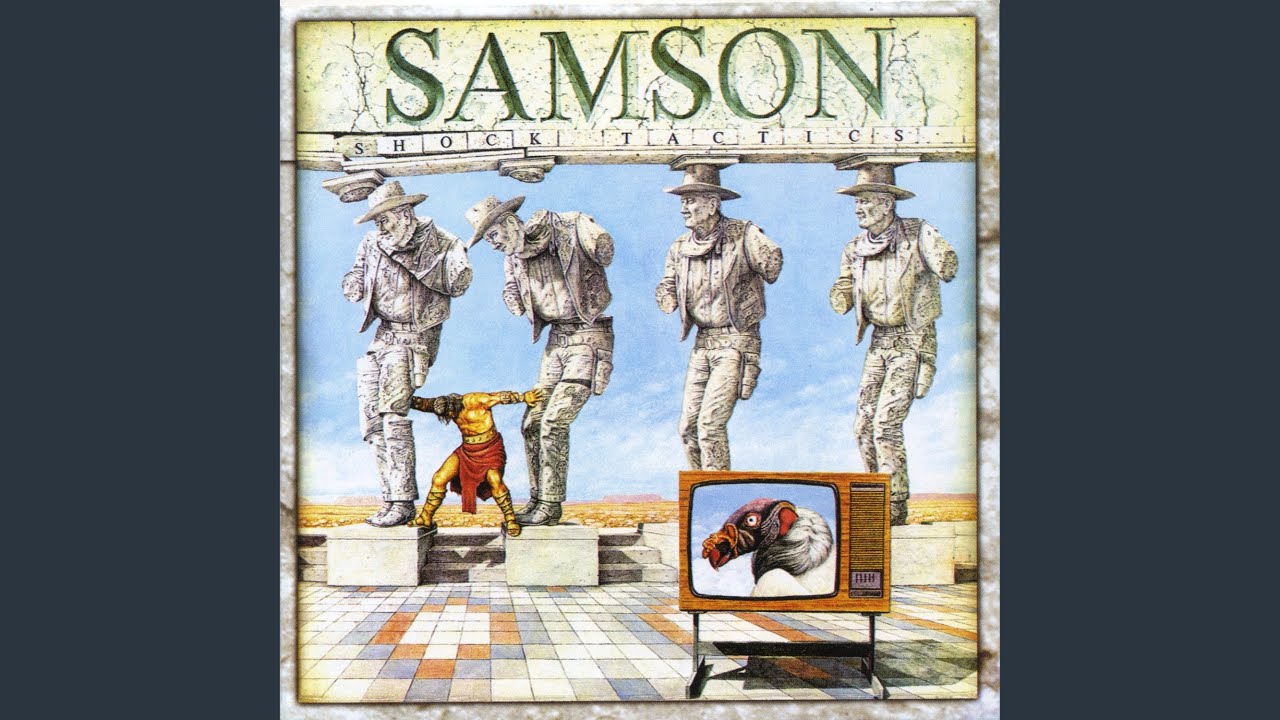
In an interview with Classic Rock, Dickinson claimed that his contract with Samson had a a buy-out clause of £250,000 – a huge amount of money in the early ’80s.
“It was a ludicrous sum,” Dickinson said. “We’d only ever had about 30 quid a week out of the band. But we were bonkers, completely out of our gourds, and we’d signed the document.”
As it turned out, Iron Maiden’s manager Rod Smallwood, acting on Dickinson’s behalf, negotiated a final settlement of £30,000, paid by Smallwood’s company Sanctuary Management on the understanding that Dickinson would settle the tab in due course.
But due to legal complications, Dickinson could not receive official credit as a songwriter for Iron Maiden at that point. As a result, his contribution to the writing of certain songs on The Number Of The Beast – Run To The Hills included – was not revealed until later.
Steve Harris, Maiden’s bassist and leader, received the sole writing credit for Run To The Hills.
In an interview with Rolling Stone, Harris explained how the song’s lyrics were inspired by Wild West tales he had read as a child.
“We’ve always been fascinated with Western movies and books,” he said. “I had never been to America at that point. I just used to read a lot of books by an author [of Western novels] called Louis L’Amour and I got inspired. The first few lines of the song were definitely inspired by reading those types of books.”
Speaking to MusicRadar in 2025, guitarist Adrian Smith discussed Steve Harris’s distinctive style of writing.
“Steve is the main songwriter,” Smith said, “and as a bass player he has a pretty unique way of playing. So when you translate that to the guitar, it’s just something you would not do on guitar, normally, which is a double-edged sword, because although it might not feel natural, when you translate what he does for guitar, it sounds different.”
Harris would write guitar parts in higher registers than other metal bands. He wrote Run To The Hills in D, but not in Drop D. Smith and fellow guitarist Dave Murray played that galloping D5 power chord at the fifth position. Harris’s bass guitar gives it the low end.
“He did a lot of songs in D, and D is not a really heavy key,” said Smith. “The Number Of The Beast, Run To The Hills, it’s not a heavy key, and I think if we did it now I’d suggest we did a different key, or we’d try different tunings, but at the time you just go along with it.”
Smith said when he returned to Maiden in 1999, he would tune his guitar to Drop D tuning when performing Run To The Hills live, which would give it more weight. But, as recorded, it remains one of metal’s most effective arrangements – not least on that intro with Dave Murray’s full-step and unison bends being shadowed by the power chords below.
For his part, Bruce Dickinson stated in 2012 that the structure of Run To The Hills is in part inspired by Frank Sinatra’s signature anthem My Way. Dickinson had watched a musicologist on TV explain how My Way used the rising sixth interval and recognised its potential for adding a sense of triumph and drama to a melody. Run To The Hills would be as good a place as any to apply this knowledge.
In late 1981, when Iron Maiden were presenting the material for The Number Of The Beast to their producer Martin Birch, a snap decision was required. A major tour had already been booked, beginning on 25 February 1982 at Dunstable’s Queensway Hall. Knowing that the album would not be released in time for the opening of the tour, Rod Smallwood instructed the band to nominate one song that could be released earlier as a single.
Dickinson recalled: “We had to pick the single before we recorded anything. We were, like, ‘Oh, fucking hell!’”
For Martin Birch, choosing Run To The Hills was a no-brainer.
“Thanks to Martin’s prize-winning ears,” Dickinson said, “that’s what we did, and it turned out to be exactly the right choice.”
Run To The Hills peaked at No 7 in the UK chart, and nobody was happier about that than Steve Harris.
He revealed to Classic Rock: “I was very worried at having a singer change at that point. But the fans took to Bruce incredibly well. It was an absolute relief, if I’m honest.”

Bruce Dickinson had never lacked confidence. He’d always believed that Iron Maiden, with him, would sell millions of records.
This was a feeling shared by Martin Birch during the recording of The Number Of The Beast at Battery Studios in London, when he told the band: “This is going to be a big, big album. This is going to transform your career.”
In April 1982, The Number Of The Beast hit No 1 in the UK.
As Dickinson recalled, “What happened with The Number Of The Beast was beyond all our wildest dreams.”
The album had been recorded in just four weeks at a cost of £28,000.
Rod Smallwood told Classic Rock: “We had no record company advance whatsoever, so EMI’s total investment in that album was 28 grand, and in the first six months it sold 1.5 million.”
On the day the album went to No 1, the five members of Iron Maiden went to the famous Marquee club in London’s Soho to celebrate. There, Steve Harris had to ask Smallwood for extra cash to buy drinks for their friends. It was at that point that Smallwood agreed to raise their wages from £60 to £100 a week.
The real money came in after they returned from a world tour at Christmas.
All of the band members bought houses. Bruce Dickinson put down a 50 per cent deposit on a place in Chiswick and cleared his debt to Sanctuary.
After a few days at home, Dickinson’s mood took an unexpected turn.
As he confessed to Classic Rock: “To be honest, I was actually quite depressed. I was in a great band, I’ve got a number one album, I’ve just done a world tour… What do I do with the rest of my life?”
Steve Harris, however, had no such concerns.
He recalled: “I never thought, ‘Oh well, we’re at the top, this is it’. I wanted more and more.”
