
Eric Clapton has admitted that watching two of his most famous electric guitars go under the hammer at Christie’s in 2004 was a momentarily gut-wrenching experience, and that the first thoughts going through his mind were that he was making a “big, big mistake”.
The Crossroads Guitar Auction was ahead of its time. Here was one guitar god parting with the holiest of holies – some of the most revered guitars in the world. There was a whole consignment of Martin guitars (including ‘the Longworth,’ the 1966 Martin 000-28 you see on the back of the 461 Ocean Boulevard cover).
Then there were the superstars of the auction, such as Blackie, Clapton’s Fender Stratocaster put together from 1956 and ’57 parts, for which his love is written all across the wear on its maple fingerboard.
Blackie changed hands for $959,500. The guitar Clapton considered, “the star of the show” was his 1964 Gibson ES-335TDC went for $847,500.
This was the second electric guitar he had ever bought, had it all through his time with the Yardbirds and John Mayall’s Bluesbreakers, and it was the one we all recognise from that night at the Royal Albert Hall as Cream played their farewell shows. Bang! Just like that. The hammer came down and they were gone. Ouch.
But speaking to Guitar Center, Clapton explained his thinking, and why he has no regrets about selling these instruments when the money raised was going to support the Crossroads rehabilitation unit in Antigua.
“When I became an acknowledged alcoholic, and realised I was an alcoholic, I took onboard and still adhere to this thing they call the Preamble, which is my primary purpose is to stay sober and help other alcoholics choose sobriety,” he says. “Believe it or not, it’s above me being a musician or a husband or a father. It’s the number one thing, so when the auction was going on I had to keep saying, ‘This is for your purpose. You are an alcoholic and if you don’t stay sober you are not going to help other alcoholics choose sobriety. So this is all for that purpose.’”
So no regrets, even if it was a little bittersweet to these instruments go. At least he can still see Blackie. Guitar Center, who is a long-standing partner of Clapton’s all-star Crossroads Guitar Festival, actually bought Blackie and keeps it on display.
Also, at this year’s festival, the ES-335TDC made an appearance, albeit in a very different guise. Gibson was unveiling its new Epiphone replica at the festival, with the release scheduled for summer 2027.
A collaboration with the Gibson Custom Shop, this Epiphone guitar comes will come with a Gibson USA pickups, the mismatched hardware of the original and with a special custom hardshell guitar case.
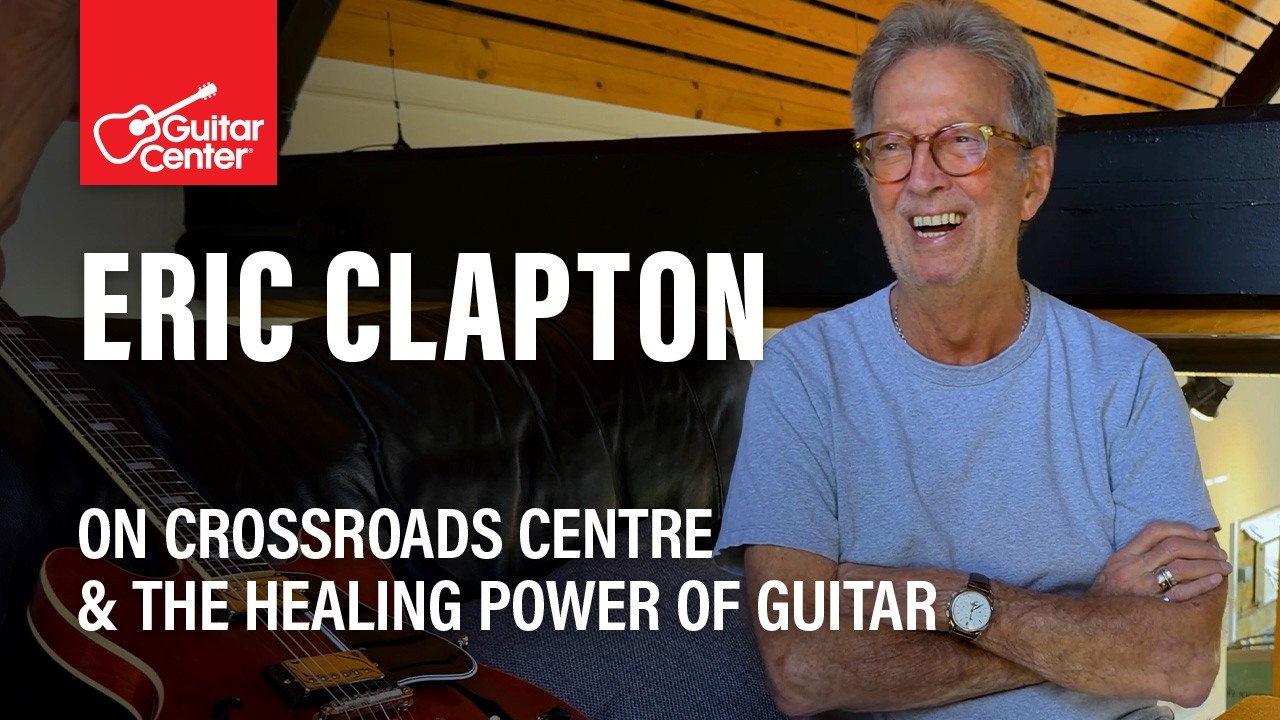
Clapton might be at peace with where the 335 and Blackie have ended up, but he acknowledged just how important they were to him. They are not just a tool for making music, they can be a source of “salvation”, too.
“That’s what they represent to me, and that’s what music represents to me,” says Clapton. “It’s the most reliable source of inspiration, and salvation.
“If you’re in a bad place, and you pick up a guitar, there’s a strong chance you will get out of that. You’ll transcend whatever the problem is, if you can keep it up… Find a way to express yourself to the instrument… They are very sacred things to me, these guitars.”
Last month, Guitar Center unveiled its limited edition Crossroads 2026 Collection, featuring a reproduction of Clapton's Blind Faith Telecaster, plus Martin acoustics, Ernie Ball electric guitar strings and a PRS John Mayer Silver Sky in Incline Blue.
