


System-1m
Unveiled at Musikmesse 2015, the System-1m was the first of several new modular products added to Roland's Aira range, which features reimaginings of some of the company's greatest products.
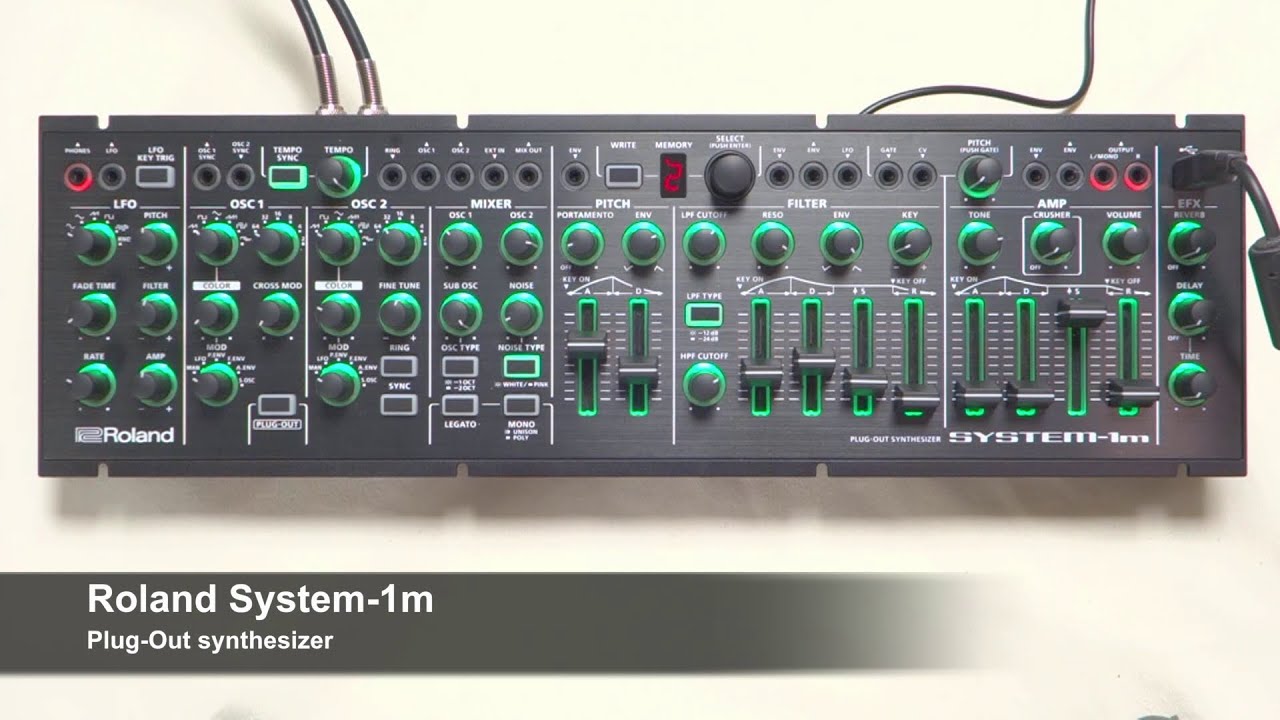
Keeping the flexibility afforded by the System-1's Plug-Out capabilities, Roland has dispensed with the keys but added patchable routing and CV/Gate connections, all housed in a very flexible case that will fit in your existing Eurorack setup (providing you have space for an 84 HP module), work as a desktop module or slot into a 19-inch rack.
Check out the video below, and click through the gallery for our thoughts on some of the System-1m synth's key features.

Build
As can be seen, the overall design follows the standard Aira blueprint, with the synth architecture taken from the System-1 keyboard (though minus the keyboard, arpeggiator and Scatter effect).
The unit itself is not particularly heavy, but feels reasonably sturdy. USB is on the front panel alongside lots of interesting mini-jack ports.

More power
Out of the box, the System-1m is ready use as a desktop synth - though Roland clearly has its eye on the exploding modular market as the System-1m will fit happily into an existing Eurorack rig (and even includes the appropriate power connector).
There is also a second set of MIDI connectors on the rear.

Waveshapes
The System-1m is, at heart, a 2-oscillator synth, though these are bolstered by a sub-oscillator and noise source.
Each of the main oscillators has both a regular and doubled version of each waveshape, with more shaping and modulation options than you would find on many ‘real’ analogue synths. Some of these controls are unused when operating the unit in Plug-Out mode.

No chorus
Further evidence that the System-1m is most certainly not a purist-pleasing digital recreation of an analogue synth can be found in the presence of the Crusher knob and EFX section - a simple reverb and delay combo.
Much fun can be had by tweaking the delay time in real time. It’s a shame there is no modulation routing for this…. and it’s very disappointing not to find a ‘Juno chorus’ emulation in here. Roland has missed a trick on that score.


Plugin, Plug-Out
Part of the new Plug-Out functionality is the ability to run the synth as a plugin and use the hardware as a controller for as many instances of the plugin you wish to use.