
PLUGIN WEEK 2026: Typically, dynamics processors have a relatively specific function. We don’t mean what type of processor it is – compressor, limiter, whatever – but rather which specific model of processor is used on what specific instrument or sound source at which specific stage of the production process.
When a processor is well-matched to these specifics, then excellent results can be produced; when deployed outside of its specialism, though, even the most lionised of tools can deliver unsatisfactory results.
For example, a Fairchild 660 (whether hardware or a decent software emulation) has a legendary reputation as a vocal compressor, but its charms often aren’t as apparent in a mastering context. Similarly, a Shadow Hills Mastering Compressor has a near-magical ability to add “glue” and cohesiveness to a mix, but is not so impressive when slapped onto a vocal track.
Given this specificity, it’s rare to come across a dynamics processor that complements any sound source: vocals, instruments of every type, sub-mixes, full mixes, masters, music, dialogue, foley… the lot! It’s even rarer for that processor to be well-suited to every stage in the production process, from recording and tracking all the way through to final mastering.
Nevertheless, since its inception a decade ago, Oeksound Soothe has grown into exactly this – a rare example of a jack-of-all-tracks also being a master of all, as revered and relied upon by recording and mix engineers as by mastering and audio post-production facilities. And with the latest iteration of the plugin boasting a freshly-minted low-latency mode capable of realtime processing, live sound engineers are sure to be catching the bug soon too.
But we’re getting a bit ahead of ourselves! Before getting to what’s new in Soothe3, we need to ask: what makes Soothe so ubiquitous and widely beloved, and more pertinently, what does it actually do?
What is Soothe?
Soothe is described by Oeksound as a “dynamic resonance suppressor”. If that leaves you scratching your head, perhaps the closest comparison would be a dynamic EQ. As you may well know, a dynamic EQ is an equaliser in which each EQ band contains a compressor-style gain reduction processor. Thus, if the signal amplitude within a band’s frequency range exceeds the band’s threshold, the compressor will reduce the volume of that band.
The primary use of a dynamic EQ is to reduce resonance and prevent frequency buildup – this is when frequencies produced by multiple instruments combined become overpowering when they sound together. A suitably configured dynamic EQ can detect these “hot” frequencies and reduce the band’s gain accordingly. A multiband compressor can do something similar too, although we typically use these for broad-brushed dynamic control, whereas dynamic EQ is a better for more focussed and surgical frequency control.

But Soothe isn’t actually a dynamic EQ, and nor is it a multiband compressor. There are elements of crossover with both, but Soothe goes about its business in a very different way, and has a sonic impact that’s different to both. Soothe continually monitors the incoming signal, sensing for resonances and frequency spikes, and when a resonance is detected, Soothe reduces the amplitude of the affected frequencies until the resonance has passed.
Per-frequency gain reduction is visualised in realtime in the plugin, and this visualisation is overlaid by a curve that, to the untrained eye, looks for all the world like an EQ curve – but don’t be fooled! The curve (and the bands that define the nodes of the curve) describes frequency-specific modifications to the resonance detector’s sensitivity.
Detection is more sensitive where the curve extends above the centreline, and less sensitive below it. This means frequencies are more likely to be reduced where the curve is above the centreline – which is essentially the opposite of an EQ, if you think about it – and entirely unlike a dynamic EQ.
How has Soothe changed over the past decade?
The original version of Soothe featured just three customisable sensitivity bands, and it processed higher frequencies with more detail than lower ones. This meant the plugin excelled at dealing with problems in the upper-mid and high frequency ranges, but was less precise in lower registers – capable of controlling a bit of low-frequency rumble or low-mid boominess, but not so effective at surgical fixes in the low-end.

This didn’t stop the plugin from becoming an immediate hit. As the company’s marketing director, Atte Karm, told us: “The success of the original Soothe was way out of proportion compared to expectations, and its continued success is something that no one could have expected”.
There are those who, if finding themselves having released a runaway success like Soothe, would have simply basked in the glory of their achievement, but that wasn’t the case for Oeksound. With the lessons of the first version’s development fresh in their minds and an eye on their users’ feedback, the company embarked on a complete rewrite of Soothe.
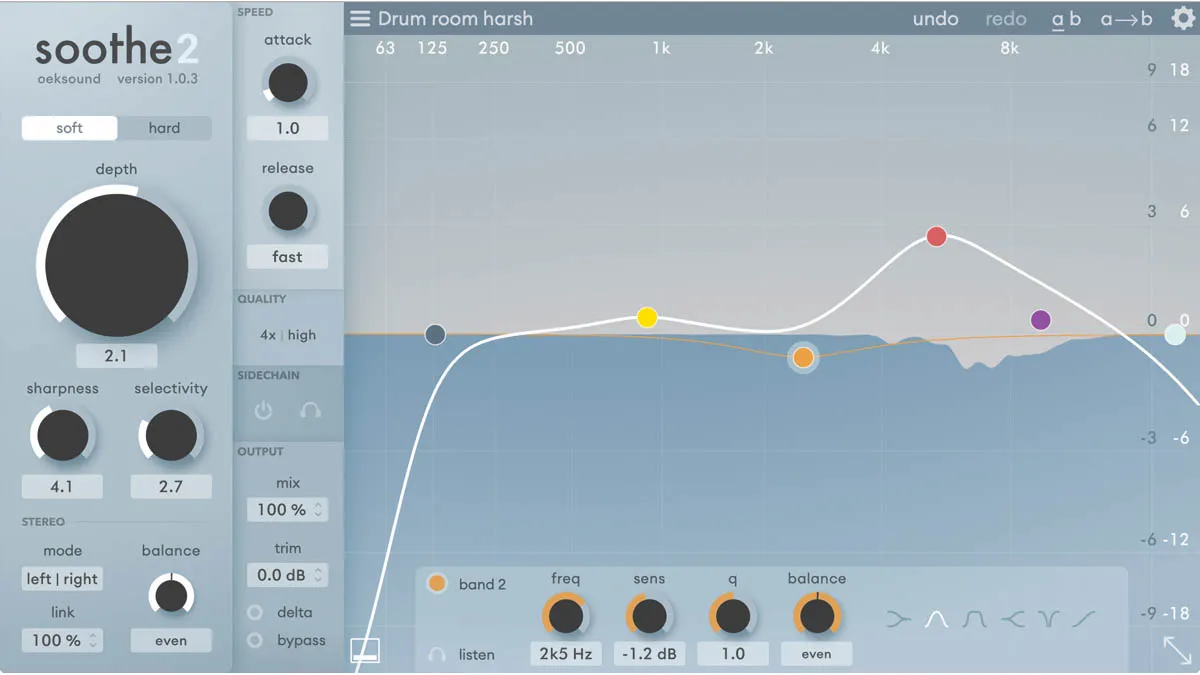
With an all-new full-frequency-range engine, an additional sensitivity band, and new band modes, Soothe2 offered far more depth and focus in its control over lower frequencies than its predecessor. The update also inaugurated the concept of Soft and Hard processing modes, the former designed to be more transparent and adaptive to source dynamics, the latter being more aggressive, level-sensitive and compressor-like. Soothe2 also gained attack and release controls for shaping the response time of the gain reduction, mid/side processing, and the ability to weight the sensitivity between stereo channels – left-to-right in L/R stereo, or mid-to-side in M/S mode.
Importantly, Soothe2 acquired the game-changing ability to work with external sidechains, thereby allowing it to be used for tasks such as reducing mic bleed, creating spectral space to reduce frequency masking, helping a vocal or lead line stand out within a big wash of reverb, and many other creative tricks.
All of this significantly broadened Soothe’s appeal, pushing the plugin into a far broader range of studios and facilities than previously. But Oeksound still wasn’t satisfied, and embarked on the development of a third version, making further changes, adding new features and generally sprucing up a tool that was already a staple in the workflow of producers and engineers across the globe. (Check out the video below for a comparison of how Soothe2 stacks up against the newly-released Soothe3.)
Soothe's next generation
While the most obvious change in Soothe3 is the crisper, brighter interface, the most impactful changes lie in the plugin’s resonance detection and reduction algorithms. As Atte explained to us: “The balancing act was to keep the process feeling ‘effective’, and at the same time make it easier and quicker to end up with settings that tame just the ‘bad resonances’ instead of sucking the life completely out of the source signal.”
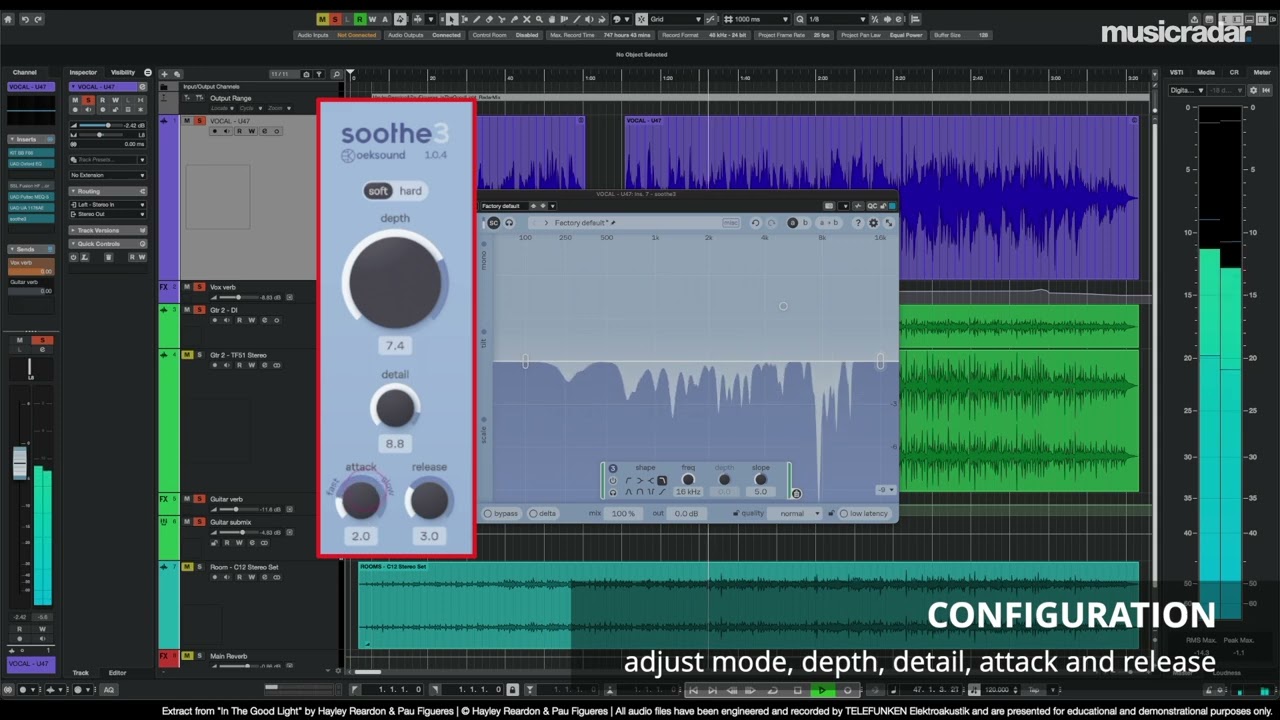
To that end, Soothe3’s Soft mode now senses resonances based on their strength relative to the overall spectrum at any given moment. This makes the processing threshold entirely independent of input level, thereby ensuring resonance control is independent of dynamic variations in the audio. As a result, processing is more musical and transparent, and setup time is reduced (just turn the large and inviting Depth dial!) Hard mode retains the more compressor-like response of Soothe2, making it ideal when it comes to applying sidechaining tricks such as de-bleeding and de-masking.
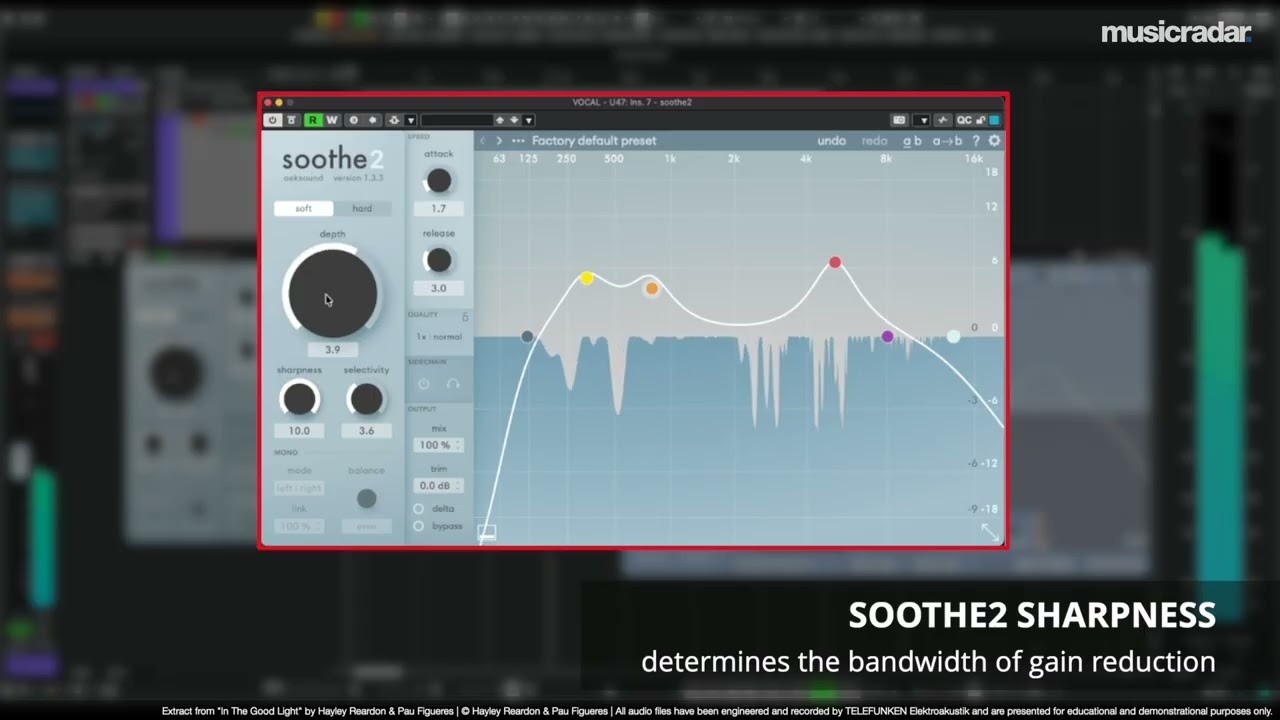
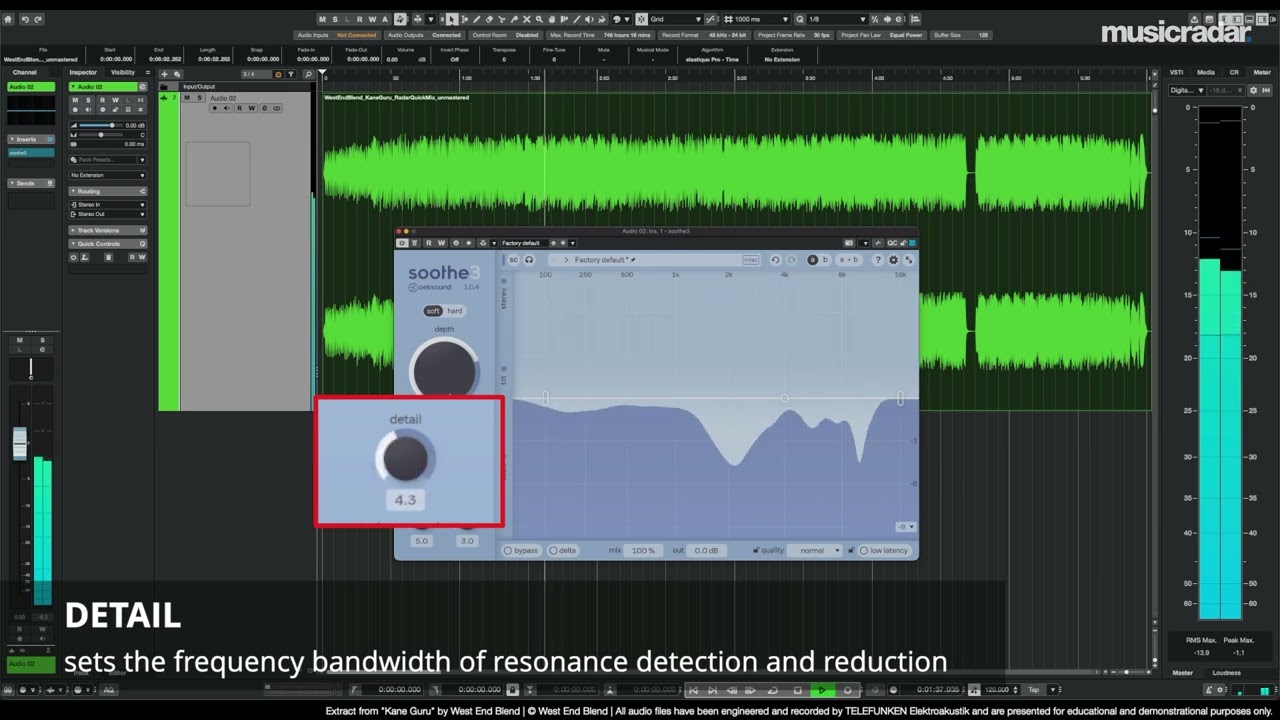
Soothe2’s Selectivity and Sharpness controls, which determine the frequency bandwidth of detection and processing (respectively), have been combined into a single Detail dial. As Atte explains: “We felt that the Selectivity control was important, but often either difficult to understand or didn't yield wanted results. So we decided to do a deep dive into how this aspect should be controlled, and we ended up at the single Detail control.” This new control saves a huge amount of time, and makes you wonder why control over the frequency focus of detection and gain reduction were ever presented as separate controls in the first place.
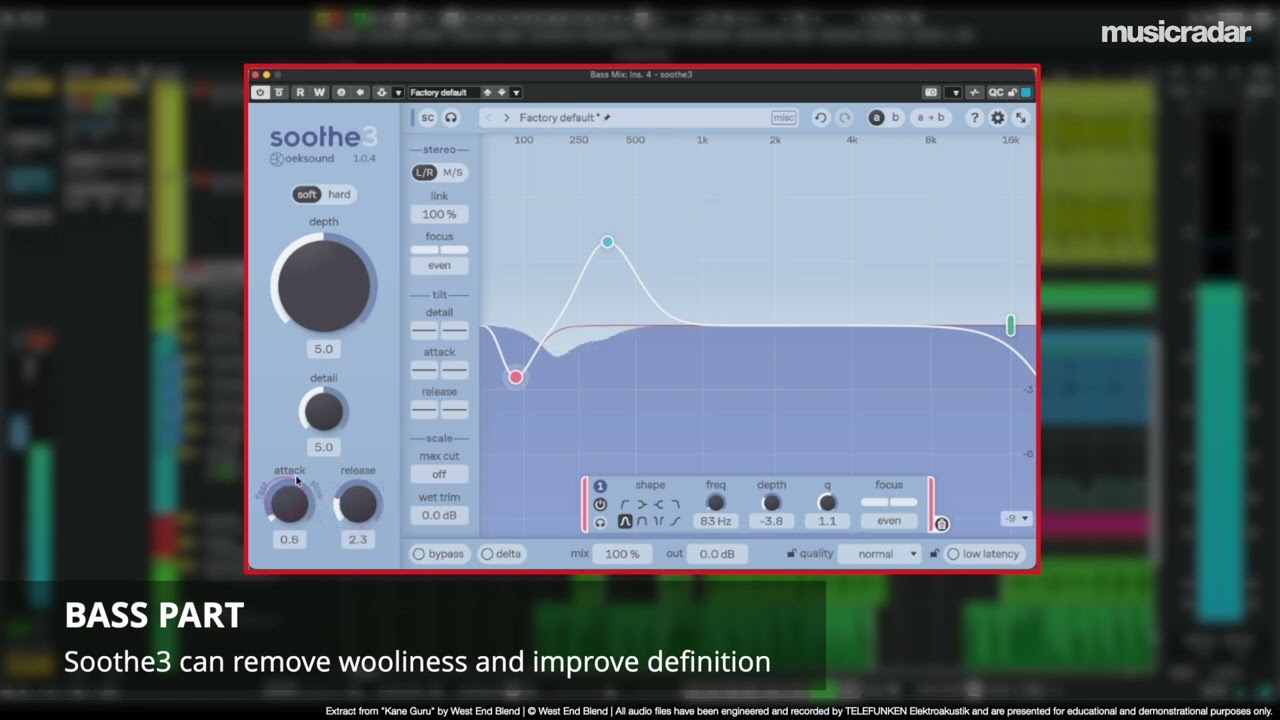
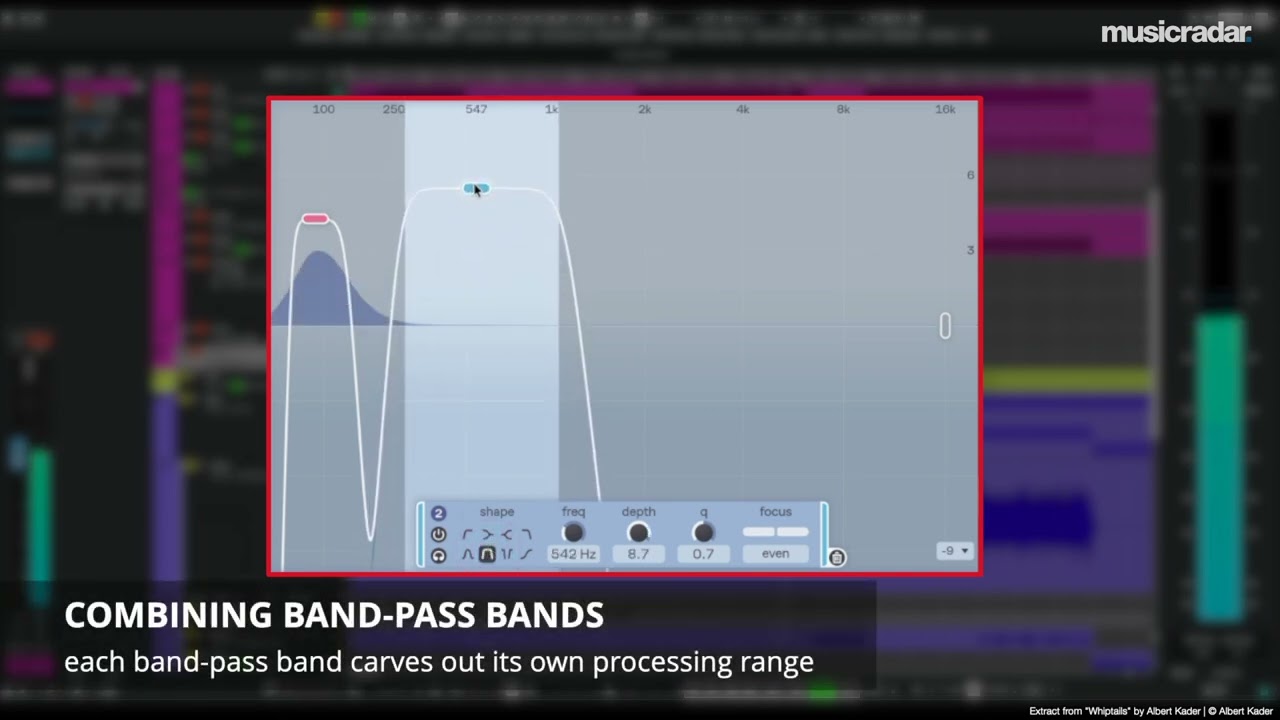
Where Soothe2 has a fixed set of six sensitivity bands – high-pass and low-pass filters plus four variable bands – Soothe3 can now freely add and remove bands up to a maximum of eight, and each band offers a free choice of eight band types. New here, and replacing the band-shelf mode, is the band-pass mode.
This focusses the sensitivity in a specific frequency range while leaving the remainder of the spectrum entirely unprocessed – essentially the same as using a paired high- and low-pass filter. Adding additional band-pass bands creates additional sensing and processing ranges, but any other band type falling outside of the range of that band will have no effect.
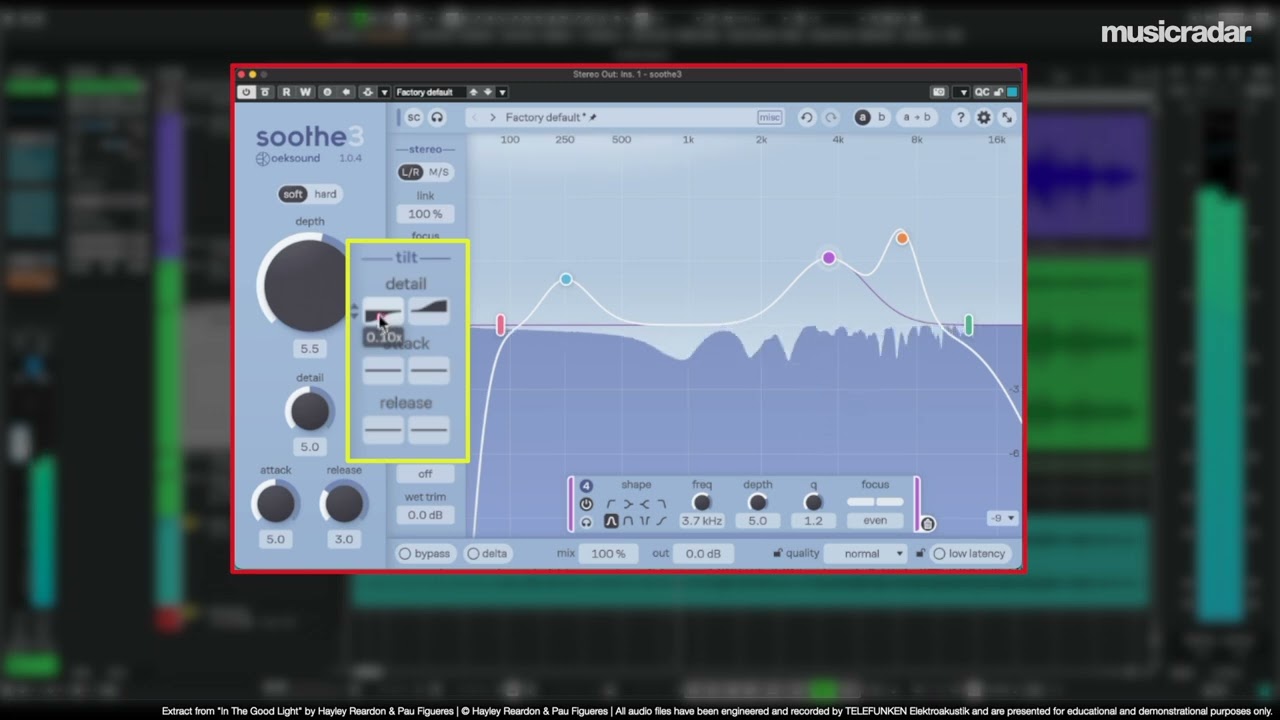
The tilt band type is also gone, but has been reimagined as the all-new Tilt feature. This lets you apply tilt – that is, a positive or negative ramping of strength – to the plugin’s Detail, Attack and Release parameters.
The tilt for each parameter is split into two, one part affecting low frequencies from around 500Hz downwards, the other affecting high frequencies from around 2kHz and up, and each tilt part can produce either a positive or negative ramp. So you can, for example, have progressively slower attack times for both low and high frequencies, or increase the Detail in the low end while reducing it in the high end. This is far more versatile than the old tilt band mode, yet also manages to be more intuitive and understandable.
Soothe3's low-latency mode
As mentioned, Soothe3 boasts a low-latency mode, and this impressively allows the plugin to run with 0ms latency when operating at 44.1kHz/48kHz sample rate, and just 1ms at higher rates. Of course, you do still have to take your own audio I/O latency into account, but nevertheless, this is a game-changer.
In the studio, it means being able to deal with unwanted mic artefacts at source – handling noise, proximity effect, de-essing and popping, and even bleed from other sources, but what’s really exciting are the live applications. Alongside giving venues all of the tonal and sonic benefits that studio-based users have come to love, we’re struggling to think of a better way of suppressing feedback and quickly compensating for the Mobile Flesh Baffle effect (the difference an audience’s size and position can make to the sound pumping from a PA rig).
Support for multichannel surround up to a 9.1.6 configuration will make Soothe3 even more invaluable in TV and film post-production than its predecessor. Each output group (LR, LFE, Centre, Surround, etc.) can be independently enabled and has its own Depth setting, which makes a lot of sense – after all, you probably don’t want the same amount of low-end control on the LFE channel as on the main LR channels, for example.
There are various other smaller changes, such as a Max Cut setting, which defines the maximum gain reduction that can be applied to any frequency, a linear phase mode that helps with parallel processing setups at the cost of a little latency, and a streamlining of the plugin’s performance controls with separate settings for realtime and offline processing.
What's behind Soothe's success?
Soothe’s particular way of shaping the spectrum and taming errant frequencies, combined with the transparency of its processing, is quite unlike anything else and can be exceptionally useful at every stage of production. You can overcook things with Soothe, but it’s pretty obvious when you do, and very easy to back off the extreme settings… unless you like how they sound!
Applied to individual tracks and parts, Soothe can mitigate unpleasant acoustic resonances, de-ess sibilant vocals and de-squeak acoustic guitars, control mic pops and handling noise, dial out unwanted mic response characteristics, and even reduce mic spill.
When creating mixes and sub-mixes, Soothe does a much better job of calming frequency build-up than does a dynamic EQ, and can also be helpful in dealing with frequency masking problems.
At the end of the chain in mastering and post-production, Soothe provides a unique means of cleanly modifying problematic frequencies and adding cohesion in a way that’s more focussed than a broadband compressor, more effective than a dynamic EQ, and more sonically transparent than either.
Despite its many talents, though, Soothe isn’t a magic wand. It can’t repair a bad recording, it can’t add life to a dull performance, and it won’t make an ineptly-mixed track sound professional.
What it will do, however, is help your audio sources stand out in their own spectral and sonic space. It can address rumbles, boominess, honkiness and harshness, it can transparently shape a source’s tone without wrenching it through an EQ, and – when configured just right – it can make the difference between a decent mix and an amazing one.
The tracks used in this article were sourced from Telefunken Elektroakustik's Live From The Lab series and the Cambridge Music Technology multitrack library, both of which offer producers a catalogue of downloadable multitracks to practice their mixing skills.
We'd like to thank Telefunken, Cambridge MT and the artists involved, Hayley Reardon, Pau Figueres, Albert Kader and Remember Jones, for allowing us to host their music.