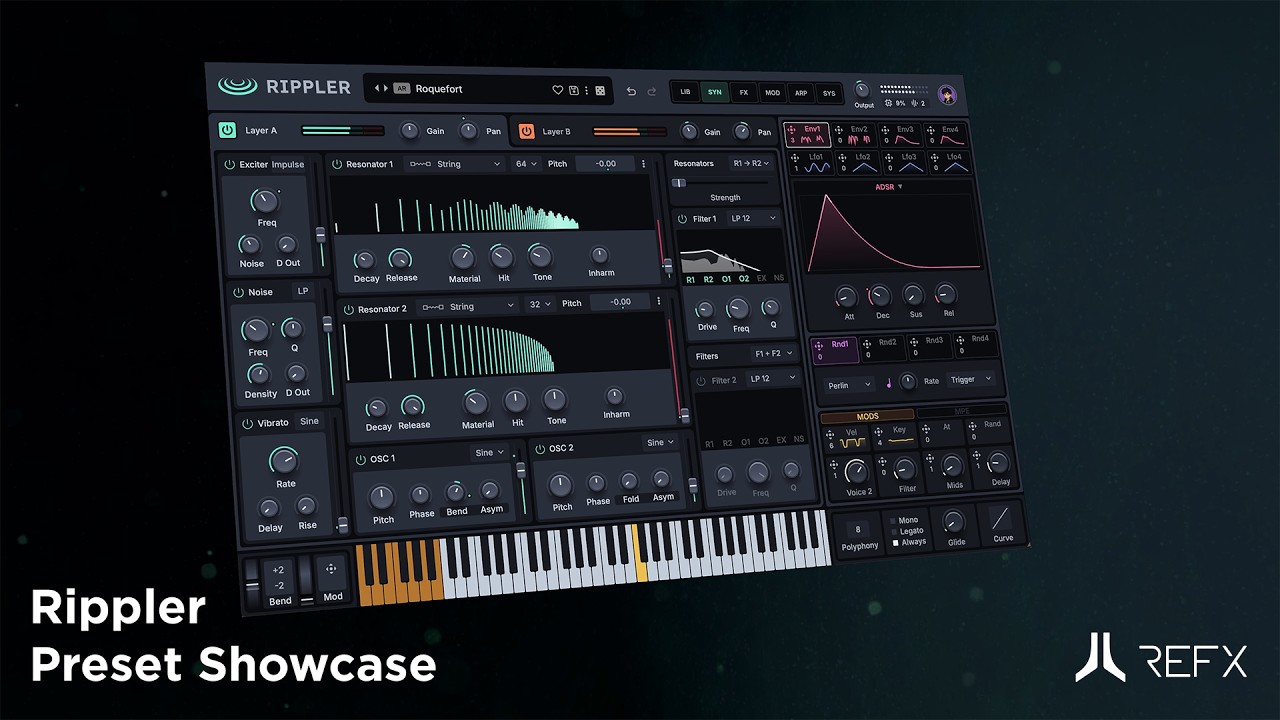
ReFX, the developer behind the Nexus virtual instrument, has announced the release of a new hybrid software synth that brings together physical modelling and subtractive synthesis with a broad array of additional features and capabilities.
Physical modelling synthesis is a technique that can emulate the acoustic properties of physical objects and instruments, or be pushed to create experimental sounds that reimagine real-world timbres in new and creative ways.
Like many physical modelling synths, the architecture of Rippler’s sound engine is based on exciters and resonators: the exciter is the initial input that triggers a sound – analogous to the pluck of a string or the strike of a drum – and the resonator emulates the body that the exciter vibrates, which determines the pitch and character of the sound.
In its Exciter section, Rippler gives you the choice of 32 onboard samples, user-imported samples, sidechain input or a custom impulse editor to shape its initial signal, and there’s also the option to use a noise generator to feed the resonators, alongside the exciter or on its own.
These run into dual resonator modules, which feature a choice of 12 models that simulate different acoustic instruments and objects: String, Beam, Squared, Bell, Membrane, Plate, Drumhead, Djembe, Vibraphone, Marimba, Closed Tube, Open Tube. These can operate in parallel or in series, the latter mode using bi-directional coupling to let the two resonators exchange energy as they would in an acoustic instrument.
There’s also a Manual resonator mode that replaces the physical model with a custom partial series that can be drawn in by hand, and lets you store resonator configurations as snapshots and morph between them in real time.
Rippler is also equipped with two conventional oscillators with Phase, Fold and Asymmetry controls that can be layered with its physically modelled output to “blend, enhance or solidify your sound”. Both these and the physical modelling engine pass through dual filters, which offer a choice of 27 filter types spanning low-, high-, band-pass and notch filters with multiple slopes, along with vintage-style models, ladder types and a formant-shifting Vowel filter.

This entire signal path can be duplicated, giving you two layers each made up of dual resonators, oscillators and filters, all running into the effects and master output. Speaking of effects, Rippler features a broad selection of 13 effects covering delay, reverb, chorus, compressor, distortion and more, which can be applied per-layer or globally. There’s also a sophisticated arpeggiator and sequencer onboard with modifier lanes that introduce variation to pitch and velocity.
Modulation comes courtesy of four LFOs and four envelopes with 64 LFO shapes and multiple envelope types, alongside four macros, random generators, velocity, key-tracking and aftertouch. All of this can be routed via a mod matrix with custom mapping curves, and Rippler will also play nice with MPE-compatible controllers, which can be used as a mod source for expressive performances.
Rippler is descended from RipplerX, a free and open-source physical modelling synth from developer Tiagolr, who has partnered with ReFX to develop and release a commercial successor.
Rippler is available now in VST3, AU and AAX formats for macOS 10.13 or later and Windows 10 and 11. It’s currently priced at an introductory price of $99 and ships with 441 factory presets. A 30-day free trial is available.
Find out more on the ReFX website.