


It’s 40 years this month since Paul Simon’s Graceland was released, and in an era when the sun is slowly setting on the long playing record, it’s hard to recall the dust kicked up by that one album.
Much of the discourse revolved around Simon’s breaking of the cultural boycott of South Africa and whether its immense success (16 million copies sold) and the exposure it gave to Ladysmith Black Mambazo, South African music and so-called ‘world music’ (a term that itself is now viewed as anachronistic) as a whole justified Simon’s original offence.
For better of worse, Graceland became known as his South African album. But it was only partially recorded inside the country. Indeed, its lead single You Can Call Me Al, was put together entirely at the Hit Factory in Simon’s home city of New York.
The lyrical idea for the track came from a party that the singer and his then-wife Peggy Harper had attended. The French conductor Pierre Boulez was at the same gathering and mistakenly addressed Simon as ‘Al’ and Peggy as ‘Betty’. This amused Simon no end and was the spark for a song that alighted on a man experiencing a midlife crisis of some sort.
Simon didn’t have far to look for inspiration. The early 1980s were a tough period for him. His previous album, 1983’s Hearts And Bones, had flopped completely, his marriage to Carrie Fisher had disintegrated and - like many of his generation - his music was increasingly seen as all a bit old hat in the fast-moving, go-getting 1980s. Speaking in 2010 to his biographer Marc Eliot, he recalled: "I had a personal blow, a career setback, and the combination of the two put me into a tailspin."
Al’s first two verses feature a character dealing with some sort of personal disappointment. The man wants ‘a shot at redemption’, asks ‘why am I short of attention’ (note the double meaning), laments that ‘my nights are so long’ and asks‘where’s my wife and family?'
In a 1990 interview with Song Talk magazine, Simon broke the song down: "You Can Call Me Al starts off very easily with sort of a joke: 'Why am I soft in the middle when the rest of my life is so hard?' Very easy words. Then it has a chorus that you can't understand. What is he talking about, you can call me Betty, and Betty, you can call me Al? You don't know what I'm talking about. But I don't think it's bothersome. You don't know what I'm talking about but neither do I. At that point.
“The second verse is really a recapitulation: A man walks down the street, he says... another thing. And by the time you get to the third verse, and people have been into the song long enough, now you can start to throw abstract images. Because there's been a structure, and those abstract images, they will come down and fall into one of the slots that the mind has already made up about the structure of the song.”
Of course, the third verse is where the character finds his redemption on the street ‘in a strange world’. Here he is a complete outsider but is enchanted by ‘the sound, the sound’ and decides to surrender to it: ‘Amen and Hallelujah!’
It’s hard not to link this to Simon’s own experience early in 1985 when he travelled to Johannesburg and played jam sessions with a number of SA bands. He and his long-standing engineer Roy Halee developed melodies, built up grooves and laid the foundations for Graceland.
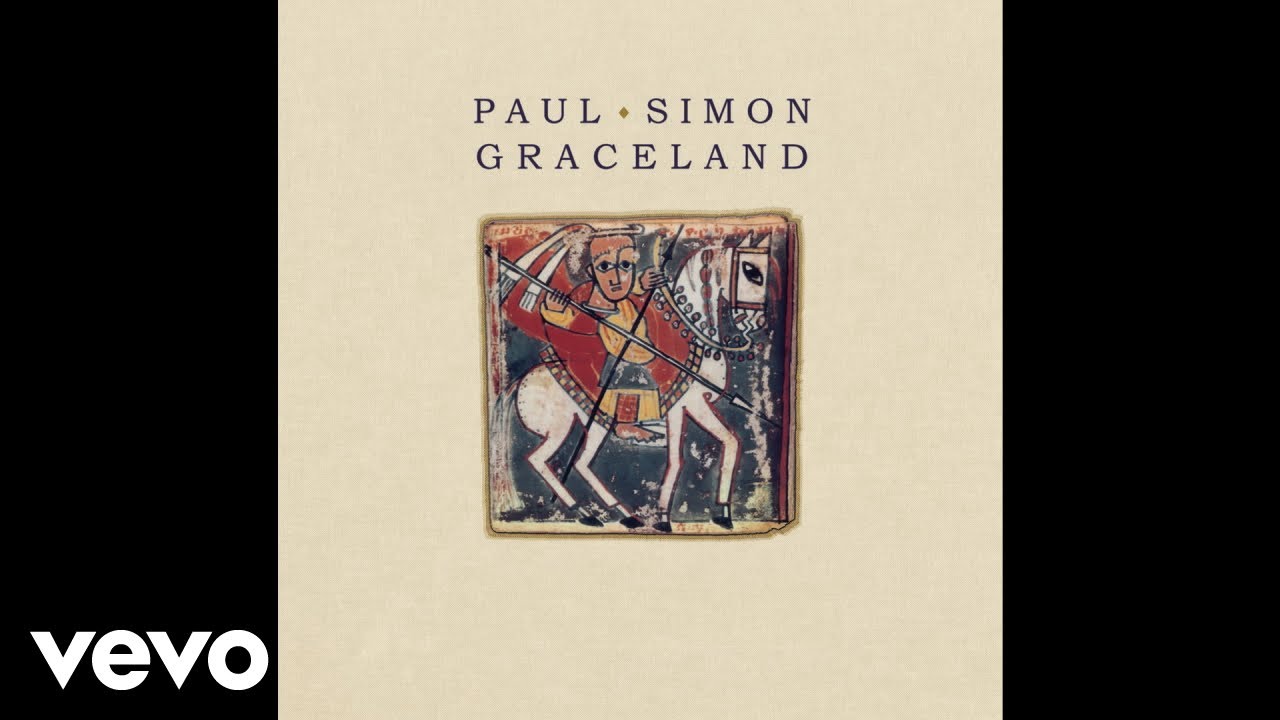
Back in New York, Simon and Halee edited the material and began to shape the album. Several of the South African musicians were flown in to the Sound Factory, as were established session players such as Adrian Belew.
The guitarist was specifically asked to bring his latest gadget – the Roland GR-700 guitar synth: cutting-edge mid-'80s tech that could store sounds like a Fairlight.
Speaking to the Music Aficionado blog in 2020, Belew remembers being baffled when he heard what Simon had recorded in South Africa: “I honestly thought Roy had mistakenly put up the wrong master tapes because what I heard confused me. It was obviously some sort of South African music, not Paul Simon music. As usual there was no singing on the tracks yet. I sat there quietly listening, slightly embarrassed for Roy, but just then Paul arrived.”
Simon then sang along to the music that had been recorded: “He began singing phrases right into my ear, so close to me it gave me chills! It was a remarkable experience having Paul Simon singing quietly in my ear. I realised then he had made a major transition in his work.”
Belew agreed to offer his bank of sounds for use on the project. “We spent four days, just Roy, Paul, and me pouring over my 200 synthesizer sounds to find things which fit the songs. Paul was very detailed and painstaking in the parts he asked me to play.”
For You Can Call Me Al, Belew’s synth contributed a saxophone section. “I had written a variety of saxophone emulations from baritone to alto which had a realistic yet unorthodox quality. He spelled out each part exactly as he wanted them for the iconic beginning of the song. They may have added real saxophones later but my synthesized saxophones are definitely there as well. I’m sure very few people realise that.”
One problem was the fact that, like many of the songs on Graceland, You Can Call Me Al has a very complex vocal, which when combined with the busy, detailed backing, spelt trouble. Which is where Roy Halee came into his own. Speaking to Sound On Sound in 2008, Halee recalled thinking: "We've got to make this work."
"What I came up with was a tape delay feeding the left channel and a different delay feeding the right," he says. "All of a sudden his vocal receded into the track, at least to some degree, and we could understand the words! Don't ask me why, but it worked, and I couldn't have done that with an echo chamber or EMT 140. In fact, remove that tape delay from You Can Call Me Al and, what with all of the sibilance, pops and other little mouth noises against what was going on in that track, the vocal would be unintelligible.
"It's about the material being well recorded and using the leakage to your advantage. How many times throughout my career have I heard, 'Oh, that's OK, we'll fix it in the mix'? In a lot of cases you can't fix it in the mix."
One of the song’s most memorable features was the two note fretless bass solo that gives way to the coda. This came courtesy of South African bassist Bakithi Kumalo, who had travelled to New York to play on the album in May 1986.
When the group reached the breakdown in the song, Kumalo asked if he could improvise a little. "I said, 'Paul, it's my birthday today. Can I just play a little bit more on the part where there's a break?'" he recalled to For Bass Players Only in 2012. "And Paul said, 'Go ahead. If it's good, we'll keep it.'"
On the spot, the bassist came up with a snake-like lick that adds a cherry on top of what is already an infectious song. "I just played, and they loved it. It was one take," he said. "Listening back, I didn't know what happened; I thought it was from God, you know? I never planned it."
Then Halee reversed the first part of Kumalo’s lick and spliced it to the second half, creating a figure that was impractical for the poor bassist to replicate live. "People have tried to copy those licks," Simon mentioned to Guitar World in 2023. “But it’s impossible.”
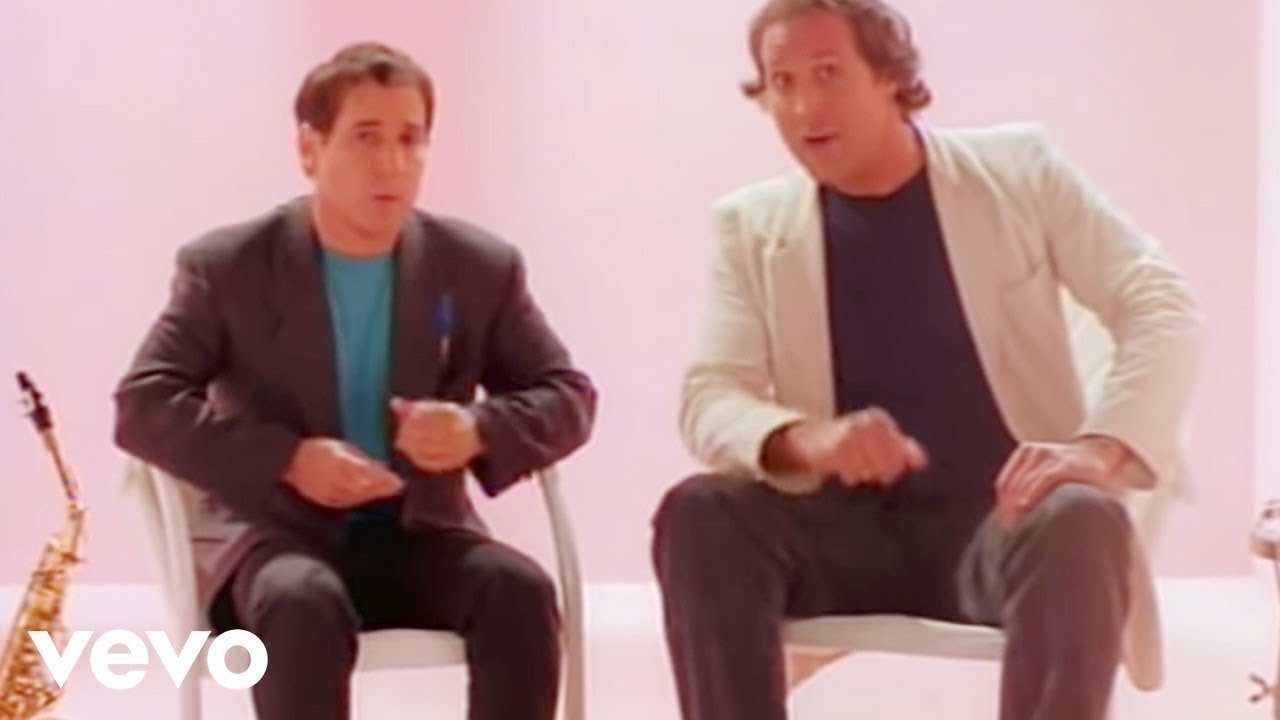
The lead single from the album, You Can Call Me Al was released in the July. In the US initially it could only reach a disappointing 44. It was in the UK – where it made Number Four and was Simon’s biggest hit since Bridge Over Troubled Water - that it piqued listeners’ interest, helped enormously by its playful video. All of us above a certain age remember Chevy Chase lip-syncing Simon’s vocals whilst the song’s author plays various instruments featured on the track.
It was the key to Graceland's success. Released at a time when non-western music was also making inroads into the consciousness of the mainstream media, and pressure on the South African apartheid regime was ratcheting up, the album became a sensation – one of the cultural talking points of 1986 and 1987. Eventually, after winning the Grammys for Record and Album of the Year and reaching Number One around the world, Al finally showed up in the Billboard Top 30, peaking at Number 23 in May 1987.
In an era when we’re all familiar with the phrase ‘cultural appropriation’, controversy still dogs Graceland. Aside from the breaking of the cultural boycott, there were allegations that Simon failed to sufficiently credit other guests on the album, most notably Los Lobos and the zydeco band Rockin' Dopsie and the Zydeco Twisters. But at its best – on the title track, The Boy In The Bubble and indeed You Can Call Me Al - Graceland transcends all that and turns one rich man’s midlife crisis into a joyful knees-up: no mean feat.
