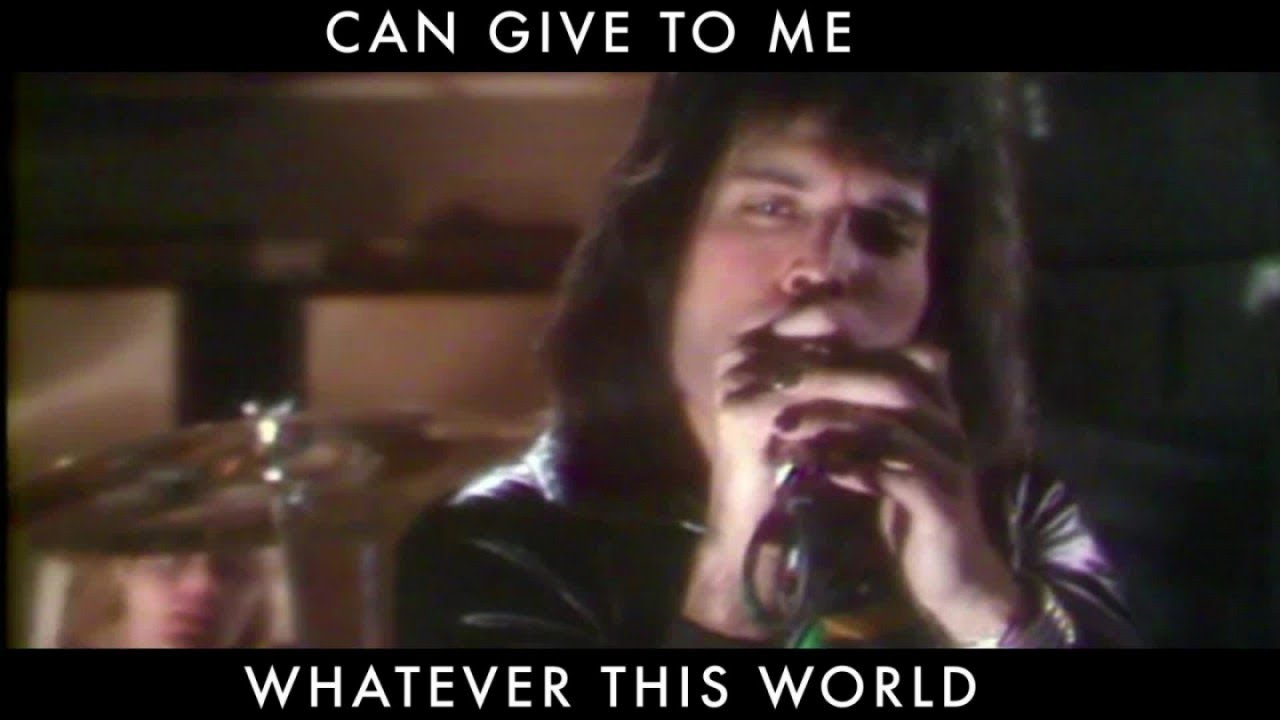
An unprecedented epic - and obviously one of the most audacious singles in pop history - Bohemian Rhapsody not only cemented Queen as a global mega-band, but also demonstrated how the very recording studio could become an instrument in itself - albeit in conjunction with the galaxy-sized talent of Queen’s four members.
The well-documented power struggle between the band and their label EMI on whether it was wise to release Bohemian Rhapsody as a single is now a thing of rock legend. It was mainly thanks to heavy airplay from celebrities such as Kenny Everett that lead to it eventually being put out as a single.
Had that not happened however, then the other option (later switched into being Bo Rap’s follow up) was the far safer bet of You’re My Best Friend.
Penned by John Deacon as an ode of dedication for his wife Veronica Tetzlaff, this second single from Queen’s 1975 opus A Night at the Opera was also a significant hit in both the UK and USA, and laid bare the wider talents of Queen’s bassist.
Although he had previously written Misfire for 1974’s Sheer Heart Attack, You’re My Best Friend announced clearly to the world that Queen's bass-man could also come up with the goods when it came to writing singles.
With a roster of further hits that would include Another One Bites the Dust, I Want to Break Free and (the co-written) One Vision and Under Pressure, You're My Best Friend was the first of many ‘Deacy blinders’ you might say…
Freddie Mercury later remarked that Deacon’s songwriting style had an almost Tamla Motown sensibility to it.
However, the song’s intrinsic electric piano sound left Mercury cold. In fact, he was quite vocally anti-electric…
“I refused to play the damn thing [the electric piano]. It's tinny and horrible and I don't like them,” Mercury stated in an interview with the BBC in 1977. “Why play those things when you've got a lovely superb grand piano?”
“Well, Freddie didn’t like the electric piano,” Deacon told BBC Radio One, “so, I took it home and I started to learn on the electric piano and basically that's the song that came out. I was learning to play piano. It was written on that instrument and it sounds best on that, you know, often on the instrument that you wrote the song on.”

Written as a fairly straightforward love song, Deacon largely kept things as lyrically unambiguous as possible.
However, despite being infused with the expected sweet proclamations of love, Deacon emphasises that often under-appreciated cornerstone of every long-term relationship.
Friendship.
In his lyric, even love itself plays second fiddle to this vital need. Something he recognises in his own marriage.
Oh, you're the best friend
That I ever had
I've been with you such a long time
You're my sunshine
And I want you to know that my feelings are true
I really love you
Oh, you’re my best friend
Looking at the song on a musicological level, and there are several noticeable hooks within this song but one of the most recognisable of all is the introduction.
Deacon wrote the chord sequence while sat at a Wurlitzer EP-200 electric piano (not a Fender Rhodes). He soon became wedded to the striking, forward bite of the sound.
Based in C Major, Deacon holds a tonic C pedal, which is the technique of playing the keynote (C) in the bass, while the harmony above moves.
The upper harmony shifts from Dm to C, with each being held for a bar. Possibly because of Deacon’s playing style at that time, the upper harmony adopts a basic voicing, based around root position triads.
The introduction demonstrates a very recognisable sound, due to the way that the Wurly bass is played and constructed. The note C is played in octaves, with the upper note pre-empting the entry of the lower octave, which thuds away on each beat of the bar.
Electric pianos, such as the Wurly, generate a degree of distortion as a consequence of the way that the sound is amplified, this leaves it with the distinctive sharp-edged colouration that we know and love.

In classic Queen fashion, the first vocal entry arrives via rich harmonised backing vocals, which follow the Wurly's upper harmonies, while Mercury’s lead vocal takes the centre ground.
One interesting point though relates to the overall structure of the song. It does not appear to conform to the usual verse/chorus pattern, at least not at first listen.
There is a definite case for the opening of the song as being the most enduring and effective hook in the arrangement, yet it is generally agreed that the opening 2-chord structure is the song's verse.
After several repetitions of the Dm/C and C sequence, the harmony goes on an excursion, modulating down to the relative Am (via G/B), cycling through chords of D, F, G, before repeating as a section. We then migrate to E/G# and back to Am, before landing on F and ultimately Fm6.
It is this busier harmonic section which feels like it fulfils the role of chorus. After all, once we reach the final chord of Fm6 (which is left hanging beautifully), that's the point where we hear the name of the song in the lyric.
But this is not your typical chorus by any stretch of the imagination. There is an argument that it is more through composed, more in the style of a jazz standard, rather than classic pop. As Mercury later noted, you can clearly hear the spirit of the old masters of Motown and Atlantic.

Another highly identifiable element of this song relates to its triplet feel, also described in western musical circles as a 12/8 time signature, or a triplet-shuffle. This is where each beat of the bar predictably has three subdivisions.
This rhythmic relationship is a relatively critical element in how the song works. There are a lot of ‘pushes’, which is the musical technique of playing slightly ahead of the beat, normally on some form of subdivision before a main beat. In this case, we hear it from the very first note, as the C on the Wurly interjects, ahead of the main beat.
It’s a central component of the chorus chord sequence too, where pushes are continually used, accentuated by kick and cymbal crashes.
Meanwhile, the bass part (played by Deacon on a Fender Precision Bass, DI’d into the desk) is incredibly melodic, with fast, fluid movement in the higher registers. It adds a gentle, supportive tone to the mix.
The laid-back feel of Roger Taylor's drum performance is notable too. The half-open hats tend to play on each beat, with the snare tending to land on beats 2 and 4. The kick adopts little skips, totally in keeping with the 12/8 feel, although this time signature becomes all the more apparent with each fill, where he often emphasises the subdivisions across the kit.
Of course, we also have to mention the extraordinary guitar and vocal work, which becomes more entwined as the track develops, particularly towards the end, where Brian May constructs a number of solo guitar lines with his Red Special, which compile to complete the harmonic picture across a further chorus section.
By normal Queen standards, Freddie's lead vocal performance is more reflective here, supported by the densely layered backing vocals, a hallmark of Queen.

Behind the theory of just how this song works, there’s also the fact that it's beautifully simple - or at least feels like it is.
From the opening Wurly piano intro, it’s a track that immediately makes the listener feel positive.
Unlike 1975-era Freddie, we love the Wurly. Can you imagine the iconic intro being played on any other instrument?
You're My Best Friend stands among Queen's most heartfelt compositions of all time, alongside that other Night at the Opera gem Love of My Life of course.
Crucially, it's arguably the first wide-appeal, full-blooded pop song that the band wrote, and it was John Deacon who showed them the formula…
“He didn’t write that many but if you think about it, Another One Bites the Dust, You’re My Best Friend, I Want to Break Free, they were big, big hits,” Brian May said in the Classic Albums documentary about the making of A Night at the Opera. “You’re My Best Friend is still one of the most played tracks on American radio."