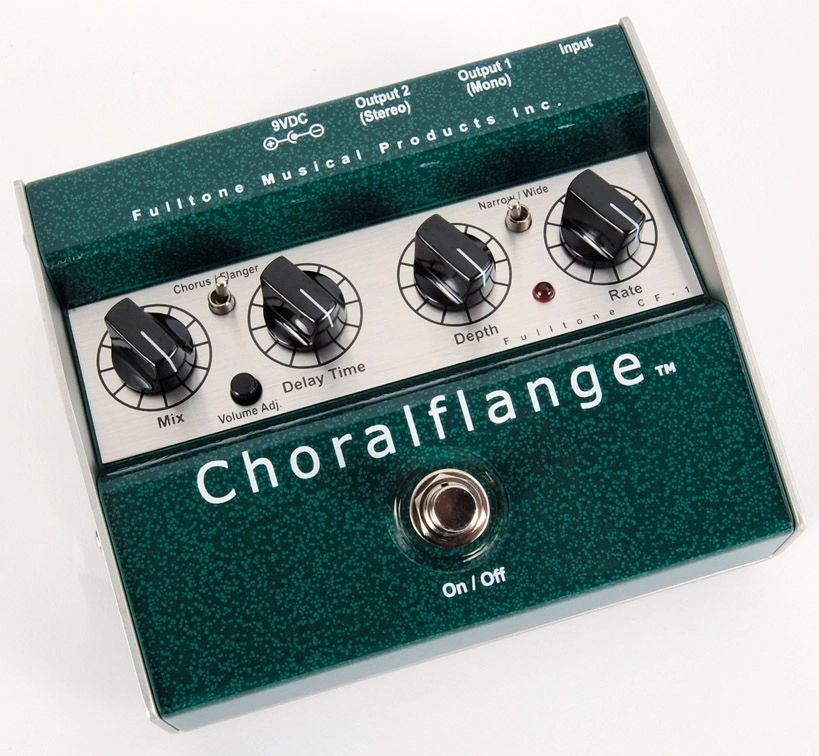
The thing about modulation effects is that they have almost no parallels in nature. In fact, the closest approximation to flanging in the real world is a low-flying jet aeroplane skimming a concrete jungle (so much so that almost every single explanation of flanging you'll ever read uses this example), and that's about as close to natural as any of these effects really come.
Consequently, they fall into the category of effects that we like to call 'special'. Why? Because, with a very few exceptions, any time you use them they will be very apparent and are nearly always meant to be noticed (there are very few reasons you might add them to impart realism and subtlety). As with any such effect, they can become tiresome very quickly, so restraint is the name of the game. We wouldn't recommend you try all of the forthcoming suggestions and techniques in one track, but don't let that put you off trying them all at some point and coming up with some of your own. With that in mind, we've put together a selection of tips to get you thinking about some creative (or useful) applications for these potentially extreme effects...
Modulation tips
1. Modulation effects will almost always take away from the sense of presence of a sound at the same time as they give it size and space, so be careful what you use them on. Used on lead elements they'll detract from energy and prominence in most mixes.
2. To counter the tendency of chorus to push sounds into the background, try applying it only to the reverb send signal - or insert it into the reverb bus itself. This gives some lush thickness to the sound, but will allow you to keep the main sound upfront.
3. If your phaser or flanger enables you to sync its modulation action to track tempo, be sure to do so, as you can set up some nice cyclic patterns (over eight bars, for example), which make the effect much more useable and easy to manage when mixing your track.
4. Try playing with the modulation rate on your phaser. Slow speeds create nice long sweeps, while much faster speeds can have a great old-school rotary cabinet effect. You can even alternate between the two, or have one panned left and the other right.
5. If you're after a classic ensemble effect, take a leaf from the synth programmer's book and use a pitchshifter in detune mode to generate another version of your signal, slightly detuned from the original. This avoids the distinctive cycling of the LFO.
6. The sound of the electric guitar is, quite simply, the sound of the effects being used on it, and some of the most enduringly popular are chorus, phasing and flanging. So if you're ever working with an electric guitar riff, you'd be crazy not to at least try one or all of them.
7. Modulation effects all rely on a very critical wet/dry balance, so it's generally more convenient to use them as insert effects rather than as part of a send and receive effects loop. They should also usually come near the end of an effects chain (ideally, penultimate).
8. A great way to get more useable and musical results from the unpredictable and usually severe sounding ring modulator is to mix in some (or a lot) of the unprocessed main signal. Taken to the opposite extreme, the ring modulator output can be used as nothing more than a backing layer.
9. Percussion loops and individual drum hits can sound fantastic when run through ring modulators. Try combining snares, hats and cymbals for some very electronic and bizarre techno percussion sounds.
10. Most modulation effects (particularly phasers) will create significant fluctuations in the signal level of any channel to which they're applied. To counter this, add a compressor immediately after the inserted modulation effect, thus flattening the level slightly.
11. Ring modulation effects require simultaneous signals to generate any noise whatsoever, so if your ring modulator accepts two external signals you might want to add a compressor to each, just to be sure of constant sound output.
12. Phasing can be just the ticket for taking the edge off harsh sounds and frequencies. Try some subtle phasing on your lead synths and guitars - it can soften them up and help them fit into a mix. It's also great for softening distortion effects.
13. For classic chorus, flanging and phasing effects, the best initial wet/dry balance is 50/50. Using this as your starting point, try shifting the balance, and you'll find that you usually end up back on the halfway line.
14. Some phasers enable you to set a frequency floor and ceiling, above and below which the phasing of frequencies is disabled. If yours does, try narrowing the range to around 300Hz-5khz, as this will offer the greatest audible effect without significant volume fluctuation.
15. Almost any modulation plug-in can be used as a stereo width effect, simply by offsetting the modulation of the left and right channels. As one peak is reached, the other side is in the trough - just as with tremolo.
16. Don't forget to automate your controls. By their nature, modulation effects are very in-your-face, so listeners can get tired of them pretty quickly. Turn this to your advantage and only use them at certain times - or at least lessen their effect in parts.
17. If your flanging is too subtle, try turning the feedback up nice and high - this will intensify the whooshing effect that we all know and love (blame Van Halen for that one...)
18. If your phased enables you to set the delay time manually, you can use this to shape the sound. Shorter delay times make for more high frequency action and a thinner sound. Lengthen them and the sound is fatter and more focused on the lower frequencies.
19. You can use chorus and other modulation effects to generate some fantastic stereo effects by panning the dry signal to one side and the effected signal to the other side. The resulting effect can be used to give width to a sound, to help it blend into a mix, or to add dynamic excitement.
