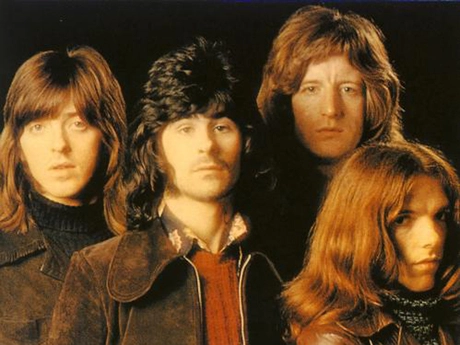

Badfinger, straight up in 1972. From left, Joey Molland, Tom Evans, Pete Ham and Mike Gibbens.
In the world of rock 'n' roll hard-luck stories, the tale of Badfinger borders on Shakespearean tragedy, with not one but two members (singer-guitarist Pete Ham, and singer-bassist Tom Evans) committing suicide, eight years apart.
As the first band signed to The Beatles' Apple Records, Badfinger - or The Iveys, as they were called at the time - appeared to have the brightest of futures. Paul McCartney wrote and produced their breakout single, Come And Get It (for the soundtrack to the movie The Magic Christian, which starred Peter Sellers and Ringo Starr), and over time, various members of The Beatles' inner circle - including John Lennon and George Harrison themselves - came to work the group.

During the four-year-period of 1970-74, Badfinger (Ham, Evans, drummer Mike Gibbens and guitarist Joey Molland) racked up a string of classic pop-rock hits, including No Matter What, Day After Day and Baby Blue. In addition, the Ham/Evans composition Without You, which appeared on the band's second album, No Dice, would become a worldwide smash when Harry Nilsson covered it - most definingly, some would say - on his 1971 disc, Nilsson Schmilsson.
But bad business dealings - the group had entrusted their financial affairs to an American businessman, Stan Polley, who ultimately swindled them out of millions and left the members all but broke - splintered Badfinger, and in 1975, Pete Ham hanged himself in the garage of his Surrey home. Ironically, eight years later, Tom Evans would choose the same desperate manner for his final exit - his widow, Marianne, was quoted as saying that the bassist wanted to join his friend and former bandmate in "a better place than down here."
At least we're left with the music, and what great music it is. Last October, Apple Corps Ltd. and EMI Music reissued 15 key albums from the Apple Records catalogue, including Badfinger's Magic Christian Music (1970), No Dice (1970), Straight Up (1972) and Ass (1974), all with bonus tracks. The CDs are available individually or as part of the Apple Records Box Set (which also includes titles from James Taylor, Mary Hopkin, Billy Preston and Jackie Lomax, among others).
As the lone survivor of Badfinger's classic lineup (there have been several reunion and touring outfits over the years, some of which included drummer Gibbens, who died in 2005), Joey Molland has done much to keep the band's name and reputation afloat - he continues to perform Badfinger songs at solo shows around the globe. MusicRadar recently spoke with Molland at his home in Minnesota about Badfinger's glory years, what it was like to work with members of The Beatles, and ultimately, what went so horribly wrong for a group that seemed to have - for a short time, anyway - the world at its feet.
You came in a little late to Bandfinger. How did you join the band?
"They had done the songs for Magic Christian, and right at that time, their bass player, Ron, decided to leave the band. They were still called The Iveys, and Tommy Evans was playing guitar. So when Ron left, Tommy switched to bass, and they started looking for a guitar player. They auditioned a bunch of fellows, but somebody told them I was the man for the job."
I have to imagine this was a fairly coveted gig, what with the connection to The Beatles and Apple.
"It was, but you know, I was kind of blasé about it at the time. More than blasé - I almost passed on it. They rang me up through a friend, and I remember saying, 'Ah, The Iveys, I don't know…' Because I'd seen them on TV, and I thought they were a little twee. I was more into rock 'n' roll and beat music, harder stuff. So even though it was a good opportunity because of The Beatles factor, my first instinct was to not get involved. But my friends talked me into going to the audition, and once there, I thought the guys in the group were very decent fellows. So all went well, I passed the audition, and off we went."
What was the Apple organization like? Did you have actual meetings with The Beatles?
"No, no, we didn't have meetings or anything. I never met Paul McCartney. I might have seen Ringo a time or two. I definitely saw John walking around the office, but I didn't have the nerve to speak to him. [laughs] George was the most social and approachable of The Beatles, by far. He'd come up to us and congratulate us on what was happening. And then later, of course, he asked us to play on his All Things Must Pass album. But as far as dealing with The Beatles, that didn't happen. We dealt with Neil Aspinall [former road manager for The Beatles, who later became chief executive at Apple] and Derek Taylor [Apple's press officer] and other people in the organization."
In many ways, Badfinger took a bit of the sound that The Beatles had outgrown, and in doing so, became the pioneers of what became power pop.
"That's true. But it wasn't like we were influenced by The Beatles per se. We came from the same place as them. Tommy and I grew up in Liverpool, just blocks away from Lennon and Ringo. We had hung out in the same clubs and record stores. I remember buying records at NEMS, which is the shop that Brian Epstein used to run.
"Badfinger had the same influence as The Beatles. As kids, we heard Frank Sinatra and all the '40s music, and then when we were teenagers we got into Elvis and Little Richard and Chuck Berry."
Was this because Liverpool was a port city, and the sailors would come back with records from America?
"Exactly! We'd get stuff before a lot of other cities in England. The Beatles and all the Liverpool bands heard American music very fast. They learned how to write songs, and so did we in the same fashion: verse, chorus, verse, chorus, bridge and so on."
In the early days of Badfinger, was their any kind of pressure put on the band to replicate the sound of The Beatles?
"No. The Beatles weren't looking for anybody to carry their flame, as it were. If you look at the artists that got signed to Apple, none of them sounded like The Beatles; they were all very different. So if we did sound a little like The Beatles, that had more to do with our upbringing. Plus, we were working with a lot of their people, guys like Mal Evans [The Beatles' other road manager, who was instrumental in signing The Iveys] and [recording engineer] Geoff Emerick. And later on we were produced by George Harrison himself on Straight Up. He did half of that album with us."
What was it like to work with George in the studio?
"Brilliant! He was a lovely man. In many ways, he'd kind of join the band when he worked with you. He'd bring in his guitar and his Champ amplifier, and we'd knock songs around together. He was very pleasant, but he'd get very involved; he took things very seriously. He rearranged some of the songs, making them completely different from the way the band had been playing them at first."
He played slide guitar on Day After Day. Did he help arrange it as well?
"Oh yeah, it was his arrangement. George borrowed my Strat and did a bunch of different takes playing slide. He was a terrific guitarist, but he spent a lot of time getting things just the way he wanted them.
"To be honest, as much as I liked George and admired him, I was a bit resentful at what was happening to our sound. We were getting too smooth. After Straight Up, it was becoming impossible for us to play our songs on stage. There were too many overdubs - eight acoustic guitars and 16 vocals and everything else. People wanted us to sound like we did on record, and we couldn't do it."
The other half of Straight Up was produced by Todd Rundgren. How did he differ from George?
"Todd was an overbearing egomaniac! I told him to his face that being in the studio with him was the worst experience I'd ever had. George had to leave to work on the Bangladesh album, but he told us that his friend Todd Rundgren was going to complete Straight Up. I'd never heard of Todd Rundgren, but I was game. What a nightmare! The guy came in and was rude and obnoxious. He thought he was just so fucking great, you know? And he wasn't great. He was bloody awful."
You and Tom Evans played on John Lennon's Imagine album, and as you mentioned, the whole band played on All Things Must Pass. Was it weird working with two ex-Beatles at roughly the same time?
"No, they were all fine with one another. At the time I joined up with Badfinger, The Beatles had pretty much broken up anyway. They were just waiting for business politics to get squared away so they could make the big announcement. But as people, they were OK towards each other. If you saw George in the studio, you'd see Ringo, too. And George worked on the Imagine album as well. Plus, I think it was George who told John, 'Hey, if you need some guitar players on Imagine, use the Badfinger guys.' We were thrilled to bits when we got called to play with John. A car got sent around to pick us up, and lo and behold, there we were at Johnny Lennon's house!" [laughs]
What can you tell me about playing with John Lennon?
"It was great! He was just a plain-talking, regular guy. No b.s. at all. Now, of course, he was John Lennon, so he had that energy about him; he kind of lit up the room, you know? But he welcomed us, said he was thrilled to have us, and then he said, 'The first song we're going to do is something called Jealous Guy.' It was pretty amazing, sitting there with your headphones on, hearing John Lennon singing this fantastic song. Totally remarkable.
"Phil Spector was supposedly in the control room, but I never saw him. He never came into the studio and talked to the musicians or anything. Same thing happened on All Things Must Pass. He'd just sit in the control room and drink his Courvoisier. He seemed to like his drinks."
Describe the musical dynamic in Badfinger. You guys had a definite pop side, but on the later records you tried to rock more.
"Yes, and most of that came from me, the rocking part. We had pop hits, sure, and we were proud of them, but we wanted to be known as a rock band. We didn't want to be one of these twee groups like Marmalade. We placed a lot of value in having great songs, but when it came time to hit the stage, we played two-hour shows and got into jams, the whole thing. If you went to see Badfinger, you got a rock show; it wasn't just about seeing this group that had some songs on the charts."
Speaking of hits, what did you think when Harry Nilsson covered Without You and had a number one smash with it?
"It didn't make any difference to us. I remember Harry came to the studio when we were making No Dice, and he introduced himself - he was friendly with The Beatles. I can't remember if we were recording Without You at the time, but I do recall Harry comin' 'round. Well, a year or so later, we got a call to come to a studio in London and listen to this song that Harry Nilsson had just recorded, and it turned out to be his version of Without You. We were all floored. Harry's version was overwhelming.
"It's funny, because when we were cutting Without You, our manager suggested to us that we do a rich arrangement of it like Harry wound up doing. But we said no way. We didn't want the strings and the lush textures; we were resisting being that kind of band. Yeah, Harry's version was a big hit, but it didn't really change anything for the group. Peter and Tommy, the actual writers of the song, won a bunch of awards, but those awards didn't help them a few years later."
Tell me about Pete and Tom as people. In the early days of the band, was there a sadness about them? Did they suffer from what we now know as depression?
"You mean, did I think they would commit suicide?"
I was getting to that, yes.
"No. No, I didn't think that. Never for a second. Tommy was a much different kind of personality from Pete. There was always something a little off-kilter about Tom. But suicide? No. Bill Collins, our personal manager, he seemed to think that Pete was thinking about it for a long time; in fact, he told me that he'd seen some poems that Pete had written in the '60s about suicide. But I never thought that Pete or Tommy would go out that way, that Badfinger would really end in suicides."
As you understand it, what was the real reason behind Pete's suicide? Was it solely because of the legal and financial problems the band had with Stan Polley?
"I really don't know. What drives a person to do such a thing? I…I really can't say. You know, he'd broken the band up. He'd put his faith in Stan and various people in New York, and they just bent him over a barrel and did it to him. They did it to him every day for years, and he just didn't want to believe it.
"We were getting reports from very, very important people in the music business, that such-and-such was happening with Badfinger. We were offered the opportunity to get away from the people who were doing it us, and Pete refused. He left the band instead. He had faith in the people who were screwing him. By now, the money was all gone. Stan Polley was unbelievable, but Pete had faith in him. It was so sad. By the end, Pete was about to lose his house, and what with his girlfriend being pregnant and no money coming in…I'm talking about a guy who had been a millionaire, or should have been one. This Ivor Novello-winning songwriter couldn't get anybody to help him."
And then Tom hanged himself eight years later. Are there any words to describe the irony, the tragedy?
"I don't know. It's all…well, it's all so sad."
When you heard the remastered albums, what were your thoughts? Can you listen to them as anybody else would, without all the painful memories attached?
"Yeah, I can. They're great records, and I think the band sounds terrific. Mike's a fantastic drummer; Tommy sounds like a great player; Pete's a wonderful guitar player and singer - both he and Tommy were unbelievable singers; and then I do the stuff that I do in the background. I think the albums and the songs stand up. We were a cool band. We had a brief moment of brilliance, but it's one that I hope lives on."
