


Just starting out as a pianist or keyboard player? Welcome to your first big hurdle – learning to play with two hands.
At first it’ll feel impossible but be assured, with practice you can beat this thing and soon play along with the best of them.
The steps to take are all simple and achievable and, yes, you’ve heard it a million times before – practice and repetition is absolutely key to success. Trust us, keep going and it WILL get easier!
Get your hands comfortable
OK. First things first. Your first step has to be getting both hands used to playing on the keyboard.
Start with your left hand and place your little finger on C. C3 (one octave down from middle C) is a good place to start and will allow you to sit centrally at your keyboard (regardless of whatever size it may be).
Your other fingers on your left hand should now comfortably rest on the keys that fall naturally below them. So, with your little finger on C, your next fingers (and thumb) should rest on D, E, F and G.
Try playing each note in turn, each with their respective finger – C… D… E… F… G… And then back down again – G… F… E… D… C.
And try mixing up the notes – C then E… D then G and so on. The aim is to get your hand used to moving fingers individually and for each finger to feel as ‘important’ and ‘usable’ as the others.
Yes, it’s possible to bash out tunes with a single outstretched index finger but you’ll never amount to any kind of player if you keep that up. And as for playing with two hands? Forget it.

Try moving your left hand up and down the keyboard. Place your little finger on D and try the exercise above.
Practice lifting and moving your hand three or four keys away from each starting point, playing the five notes and resetting your hand in a different position after each five-note playthrough.
And try spanning your fingers out, leaving gaps of ‘empty’ keys between a couple of them. And again, playing the five notes and moving your hand to a different position after each playthrough.
And try mixing in some black notes too. It’s a simple fact that black notes sound ‘cool’ and your favourite tunes are full of them, so don’t forget to get them involved!
This simple exercise really can’t be repeated and practiced often enough. You’re teaching your brain and hand where the keys fall and what message you need to send to your hand to trigger the note that you want to hear. The more you do this the more natural the entire process becomes.
So stick at it.

And – of course – when your left hand needs a rest, do the same with your right hand. Place your right thumb on C5 (the C above middle C) and perform the exercises above.
If anything, getting your right hand nimble, flexible and connected to your brain is even more important than getting your left hand working. That’s because – traditionally at least – your right hand will be playing the melody of the tune you're working on while the left provides harmonious backing.
That is to say your right hand will be playing the lead lines and solos (or the melody that a singer would sing) while the left hand plays chords or basslines.
And, if you’re using sheet music you’ll see both your left and right hand’s ‘roles’ clearly defined right there on the stave – your right hand plays everything on the treble clef and your left hand performs everything on the bass clef.

Left hand lessons
OK. With both hands warmed up, let's zoom in on a few simple exercises that are entirely bespoke for each hand. Starting with your left, let’s play some of the basic ‘jobs’ that your left hand will be employed with.
Block Chords
Place your little finger on C, then miss a white note and place your middle finger on E, then miss a note and place your thumb on G. That’s the C major chord – one of the most popular building blocks in music and you’ve just played this as a simple triad.
Now simply move this chord shape up and down the keyboard – always three notes, always with a single blank, white note ‘gap’ between them.

Try extending the gap… placing two ‘gap’ notes between those that you’re playing. Pretty soon you’ll find something pleasing to the ear and a sequence that you can repeat and practice. Keep experimenting and keep those fingers moving!
Broken Chords and Arpeggios
Don’t let the fancy name put you off. These are simply chords where rather than striking all three notes at the same time, you play them separately – just as you did with the five finger warm-up exercises earlier.
Instead of playing your chord sequence as block chords, play each note separately as a sequence before moving your hand to your next chord. This is called an arpeggio and being able to rhythmically enhance a chord rather than simply bashing it out is an essential element in modern music and something your left hand needs to get used to.
Octave Bass
Finally let’s master a simple but much beloved bass technique.
Place your left hand’s little finger on C2 and your thumb on C3, the octave above. Play the low C, then the high C… Low C, then high C. And repeat… And repeat… And that’s it… Keep rocking your hand side to side and striking the keyboard with your little finger and thumb alternately. Now move your hand up and down the keyboard, playing the same note in different octaves. Simple.
This bass line pattern is still a hugely popular bass line and is all over countless tunes, being particularly popular in the 80s. Try it for yourself. Play along from 0:32 on this classic of the era – Laura Branigan’s Self Control.

Altogether now… F#… down to C#… F# again… down to C#… up to E… up to B… down to D… up to A… And repeat.
Get good at this and there’s a world of electro classics waiting for you!
And something for your right hand too…
The right hand usually carries the melody or a harmonic counterpoint to the melody, but often plays solo single notes.
Place your right thumb on C5 and without moving your hand play Mary Had A Little Lamb. The notes will fall under your fingers. There’s just one tiny stretch to do, moving your little finger up from G to A for the word ‘little’ but that’s it.
Keep practicing this until you can do it in your sleep (not literally… but you get our meaning).
And when your right hand isn’t playing melodies and counterpoints it’s often playing chords too, while your left hand plays the bass.
Try some more of that octave bass with your left hand and play some block triad chords with your right. Now you're using your thumb, middle finger and little finger (left to right up the keyboard) playing the notes with gap white notes in between.

Play octave Cs with your left and play that C major chord – C, E, G – with your right. Now simply move that triad up and down and move the octave bass note to match. E on the left hand and triad beginning with E on the right. And so on.
With octaves and triads nailed, try and introduce some different timing. Try striking the chords to a rhythm rather than simple blocks and keep that left hand octave bass ticking along to match. It’s a good idea to try playing along with a metronome to tighten up your timing.
You can simply play along with the ticking of a clock of course, or there are countless metronome apps both online and for your phone.
Getting your two hands to play different rhythms in time to a ticking tempo is hard, but it’s key to playing with two hands. This triad-plus-octaves is a great way to get started in getting your hands working to different rhythms.
Imagine you can play the piano…
By now you’ve got the basics. And you’re doubtless dying to play something ‘real’. Want the perfect ‘starter’ song?
We recommend Imagine by John Lennon. Everyone loves it and it’s incredibly simple to learn and play, using all the block triad chords and fingering we’ve used above.
And there are hundreds of lessons on YouTube to help, but here’s a particular favourite of ours:
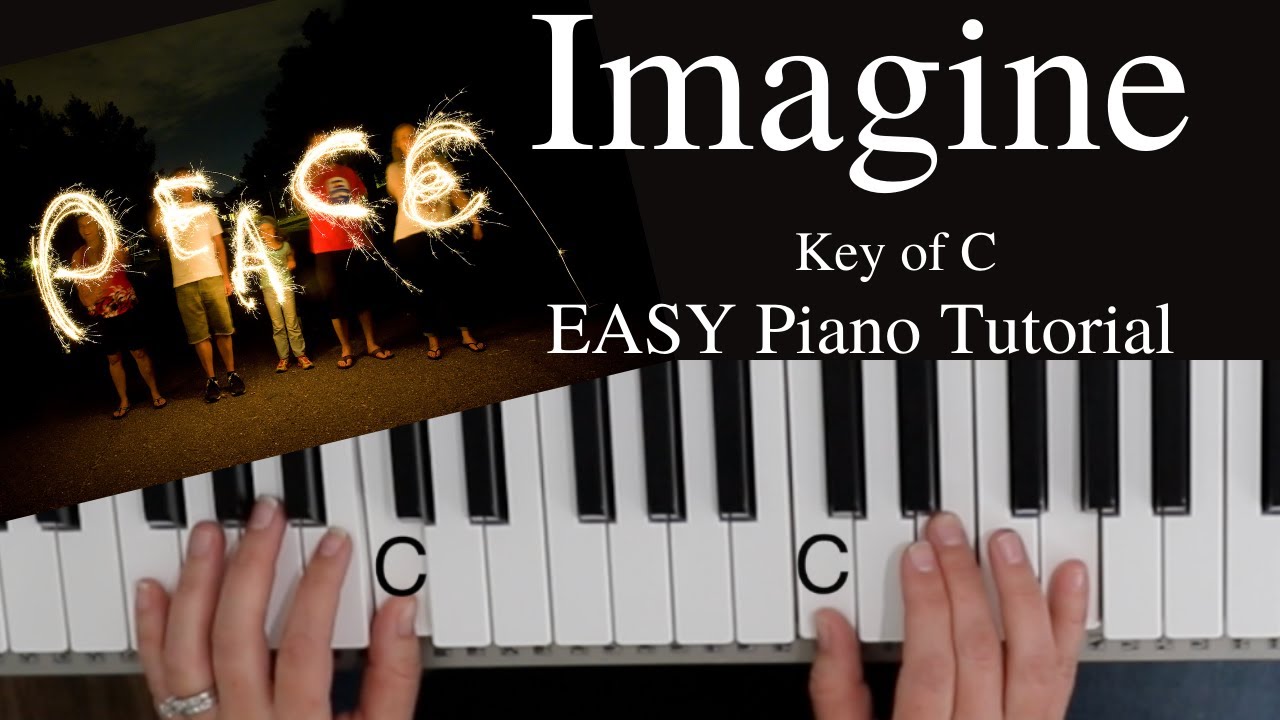
Take your time and have fun!
Things to remember
Slow it down
Go too fast or don’t practice enough and you’ll always make mistakes. If it sounds messy, slow it right down until it sounds clean and perfect with each note struck perfectly in time. Get it right by playing it slow… And only then try speeding it up.
Break it up
Learn it with each hand separately first, before putting the two together. You’ll find it much harder if you try to learn both hands together.
Little and often
Keep your practice sessions to ‘little and often’ rather than one mammoth session. 15 to 20 minutes fun each day will get you much further than a three-hour workout once a week.
Relax
Be patient with yourself. Two-hand coordination genuinely takes time to develop – it's not a talent thing, it's just practice. Remember that everyone finds it hard at first but everyone gets better with practice.
Good luck!
- Here are the best digital pianos for beginners
- Or these are the best digital pianos overall
- Don't forget about these essential piano accessories
- Explore our pick of the best Casio keyboards
