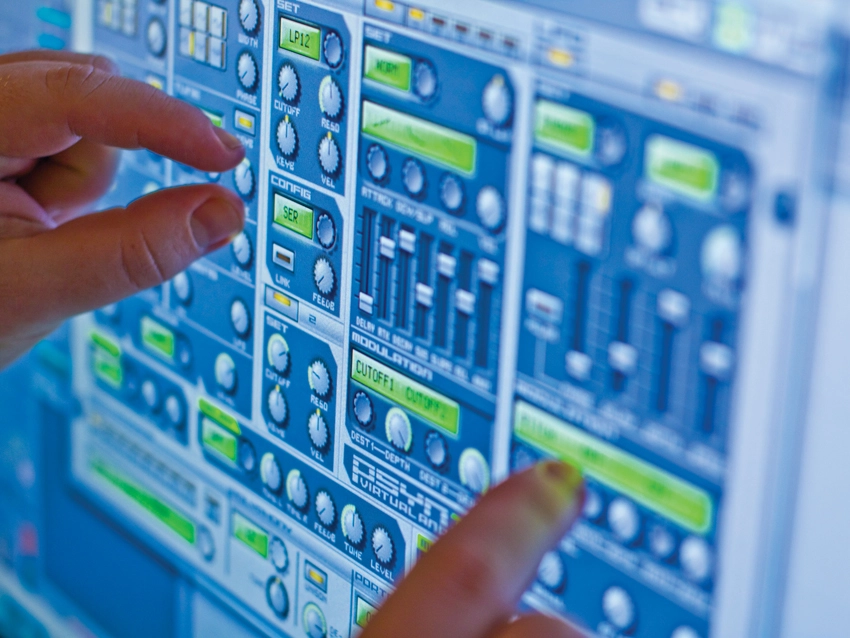
It would be hard to dispute the fact that software has forever changed the way we make music, but the one area in which it has always fallen short of old-school gear is that of hands-on control.
In terms of functionality, software can do everything that hardware did and much more, but there's no getting away from the fact that the knobs and faders you see on your screen aren't actually real.
Manufacturers have attempted to get around this limitation by producing hardware devices featuring controls that mirror those we look at on our displays, and to an extent, they've been pretty successful. Being able to actually push and grab controls - sometimes more than one at a time - has certainly helped to make the computer music making experience more satisfying, and integration is ever-improving.
Novation's Automap technology, for example, takes much of the tedium out of assigning controllers, but while it's about as good as it gets right now, it's still not the 'perfect' solution that musicians dream of. Yes, it's great to get a sense that the software is at your fingertips, but it's not the same as being able to reach out and touch your DAW and plug-ins for real.
However, this idea is starting to become a reality, for it seems that we are at last entering the era of the multitouch interface, with new technology giving users hands-on control over several on-screen parameters at once.
What is it?
For the unfamiliar, a multitouch display is a touchscreen that can interpret more than one finger-press at once. This allows for such neat tricks as using two fingers to 'pinch' on-screen items, or zooming by sliding fingers apart, as seen on Apple's iPhone. Over the next few years, this technology is set to take off in a big way, and its impact on computer music could be huge.
JazzMutant is the best-known bearer of the computer music multitouch torch, thanks to its Lemur and Dexter devices. JazzMutant's Communications Consultant Gareth Williams sees big advantages to multitouch, and touchscreens in general.
"Touchscreens are completely dynamic, which means that only the controls you need at any one time are presented to you," he says. "With touchscreens, you can have several interfaces in one box. If you want a whole interface dedicated to the plug-ins on the effects return, then you can. And you don't have to go and buy another controller to do so."
In addition, Williams also believes that the Lemur gives the user more creative options. "The control objects are not limited by real world physics, so there's no reason to follow the traditional rules," he reckons. "If you want controllers that can move and oscillate as if free of gravity and friction, then you can have them. These new control paradigms and ways of interacting with sound can generate very fluid, organic live automation."

In your hand
The Lemur is certainly a fine piece of kit, but it's expensive, too. If you want to make music with a multitouch screen today, a far more affordable route in is Apple's iPhone/iPod Touch platform.
Ilya Tretiakov, developer of the synth app Noise.io for iPhone, is only too aware of the platform's potential.
"Noise.io uses multitouch extensively, and not only for controlling but also for editing sounds," he explains. "In Noise.io's preset editor, there's a special 'ribbon' controller, drawn at the very left of the screen. To adjust any synth parameter, the user first taps it with his right thumb, and then adjusts it with his left thumb by performing a finger slide on the ribbon.
"While doing that, he can hold his right thumb on the Note On button, immediately auditioning sound changes. Thus, the average preset creation time reduces significantly."

What next?
You could argue that mobile devices are well suited to multitouch because they're small, so the screens don't have to be too large, and therefore pricey. The question, then, is whether the falling costs of technology will eventually make multitouch screens part of our 'standard' computing setup, or whether they will remain an add-on peripheral?
"I'm completely sure that desktop computers will have multitouch interfaces as soon as they turn into 'table PCs'," says Ilya Tretiakov, referring to angled touchscreen panels mounted into the desk surface. "It is just not comfortable to work while stretching hands to the LCD display all the time."
As for portable use, it's not hard to imagine laptops with two displays - like a giant Nintendo DS - with a multitouch display panel replacing the functionality of the keyboard and touchpad with something far more flexible.
Gareth Williams agrees with such hypotheses, but doesn't believe they'll mark the end for dedicated products such as the Lemur.
"I think there will always be a need for dedicated control hardware," he says. "Yes, a computer may have a touchscreen display interface in future, but the GUI of most music software isn't designed for direct manipulation.
"At Jazzmutant, we also have the experience to know how to create a usable interactive controller which is 'musical'. Merely having the technology is one thing, but the implementation of it is equally important."

Windows of opportunity
There seems to be a general acceptance that multitouch hardware will become commonplace, but is our software ready for it? Tellingly, Microsoft is making multitouch an integral part of Windows 7, the forthcoming successor to Vista, and the company's Technical Evangelist Arif Gursel sees great potential.
"Although its development is not intended for a single ecosystem (music creation), there are some exciting benefits and scenarios that will be enabled. Like any new technology offering, it doesn't just stop with the existence of the APIs; Windows 7 multitouch will have to be adopted by software and hardware manufacturers.
"DAWs, editors, and plug-ins all have unique characteristics that could benefit from this new data input experience. As many larger firms are slower to adopt new technologies, it will be fascinating to see what some of the new up and coming hardware and software companies produce on the Windows platform. This is definitely a shift for music technology and there are exciting times on the horizon."

How long it'll take for that horizon to roll into view remains to be seen - barriers of cost and design still need to be overcome before multitouch becomes the norm rather than the exception - but it's clear that good times are ahead.
Let's face it: in terms of sound, today's music software has caught up with and, in many cases, exceeded hardware, but there's still a lot of room for interface improvements.
"The fact is that most interfaces between a human and computer involve some degree of separation," says Gareth Williams. "Your hand moves a mouse, and this is translated into movement of a cursor on the screen. Wouldn't it be much nicer to reach in and touch?"
Liked this? Then try:
The beginner's guide to MIDI controllers
5 iPhone music-making apps we want to see
Sign up for our free weekly newsletter
The free MusicRadar newsletter serves up the week's biggest artist and product news stories alongside exclusive tuition and gear reviews. Sign up here!
Follow MusicRadar on Twitter
Get instant updates and bonus content plus chat with the team. Start here!
