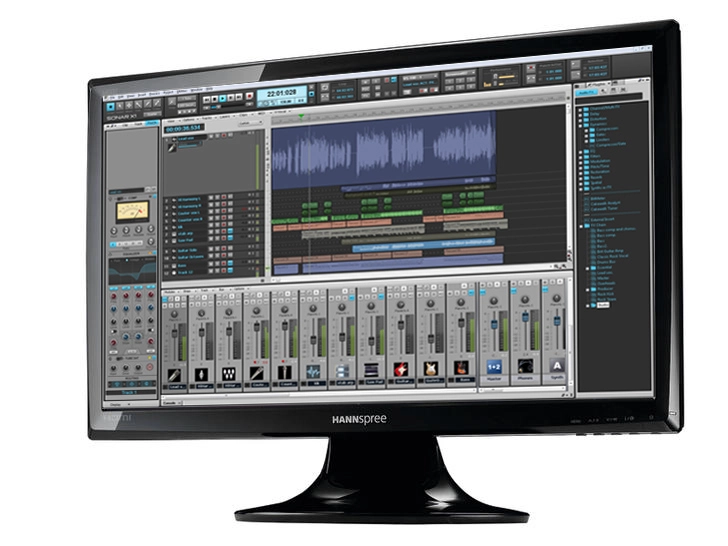
Cakewalk's recently released Sonar X1 represents a massive overhaul of the company's venerable DAW, and one that should please both existing and new users. With change, though, comes the need to subtly adapt your workflow, so here are eight ways to get just that little bit more out of Sonar X1 and its new features.
Double your pleasure
The ProChannel offers some awesome options for controlling dynamics, but you'll no doubt want to use your favourite compressor or limiter to tighten up your tracks at some point.
Our advice: don't be afraid to double up. Open your compressor in an FX bin on a track that's already being compressed via the ProChannel's dynamics, then dial in less drastic settings on each. This is an old engineering trick that helps to tame dynamics without beating them to death.


Double Double your pleasure
Want to recreate the above tip using only ProChannel dynamics? Sonar's flexible routing has long been one of its strengths, and we can take advantage of it to double up our ProChannel effects.
Simply create a new bus, then route the track you want to process through that bus. This will give you the ability to use the track and bus's ProChannels simultaneously.
Trust the man in the ostrich feathers
We love Sonar's new FX Chains. As you'll recall, they make it possible to create bundles of processing and then treat them as a single unit. They can also be saved for recall if you come up with something you really like. However, it's all too easy to fall back on a favoured effects chain again and again. Revered producer Brian Eno once claimed that he never documented the complex signal path of his effects boxes, so that he'd never be tempted to reuse them. There is some wisdom in that!
Do things the British way: make a commitment
Traditionally, the difference between US and UK productions has been in the approach taken by the engineers. When production techniques began to evolve in the '60s, even the most famous UK studios suffered from a lack of gear compared to their US counterparts. This forced them to be creative and second-guess how the mix would eventually sound.
As a result, British engineers got into the habit of tracking their effects to tape. Though it sounds like a scary proposition, it could actually make mixing a lot easier. Try freezing or bouncing your tracks and, if you dare, deleting the FX chains you used so that you can't turn back.
Screen gems
Screensets are a boon to the busy producer, enabling you to create individual layouts for specific situations. They can also create a distinction between different stages in the production process. We recommend you create a set for tracking acoustic and electric instruments, another for MIDI composition and another for mixing and mastering.
No peeking
When was the last time you recorded a performance all the way through? Desktop production has provided us with the ability to visualise our arrangements as individual (and brightly coloured) clips that can be copied pasted and moved about. Don't get us wrong - we thrive on this freedom. Still, it might be worth creating a tracking screenset based on Sonar's mixer, rather than the Track view.
Record your tracks individually and in their entirety, only returning to the Track view during the editing process. Track with your ears for a change, rather than your eyes.

Upper management
There's an often-overlooked feature lurking in Sonar's FX bin: the ability to filter and categorise your effects plug-in collection via Cakewalk's Plug-in Manager. Most obviously, this handy system can be used to filter out which effect plug-ins are available in Sonar's FX bins. You can also create folders for each category or for specific purposes. The presets for the FX Chains are not, alas, included - but there's nothing stopping you categorising those presets on your own!
Ready, (screen)set, go!
Screensets may be intended for swapping views and configurations, but remember that the Browser's current directory is also saved when you create one.
This is a great way to speed up your workflow. When saving screensets, take a moment to open the Browser directory that you're most likely to need when using whatever the focus of that screenset might be. For example, a screenset for use during mixdown might contain a Browser opened to effects preset settings. It's all in the detail!
Liked this? Now read: The 11 best DAW software apps in the world today
Connect with MusicRadar: via Twitter, Facebook and YouTube
Get MusicRadar straight to your inbox: Sign up for the free weekly newsletter
