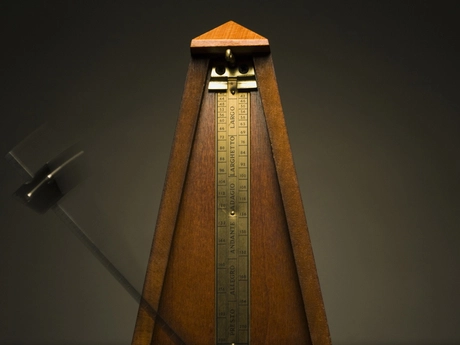

The secret of good comedy, they say, is timing, but that maxim could easily be applied to music, too.
It's all too easy to slip into a 4/4 rut and never get out of it, but if you open your mind to other timing and rhythmic possibilities and start to vary things a bit, your compositions will become all the more interesting.
Here are eight things to try if you want to slip your rhythmic shackles; for more tricks with time, check out the June issue of Computer Music (CM152) which is on sale now.

1. Combine multiple forms of syncopation
Create rhythmically adventurous synth, bass and percussion lines by applying multiple forms of syncopation to simple sequences. Bringing in a lead synth line with before-the-beat phrasing can give it the effect of jumping out at the listener, while backbeat transformation can add weight and energy to dance tunes.
2. Work in different time signatures by breaking bars down
If you're used to working in 4/4, it can sometimes be difficult to adapt to alternative time signatures. When working in less common time signatures, such as 5/4 and 7/4, it can help to think of the beat as being broken up into shorter sections of two, three or four beats. A 7/4 beat might be broken down into a bar of 4/4 followed by a bar of 3/4, for example.
3. Skip beats to emphasise different beats
Sometimes a missed note can have more impact than a played one. Missed beat syncopation creates tension by giving us a rest when we expect to hear a note. It can also be used to emphasise other beats in a rhythm. Try unexpectedly missing out the first note of a bassline and notice how the second note now feels stronger.
4. Stack loops of multiple lengths
DAWs like Ableton Live make it easy to build up complex, evolving arrangements by layering beats of varying lengths on top of each other. Rather than sticking to beats and loops of lengths that divide down to four beats, try adding a few parts of unusual length, such as nine beats, 15 beats or even 90 beats, and notice how the arrangement changes as different parts of the mix go in and out of phase.
5. Offbeat syncopation on trance and house lines
Using offbeat syncopation on bass or synth lines can really help drive a rhythm track forwards. Emphasising the up and down beats with different instruments can add energy, giving tracks a sort of double-time feel - which is why it's such a popular type of phrasing in dance genres such as trance and electro.
6. Shift parts out of sync to add interest
As an interesting and unexpected effect, try shifting one part temporarily out of phase by an eighth- or 16th-note. This is particularly effective when used on drum parts for just a bar or two, as it can give the effect of the rhythm collapsing in on itself, then setting itself right again.
7. Change rhythm timings in choruses
Bridges and choruses make good places to switch rhythmic styles. Even if you're writing tunes for a club environment, where long, mixable sections in 4/4 will be required, you can still use these points to try different things out and break free of the grid-like mentality that much modern music is stuck in.
8. Combine rhythmic effects
The next time you're starting a new track and feel like you want to break away from the rhythmic norm, try starting out with a standard sequence and applying a variety of rhythmic effects to it. Try altering the syncopation, then adding a layer to make it into a polyrhythm. Or why not try moving the whole sequence out of sync and then working it into a different time signature?
Liked this? Then try:
Play better rhythm - 5/8 and 5/4 time signatures
6 ways to improve your hip-hop breakbeats
Sign up for our free weekly newsletter
The free MusicRadar newsletter serves up the week's biggest artist and product news stories alongside exclusive tuition and gear reviews. Sign up here!
Follow MusicRadar on Twitter
Get instant updates and bonus content plus chat with the team. Start here!
