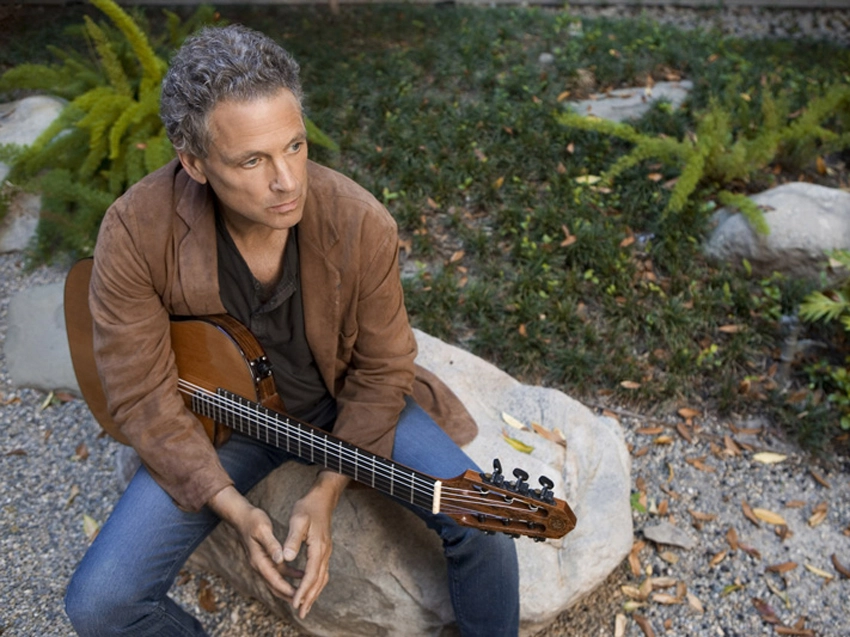
"Rumours was like climbing Mount Everest," says Fleetwood Mac's Lindsey Buckingham. "Once you've done that, you can't go any higher. You just have to find other places to go."
And in the three decades since the release of that worldwide favorite (which has racked up sales of over 30 million copies), Buckingham has indeed followed his own erratic muse. There have been band breakups, reunions, solo albums, and a general understanding that Fleetwood Mac will only come together when the mood is right.
"We've been through it all," Buckingham says. "I think the fact that we're still standing is proof of how strong our bond is. It's taken a while to get to this point."

Buckingham states that 2009 will be a Fleetwood Mac year, but before he reunites with the band he's on the road to promote his strongest solo effort in years, Gift Of Screws.
Back to the amps
Unlike 2006's Under The Skin, which was a largely acoustic work, Gift Of Screws is a more rocking affair. "It just felt right," says the guitarist. "For me to put out Under The Skin II wouldn't have made any sense. It was time for me to amp things up again."
While the new album is resplendent with moments of ethereal beauty and intensity - and virtuosic fingerpicking that will drop jaws to the floor - there are also cuts that recall the Fleetwood Mac at their most rhapsodic. Not surprisingly, on these songs, Wait For You and The Right Place To Fade, Buckingham is backed by one of the finest rhythm section in rock, Mick Fleetwood and John McVie.
Lindsey Buckingham recently sat down with MusicRadar to discuss Gift Of Screws and to give us the lowdown on Fleetwood Mac.
"It's been a twisty little road for the band," Buckingham admits. "But nowadays things are a little easier and the line is a lot straighter. To be in this place is quite a relief."
Lindsey Buckingham: Q&A
How does Gift Of Screws relate to your last solo album, Under The Skin? Could you have released this one without having released that one first?
"I could have. In fact, Warner Brothers would have much preferred this one. [laughs] When I turned in Under The Skin, their general response was 'Yeah we'll put it out, but don't expect us to do too much.' But Under The Skin was an approach I'm very interested in, which is to take the kind of energy that a single guitar and voice have and apply the manner in which they succeed on stage in a studio situation.
"So I would use one or two guitars and have them do the work of the bass and drums and lead guitars pretty much throughout. I was very happy with that album. In retrospect, it functions as an opening act for Gift Of Screws."
You went through many years between solo releases, but Gift Of Screws and Under The Skin happened in rapid succession. Is this the sign of a new wave of productivity?
"To some degree. Some of that is reflective of my personal life, and a certain stability that I have been able to find, having gotten married and having had children. But it also is about the fact that I put a three-year boundary in terms of Fleetwood Mac. I basically said, 'Guys, I need these three years to do solo work and tour. But the band has had a pattern of coming into the picture anyway. [laughs]
"That's happened several times, the most recent being when I was poised to release a solo album and the band wanted to record, and so almost all of my solo material got folded into the 2003 album Say You Will. And I've just kind of made it under the wire here because I think Fleetwood Mac may start rehearsing some time in January."
The return of Fleetwood Mac
Are Fleetwood Mac going to record an album as well as tour?
"We'll do some dates and get comfortable again. And assuming all goes well, we'll make an album and then tour. So we have a rough, long-term sketch going and everyone's very excited about it. I think Fleetwood Mac still have a lot to say musically."
"I think Stevie and I will get to explore a lot, musically and emotionally."
Tell me about Sheryl Crow's supposed involvement at one point. Did you guys rehearse with her?
"No. [laughs] That whole thing has been blown up so far out of proportion to anything that was real. The reason that there was even any consideration in bringing in someone like Sheryl was that Stevie, having gone through a tour in 2003 without Christine McVie, missed that female camaraderie on stage, and so she was looking for someone else to kind of share that with.
"We're all acquainted with Sheryl and Stevie brought up Sheryl's name. I was fine with the idea, hypothetically speaking. I did have some private reservations about it that I didn't voice, like, 'Hmmm, are we now going to be doing Sheryl Crow songs in a Fleetwood Mac set?' [laughs] That would be something of a mixed message. So the idea sort of sat there and there was no decision on it.
"Then Sheryl had an album come out and, as I understand it, during interviews she took it upon herself to announce it to the world that she was joining Fleetwood Mac! [laughs]
"That was something I was distanced from, but I guess it bothered Stevie a great deal. It was weird, and I think it led to Stevie having a bit of friction with Sheryl. Plus, Sheryl then realized that we weren't just talking about 40 dates; we were talking about three years. So, after that…it just kind of went away.
"To me, the best way to approach Fleetwood Mac is to take the four core people and work on our dynamic, and there are many positives to that. I think this is going to allow Stevie and I to explore a lot, musically and emotionally."
How do you and Stevie maintain a relationship? She's said in interviews that you're still the great love of her life. Does that make you uncomfortable?
"One of the things about Fleetwood Mac is, when we're not together, we don't talk a lot or keep in touch. We keep a healthy distance. But a good part of what we need to approach this time around is the dynamic between Stevie and me. It's intense. We've been down a long road and we've known each other since we were about 16. We need to honor that and dignify that story, and I think that we'll do that on our next recordings."
Guitars and production
On the new album's song Great Day, you have a wonderful mix of acoustics, and you play a blazing electric solo. What guitars did you use?
"I use a Rick Turner Renaissance gut-string for playing those little bluesy kind of drop-D riffs. The solo is the normal Turner stage guitar. I like that song a lot because it's almost like a potpourri of everything that follows on the album."
Tell me about the Rick Turner guitar, your mainstay instrument. When did you start using it and what do you like about it?
"It was brought to me probably after Rumours and during the making of Tusk. Its funny, because I don't play with a pick, and before joining the band I had used a Telecaster which was appropriate for my playing style, and yet the Telecaster didn't blend with the existing sound of Fleetwood Mac - the fatness of Christine and John's instruments. So I had to switch over to a Les Paul to get the tone that seemed to work. A Les Paul is not a very good fingerpicking guitar, though, so I asked Rick to make me something that was somehow a cross between a Les Paul and a Telecaster. The guitar he came up with delivered in every area and it's worked for me since."
"I don't practice per se. I learned to play on my own, taught myself how to play. I've never really had a lesson and I don't read music."
On the song Time Precious Time your fingerpicking is unbelievable. Are there any particular exercises you practice?
"I don't practice per se. I learned to play on my own, taught myself how to play. I've never really had a lesson and I don't read music. So all the stuff that I do doesn't come from the normal set of disciplines that they teach you where you sit down and run through scales for a particular number of minutes a day.
"I'm not that knowledgeable with the guitar - I just find ways that are pretty creative, but it's all within the framework and the limitations of what I can do. As they say, it's not what you got, it's what you do with what you got.
"On that song, the actual finger pattern of the right hand is just an arpeggio back and forth between the thumb and three fingers. It sounds like a waterfall to me - that was the idea, at least. In order to get that, I had to find a tuning that was specifically geared towards the notes that I wanted to use and then to find the new thumb notes that needed to be used with those, which were a root and a fourth.
"I figured out a tuning that was more or less open so I didn't have to do a lot of fretting. And then I taught myself the positions all the way up and down the neck that would that would get to those things. It was an interesting exercise."
Some of the sounds on the album recall the edgy production techniques from Tusk (1979). Your fascination at the time with punk and new wave was a very big deal. Did that have a negative impact on the band?
"Yes and no. I always made the joke that I would have loved to have been a fly on the wall when Warner Brothers first put Tusk on and listened to it in their boardroom as a follow-up to Rumours. That was an interesting, defining moment for me. The idea of subverting the formula that led to the success of Rumours, because clearly we were poised to follow that same formula to try and recreate the same success.
"And yes, a lot of new kinds of music had flooded in during that time and I was quite intrigued by a lot of it and loved a lot of it and it reinforced a lot of my belief system anyway.
"For me, it still defines the way I think, which is to try and follow your own instincts and not the expectations of external forces that may be wanting you to do certain things for the wrong reasons.
"In terms of the band, it did have a negative impact in a way. There was kind of an arc in the whole process where they were a little bit alienated from what was going on because at first I was working at home and bringing stuff in, and I think they were a little bit threatened by the lack of status quo at that point. As the album unfolded and people became aware of what it was I think everyone got pulled into what it was and got enchanted by the fact that it was different and experimental.
"Of course, when it didn't sell 16 million albums there was a backlash from within the band. Basically, it became, 'Well, we're gonna put it back on track and work in the manner in which we made Rumours.' If you want to call that an in adverse effect on the band I guess you could."
How do you feel now about the belated regard to Tusk? Now people are calling it a masterpiece...
"All of those events never affected my feelings on the album and what it was. It only affected my feelings for the politics and it gave me a little sense of disappointment in the sense that I guess I was feeling at the time. It drove in the point that not everyone in the band were doing things for the same reason. But that's fair enough too because Fleetwood Mac as a fivesome was a very unlikely group of people to be together in the first place."
On a couple of the new songs on the new record, you're joined by Mick Fleetwood and John McVie. How aware are you that whenever they play with you, it immediately sounds like Fleetwood Mac?
"I'm a little too close to it to be completely aware. It's really hard to hear because on some level I am close to it and maybe take it for granted a little bit. But I have so much regard for Mick, especially as a drummer. He's completely unique. Nobody else in the world sounds like him."
Of all of your solos, I'm So Afraid is a show-stopper. What goes through your head every night you play it? And how much room for improvisation do you give yourself?
"I'm no Jimi Hendrix. I don't have the level of proficiency to just let myself go off into something completely different every night. Nor do I think I would want to. I am someone who values musical themes. Someone who feels there should be a consistency from night to night with something. I'm not one of those people that can slam out a completely different solo every night because I don't have the skill to do that."
Buckingham and Nicks
Let's go back to you and Stevie. What do you think would've happened if the two of you never joined Fleetwood Mac?
"That's a good question! [laughs] I don't know what we'd be doing now. But there was a period of time where we both wondered what would have happened if we had passed on the offer from Mike Fleetwood, because after Stevie and I had done that one album together we started to play some shows in the South - and things started to happen for us there!
"It was weird: we lived in LA and we were starving, but in the South we were headlining for three and four thousand people a night, which is more then I can play to now! [laughs] To be honest, I don't really don't have any answers to that question. Who knows where we'd be?"
Fleetwood Mac became famous for the soap opera - the fights, the squabbles, the walkouts. Do you think you have all mellowed with age and the things that used to bother you don't seem so important now?
"I think one of the reasons why everyone is looking forward to next year is that we're at a point where we're feeling the same thing, which is to go out and acknowledge that there is a great deal of caring and love between us and acknowledge that we've accomplished something significant; and to acknowledge that everything we do needs to be come from the perspective of us sharing something and enjoying that thing and keeping that particular individual agenda down to a minimum.
"Just to relax into it and have a good time. What I think is going to happen out of that is that feeling is going to translate on stage. So yeah, I think we have gotten there. We've mellowed, but we'll still rock!"
Lindsey Buckingham: Did You Miss Me
Listen to an exclusive stream of Lindsey Buckingham's new single, Did You Miss Me.
QuickTime
WMA
