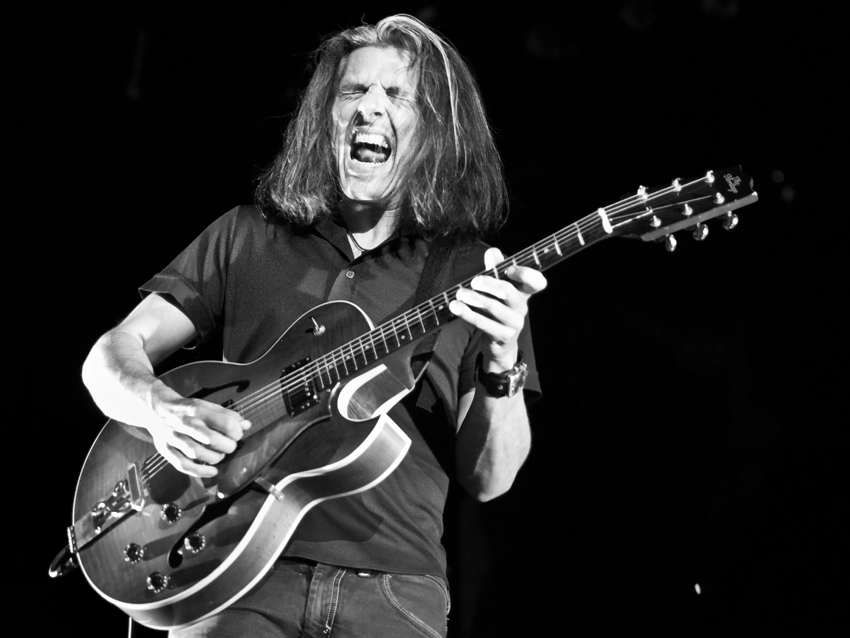
Guitarist Alex Skolnick first came to prominence as a member of the thrash metal pioneers Testament. The Bay Area-born, Joe Satriani-school musician made a number of groundbreaking albums with that band during the late '80s and early '90s before splitting in 1993.
What did Skolnick do next? He studied jazz, of course, at the New School in Manhattan (he's been a New York City resident for the past several years). Eventually, he hooked up with fellow New School students Matt Zebroski (drums) and John Davis (bass) to form the Alex Skolnick Trio. "A total dream come true," says Skolnick. "I was finally playing music that I could adore 100 percent. Not that I don't love metal. But jazz speaks to me on a much different level."
Bassist Nathan Peck soon replaced John Davis (who left to pursue a career in indie rock), and with that the Alex Skolnick Trio went about releasing a string of critically and commercially successful jazz albums, the bulk of which featured inventive reworkings of popular hard rock and heavy metal songs. During this time, Skolnick also became a featured guitarist in the massively popular touring rock opera Trans-Siberian Orchestra.
And metal fans had reason to rejoice when Skolnick, who did a one-off with Testament in 2001, rejoined the band as a full-time member in 2005. "It's been an insanely busy ride the past...oh, 20 years!" the guitarist jokes. "But it's good to be working, good to be in demand. I'll take it."
MusicRadar sat down with Skolnick recently to talk about Veritas, the brilliant new album from the Alex Skolnick Trio. We also discussed how the guitarist switches gears creatively, going from jazz to metal to the symphonic rock of TSO.
Do you have to get into a different headspace to play with Testament than in the Alex Skolnick Trio?
"Yes, I do. Depending on what I'm doing, I can become two different people or two different musicians. A lot of things go into each situation - how you think, how you hold the guitar, the intensity of the muscles that you use, the artists that influence you...
"In both cases, though, I do try to shut everything off and let the music happen. I think there's a lot of people out there who listen to just one genre of music, which is fine, I guess - it's their choice. But to play more than one genre, it's…it's almost as though it's unaccepted, and I'm trying to change that."
Jazz vs metal...or does it?
One can easily talk about the differences in heavy metal versus jazz, but do you see any similarities?
"Sonically? No! [laughs] No way. We're talkin' night and day. Sociologically, they both are driven by true dedication and a love of music. There's no chasing of trends. Both genres, to a large degree, never really had a big payoff. It's been a challenge for me to make a name for myself in both metal and jazz. Although I don't run Testament, I do run the Trio, so I'm always aware of the risks I'm taking and the challenges I face. It doesn't make it easier, but it does make any success I have sweeter."
You quit Testament for a time to study jazz guitar. During your first tenure in Testament, were you a closet jazz fan?

Even in jazz, one can use the 'devil's horns.' The Alex Skolnick Trio live. © Tom Couture, 2011
"Oh, yeah. Completely. It was the music that interested me. Not that I know what it's like to be a closeted homosexual, but that's what my interest in jazz felt like. [laughs] It was like this secret that I couldn't let anybody in on. That's one of the things about metal: You're not supposed to like other music. And you're really not supposed to like stuff that's…less 'manly.' [laughs]
"And that includes glam-metal, too. I mean, it's not like I was listening to Motley Crue or Poison, because I wasn't. I was listening to Thelonius Monk, Bill Evans and Herbie Hancock. It was considered freaky. I remember Testament would do these in-stores, and afterwards we'd get to pick out a couple of CDs. I'd always go down to the jazz section and look for a Miles Davis CD I didn't have, or something by Pat Metheny. I'd get funny looks from the metalheads, but I didn't care."
Metal fans come around
Over the years, you've been accepted by the jazz community -
"Which I never expected, but it's great."
Have you received e-mails and letters from Testament fans wanting you to "stay true to metal"?
"I used to get a lot of e-mails like that, but it's quieted down now. I think a lot of the younger metal fans are more open-minded, and even some of my original fans have written to me and said things like, 'I checked out this jazz record, and you know, it's not that bad.' So that's been cool."
On past albums by the Trio, you've done jazz versions of hard rock and metal tunes. What have you discovered about the songs when you change them so radically?
"That's hard to say. I try to take songs that most fans know. You know there's KISS fans and then there's insane KISS fans [laughs], and by that I mean people who will stick with the band no matter what - the kinds of fans who think that Crazy Nights is as good as anything the group ever did. I'm not one of those guys. But, of course, everybody agrees that Detroit Rock City is a great song.
"So in taking these well-known songs, I've discovered that they have one thing in common: they all have fantastic vocal melodies. A lot of the jazz repertoire comes from the popular music from the '20s, '30s and '40s, and that includes show tunes. All of those songs have great vocal melodies. Same thing with classic hard rock and metal tunes. I just change certain time elements of the riff and the main melodies and hooks."
You do a very cool version of Fade To Black on the new album. Have you played it for any of the guys in Metallica?
"No, I haven't. But they're very aware of what we're doing. Kirk's said some very nice things in the past about our version of Detroit Rock City. [laughs] However, I did sort of mention Fade To Black to them: 'We're doing something kind of special on the new record. Hope you like it.' I don't think they've heard it yet; otherwise, I probably would have gotten some sort of word."
With original songs, how do you compose? Do you make fully fleshed-out demos, or do you come up with basic changes and riffs, knowing that there will be improvisation?
"For this album, I did a few demos, just pieces, really. Some of the things I demoed while Testament was on tour with Judas Priest and Megadeth last year. There was a lot of downtime on that tour. I remember sitting on this bus for hours on end, a lot of it spent looking at mountains. That kind of inspired me. So after driving all day, we'd get to the arena, and I'd sit in the backstage lounge area and play what was in my head. Sometimes I'd record the stuff on GarageBand - those would be the demos I'd give to the guys.
"A few of the other songs came about from us jamming in a room together, like the song 99/09. Another one was Bollywood Jam - I played the basic riff, but the chorus of the song came about in a jam."
It's a concept album!
Talk to me about the concept, which is kind of like imagined pairings between various artists you admire, people like Ravi Shankar and John McLaughlin, Prince and John Scofield. Plus, there's homages to artists like Dave Grohl.
"I was basically taking advantage of the freedom I have in this project, which is 'anything goes.' All of those artists you mentioned make what I consider to be good music, and the guys I'm playing with agree. If the band were driving in our van and Ravi Shankar's music came on, nobody would complain. If the Foo Fighters came on next, nobody would complain.
"The 'homage' issue came about after the fact, though. Take Song Of The Open Road, which is very Foo Fighters-like. At some point when we were working on the drum groove, I would say, 'What's that Foo Fighters tune…?' Or not. Sometimes it was when I was listening back to a completed song."
Your guitar tone on the record is a far cry from how you sound in Testament. What are you using guitar and gear-wise for playing jazz as opposed to metal?
"The main guitar for the Trio is a Heritage H 575, which is a little like a Gibson ES-175. Heritage guitars are made in the original Gibson factory in Kalamazoo, Michigan, which was abandoned when they moved to Nashville. Some former Gibson workers stayed in Michigan and started their own company.
"I also use a Heritage Alex Skolnick model, which is a little bit like having a signature Les Paul. I play that guitar in Testament as well. My foot pedals can be the same. I don't use a lot of distortion with the Trio, but when I do, it's an old Ibanez Tube Screamer. Then I use a Dunlop Carbon Copy delay, and a Boss DD-20 Giga Delay. I use a Budda amp, which the company custom makes for me, called the Alex Skolnick model."
That's very nice of them!

On stage with Trans-Siberian Orchestra, 2008. © Sayre Berman/Corbis
"Yes, it is. [laughs] We're working on a high-gain amp to use for Testament and other metal projects."
Shifting to Testament, I understand the band is in the beginning stages of a new album.
"We're writing and demoing. I've made several trips to the Bay Area, where I'll work with the guys very intensely. Then I'll work on some things here in New York on my own. I even had Matt from the Trio come by and work on the metal ideas, some of which might work for Testament."
TSO - a 'really big shoe'
In addition to the Trio and Testament, you've been involved with Trans-Siberian Orchestra for a number of years. What do you learn working in a huge production like that?
"It's a very positive experience, but it's challenging at the same time. You're involved in this production which is at the top of its game. The same people who do lights for TSO do the pyro and lights for major pop tours. It's a massive show that has to be put together and broken down every night. And being on an arena stage night after night and giving it your all, giving 200 perfect all the time - I know it carried over to other things I do now. On a performance level, it really helped my confidence.
"At the same time, it's not the kind of thing you want to do forever. You're not part of the creation. You're like a light or a laser. You're part of a presentation, and there isn't much room for variation and spontaneity."
It's like you're in a chorus line: you have to hit your marks.
"Yes! Exactly. It was great for a while, but I'm a little too creative to do that for too long. It takes a lot out of your life. Very long days. Especially on those days when you do two shows - that's just massive."
So now you're jumping back and forth between the Trio and Testament.
"Yeah. And I've found a very happy medium with being in both. I don't have as much input in Testament as I might like, but that's part of being in a band as opposed to leading a band. But in the Trio, I call the shots. The other guys will let me know if they don't like something and I have to consider it, but ultimately, it's my deal, and I need to have a group that I can call mine."
