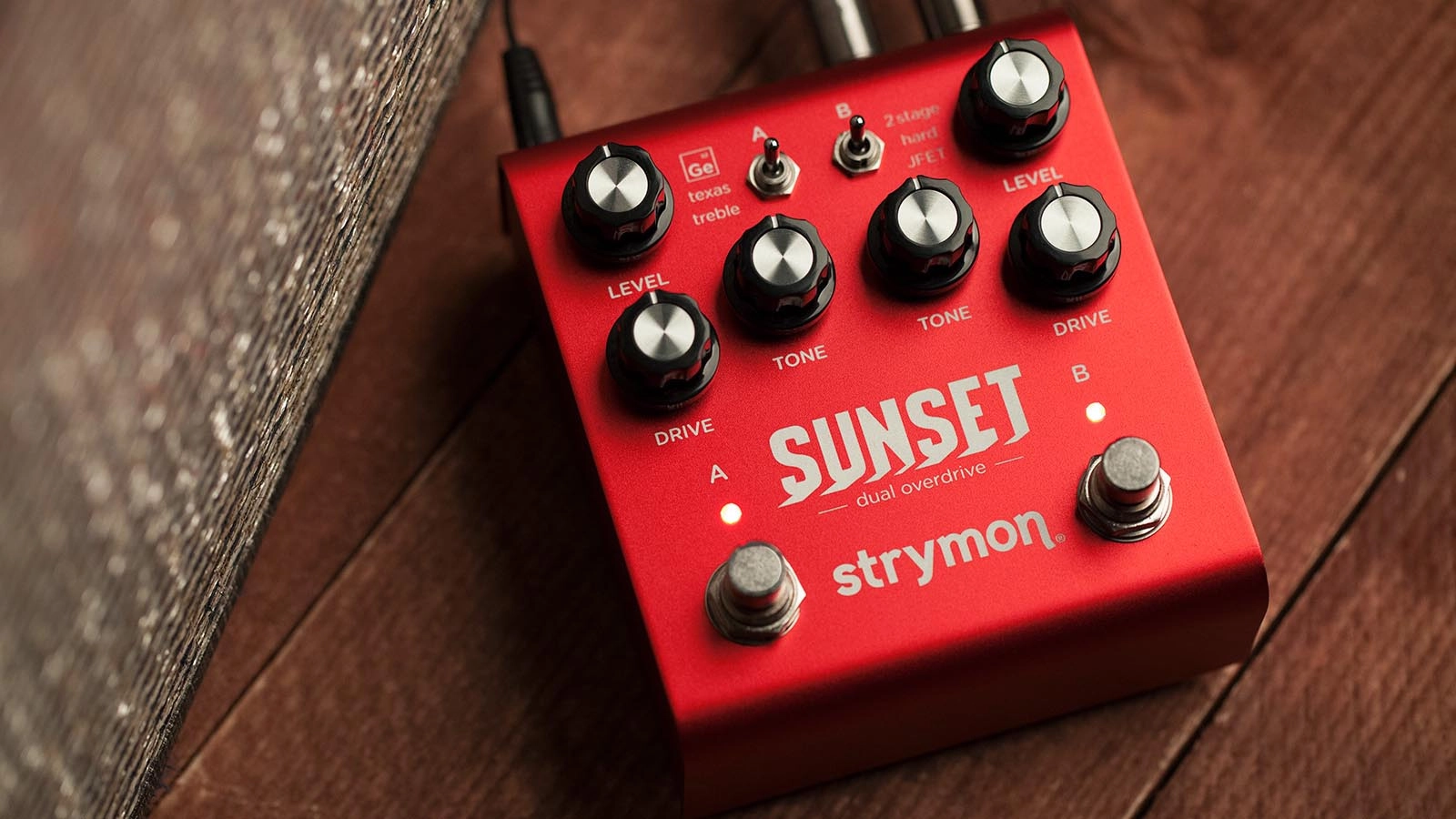
Nothing causes mass hysteria among pedal fans quite like a new Strymon release, and, unsurprisingly, the Sunset Dual Overdrive looks set to do exactly that.
Promising “the best of the best classic overdrive circuits” via an analogue class-A JFET circuit and SHARC digital processor, the Sunset features six overdrive and boost circuit types, which can be assigned to the Sunset's two channels.
Channel A overdrive circuits include germanium and Texas sounds, as well as a treble booster; Channel B, meanwhile, features a two-stage soft-clip overdrive, single-stage hard-clipping and JFET clean boost.
All the circuits are designed to complement and stack well with each other, and can be re-routed A>B, B>A or run in parallel.
Around the back of the pedal, there's a three-position bright switch to match amps, a noise reduction option silences hiss and hum, while an expression pedal and Strymon's Favorite switch can also be connected.
We're intrigued to see how this analogue/digital hybrid stacks up to Strymon's last overdrive effort, the Riverside Multistage Drive. The Sunset Dual Overdrive is available to preorder from Strymon for $299, and ships within seven to 10 days.
