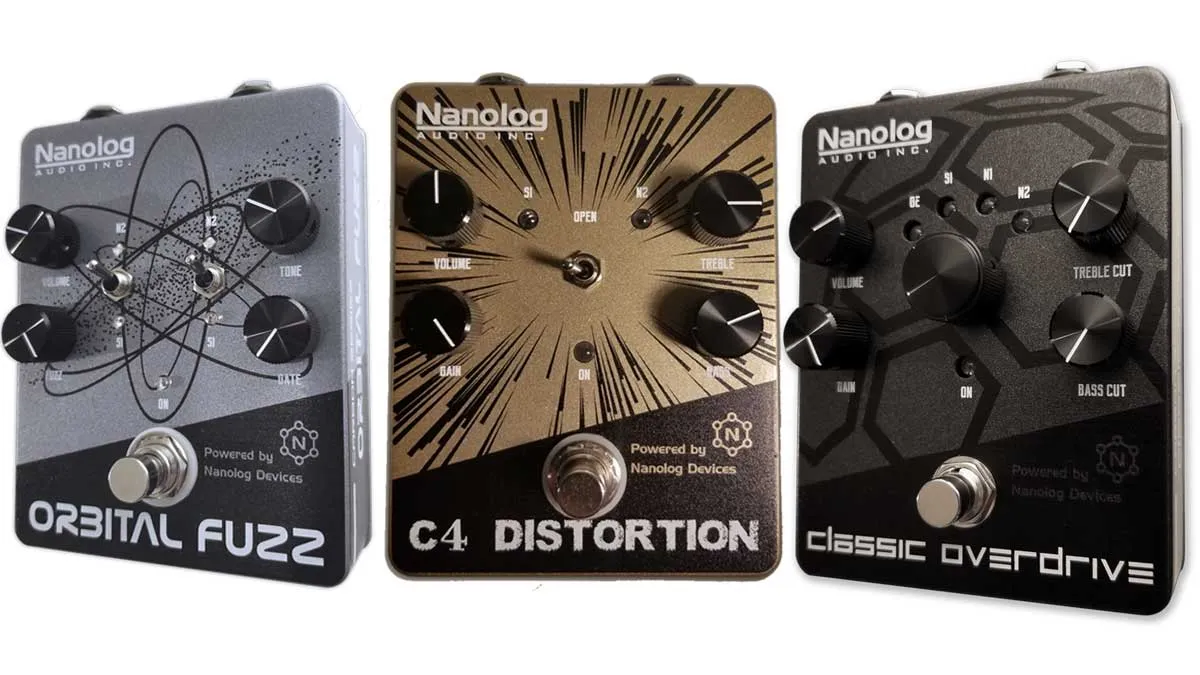
Traditionally, drive pedals have utilised silicon and germanium diodes, but Canadian newcomer Nanolog Audio has employed quantum physics to develop carbon clipping for three new pedals.
According to Nanolog Audio, carbon clipping delivers less compressed, smoother soundwaves, courtesy of “quantum tunnelling”, which sounds too sci-fi for us to even comprehend.
Promising “improved tones, dynamics, feel and warmth”, the clipping appears in the Orbital Fuzz, C4 Distortion and Classic Overdrive.
The Orbital Fuzz is inspired by Muff circuits, offering four clipping pairings, combining silicon and carbon, plus a built-in gate control.
Three clipping options appear on the C4 Distortion for a wide range of distortion when combined with the two-band passive EQ.
Finally, the Classic Overdrive employs silicon, germanium and carbon diodes, and boasts treble- and bass-cut controls.
There’s some seriously big talk going on here, but if the sounds match up to the sales pitch, we could have a game-changer on our hands. Videos are apparently coming soon...
The Classic Overdrive, C4 Distortion and Orbital Fuzz are available from 13 November for $235 each. Head on over to Nanolog Audio for more info.
