


It’s a big day for Roland fans, as the Japanese manufacturer has announced the release of not one, but two new synthesizers in its compact and affordable Boutique series: a 32-voice take on the Jupiter-8 and an all-new wavetable synth named N/vision.
Jupiter-08 is a portable, digital recreation of the Jupiter-8, the classic analogue polysynth released in 1981 that, along with the company’s Juno series, remains one of the most beloved instruments in synth history. This isn’t the first time Roland has revived the Jupiter in Boutique format: the Jupiter-08 follows the JP-08, a four-voice Jupiter-inspired synth unveiled in 2015 with the launch of the Boutique range.
Released in celebration of the Jupiter-8’s 45th birthday, the Jupiter–08 recreates the original synth’s eight-voice/two-part architecture and models its oscillators and filters using Roland's ABM (Analogue Behaviour Modelling) tech, while adding a handful of modern enhancements.
It's limited to eight voices by default, but players can expand its polyphony to 32 voices, and in true Jupiter fashion, two patches can be layered in Dual mode or played on either side of the keyboard in Split mode.
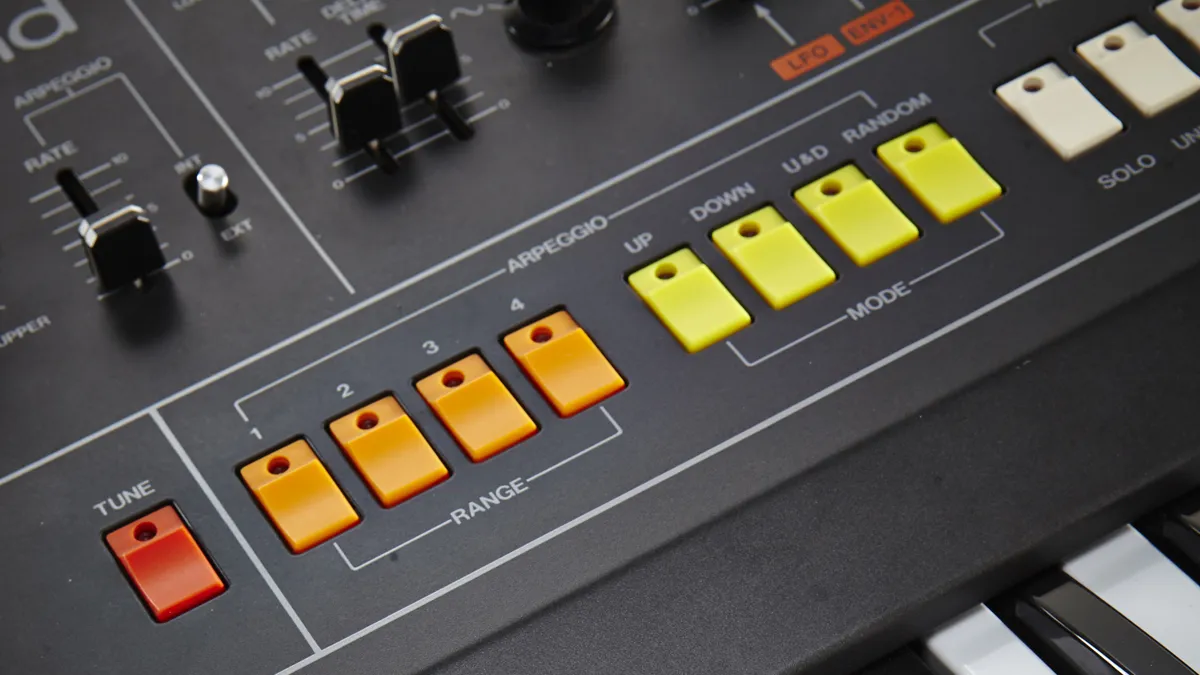
The front panel follows the original design fairly closely, both in layout and aesthetics. VCO-1 has cross-mod and VCO-2 has sync and fine tune, with a source mix control between them, and there’s a separate high-pass filter alongside the main VCF, which has switchable slopes and key tracking.
There are a few differences though: like the JP-08, you get extra waveforms on the LFO and VCOs that weren’t available in the original. Notably absent are the pitch and mod touch-strips that featured on the JP-08, which have presumably been removed to make room for a more authentically Jupiter-esque control panel.
Unlike the JP-08’s ACB (Analogue Circuit Behaviour) sound engine, the Jupiter-08 uses ABM, a different kind of analogue modelling tech that Roland has previously deployed in the Jupiter-X. We asked the Roland team why they made the switch, and were told that opting for ABM over the processor-intensive ACB allowed them to increase the polyphony, which was unsurprisingly the biggest customer request the company received for the four-voice JP-80.

Next up is the N/vision, the first wavetable synth in the Boutique range, and an instrument that Roland promises is capable of "animated movement, moving pads, aggressive leads, complex timbres, and more".
N/vision is stocked with 63 factory wavetables which can be blended together using its dual-layer architecture and transformed using the waveshaper, which bends the waveform using non-linear processing to add harmonics and change its timbre. There's also an analogue-modelled filter with multiple vintage-inspired filter models and drive for extra bite.
Battery-powered and equipped with a built-in speaker, both N/vision and Jupiter-08 feature a two-part, 64-step polyphonic sequencer and arpeggiator, alongside a healthy selection of digital effects that spans multiple reverb and delay algorithms, chorus, drive, bitcrusher, pitch-shifter, phaser and more.
Connectivity is the same across both synths – you get a 3.5mm headphone output, main output and auxiliary input alongside 5-pin MIDI In and Out and USB-C for audio and MIDI – and they both come with a velocity-sensitive 25-key detachable keyboard, the K-25m. (They can’t be purchased without one, unlike other models in the Boutique line.)
Jupiter-08 and N/vision are priced at $549.99 and available now. Find out more on Roland's website.


