


Johnny Marr talks guitars, songwriting and solo success
It's hard to follow a legend, especially when it's your own. Since the 1987 breakup of The Smiths, Johnny Marr, a master of guitar melody, layers and textures, spent the better part of 10 years trying to disown his legacy. "People called my sound 'jingle' and 'jangle,' two descriptors I really didn't care for," he says. "I'd say the '90s was me rejecting anything that sounded like what I'd done before."
After a brief stint as one of The Pretenders, he joined The The, a membership that lasted six years. From there, he formed Electronic with New Order's Bernard Sumner, an off-and-on partnership that ran until 1999. There were more bands – Modest Mouse, The Cribs, along with his own short-lived outfit, Johnny Marr And The Healers – and a series of guest shots with Pet Shop Boys, Talking Heads, Beck and Bryan Ferry, among others, all of them far removed from the sonic gestalt of The Smiths.
“I wanted to go forward and do stuff that excited me, stuff that I haven’t done before," Marr says. "You can fall into a trap as an artist and say, ‘I’ve done this, I’ve done that,' and I think that’s healthy. Who wants to paint the same picture over and over? Gradually, though, I started to realize that if I did something that sounded like my own voice, it can still be inspired. There's no reason to run from it. I follow both trains of thought now.”
Last year, a quarter of a century after The Smiths' demise, the guitarist finally got down to issuing what many of his fans had been pining for, a dose of pure, unadulterated Johnny Marr, with the release of his first solo effort, The Messenger, a winning collection of brisk, smart and tuneful guitar-driven rock that saw Marr play to his strengths as both a musician and composer while coming into his own as a lead vocalist. He's followed that debut in record time with Playland, once again co-produced by Doviak, which builds on the first album's promise with even more snarling riffs and whirling atmospherics.
Marr sat down with MusicRadar last week during a tour stop in Calgary, Alberta Canada, for a wide-ranging interview that focused on the new album, his guitars and his recent movie soundtrack work. Unfortunately, days after our chat, the guitarist had to cancel the remaining dates on his tour, citing a "serious close family illness." We wish him and his family all the best.
It took you so long go solo, and now we have two albums in two years. Are you making up for lost time?
“I don't know. There's no blueprint for any of this, really. I feel as though my time with Modest Mouse and The The and The Cribs was really worthwhile personally. And then getting into the movies, doing Inception with Hans Zimmer – all of those things were what I wanted to do at the time. From a guitarist’s point of view, I’ve had the best gigs that anyone’s ever had. [Laughs]
“After doing those records and working on Inception, I found that I wanted to be in a band, but I didn’t want to be in an existing band. I had a lot of ideas for songs, but I hadn’t written the music before The Messenger – I just started from scratch. Along with concepts for songs, I had an idea for a new group. Unless a new British band came along where the lead singer played the guitar, there was no point in it; I was just going to form my own band.
“Again, I didn’t have any kind of blueprint for how to make a solo record; I just followed what kind of music I wanted to make. The crucial thing is that I knew what I wanted to sing about and that I didn’t want to be in any other group. All that said, the whole thing has come together pretty naturally. Playland followed The Messenger quite quickly because I didn’t see any reason to stop. I come from a time and culture where bands made a record a year.
“I don’t know how soon the next one will come, though, because I plan to tour a lot with this record. It’s a funny thing: I’m not really a one-album-every-five-years kind of guy. I like staying busy. In fact, I’ve had to leave bands because their schedules didn’t really suit mine. They’d want to take a year off and stuff like that.”

On replicating the guitar sound of How Soon Is Now?
You took the inspiration for the title Playland from a book, but it was also an arcade you used to go to in Piccadilly. There was also a Playland arcade in New York City – did you know that?
“I did. Yeah, I’m aware of that one, but I never went to it. The Playland arcade I went to when I was a kid was very dangerous and elicit – a magnet for a little kid, at least the kind of kid that I was. [Laughs]
“I also like the word ‘playland,’ and I like the metaphor for adult life in modern cities. That’s what I wanted to sing about. I started The Messenger along those lines, and I wanted to continue it on this record. A friend of mine recommended the book Homo Ludens, and when I read it I couldn’t believe it. It’s somewhat academic, but it’s really ahead of its time, and it described everything I wanted to sing about.”
On the song Back In A Box, are you doing a brief homage to the famous tremolo guitar opening of How Soon Is Now? Sure sounds like it.
[Laughs] “No, I’m not. I’d never do any kind of homage to myself. I’m not that vain. If that’s part of my sound, I don’t know – maybe I need to get some new techniques. I just play what I think works on the track. The only homage I ever did was to Johnny Thunders on some old Smiths track, and I can’t even remember what that was.”
Dynamo has a great mix of tough guitars and ringing textures. You like that kind of dichotomy, don’t you?
“I guess. I’ve always followed the philosophy that whatever is appropriate for the song and the point you’re trying to get across is what gets the job done. On the song Speak Out Reach Out, that sound you just described wouldn’t work at all. You know, man, it’s whatever works. In the case of Dynamo, I came up with a backing track and put down a guide vocal, and a friend of mine said it sounded like Dinosaur Jr., so I thought, ‘OK, I’ll go with that.’ I quite liked that description.
“I do like the sound you described, though. Dynamo has a kind of tough, choppy, new wave thing in the verses. That’s something I get very excited about. But on another day, I might say that a slide with a load of delay is my favorite sound. Whatever mood I’m in, you know?”
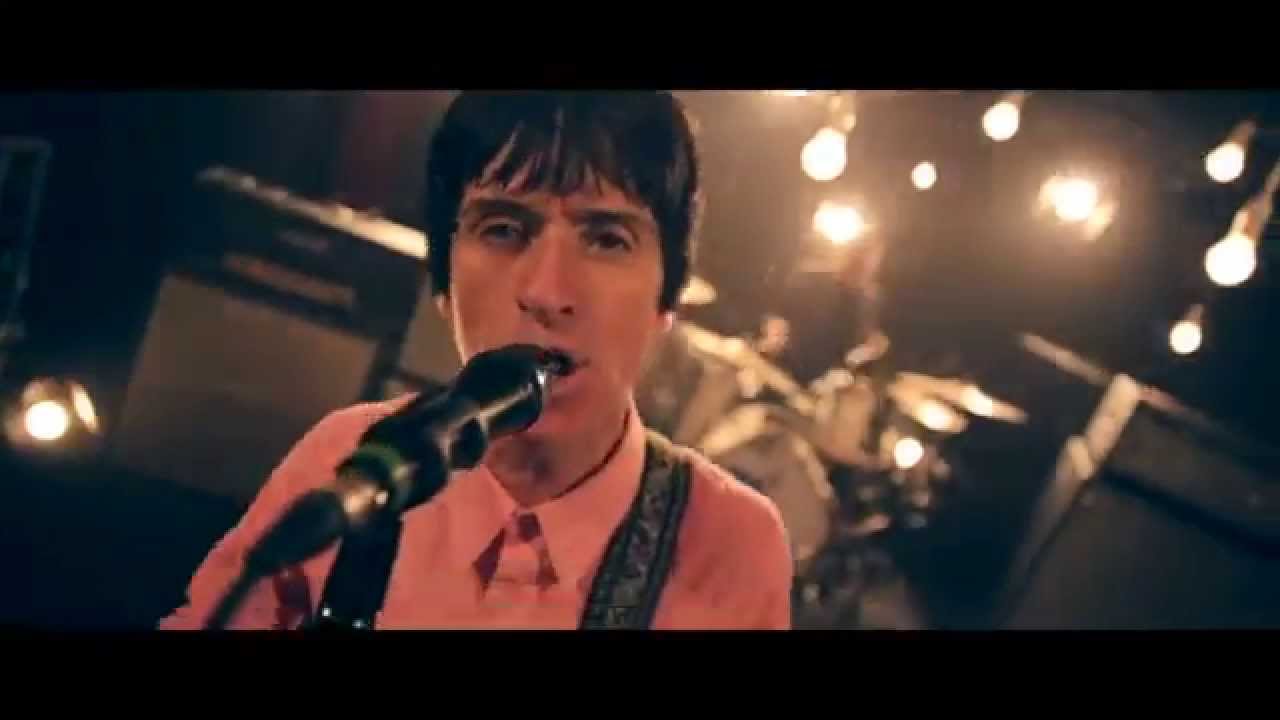

Loving the Jaguar
On Candidate, you have these massive bass-note drones that sit on top of top-string patterns. That’s another texture you like a lot.
“Yeah, yeah. That’s a song where the music came before the words. Sometimes I’ll play riffs and I get excited; other times, you work something up and want to throw it away. Candidate just nabbed me. Even though it was simple, it had a quality that was very emotive. It wasn’t my intention to put emotive music on the record, but that song felt genuine. It felt real and not overly thought out – it wasn’t contrived.”
Thinking about the song Candidate, I’ve noticed that you haven’t been afraid to talk politics in some recent interviews. A lot of artists want to remain neutral. Do you feel it’s incumbent on artists to speak out?
“You know, that’s a tricky one. I’ve always said that I don’t – it’s people’s personal responsibility and all that. You know, I’ve been a vegetarian since 1983, and I’ve never felt the need to lay that on other people. I don’t want anybody telling me how to live my life, so I don’t wanna tell people how to live their lives, either. However, I do feel that if people in pop culture aren’t going to make fun of the government, then who is? Some people deserve it.”
Has it been hard to maintain a vegetarian diet while touring? I’d imagine that it would be.
“It was in the early ‘80s, for sure, particularly in parts of Europe. Germany was tough, and so was Spain, believe it or not. North America was always easier – the culture of convenience and choice. If you can make a buck out of it, people will sell it. I’ve always done OK in North America, except for Texas in the middle of 1985. These days it’s a different deal; the world’s changed a lot.”
Were Jaguars your main guitar on the record?
“Oh, yeah. Absolutely. I love Jaguars so much. They do the job of three other guitars – there you go. I wouldn’t have been able to make my signature model when I was younger because I didn’t have the experience or expertise, but if I did it would have saved me a lot of money.” [Laughs]

Giving guitars to Noel Gallagher
You’ve given Noel Gallagher two of the guitars you used with The Smiths. The first guitar Noel broke on tour, so you sent him another one – the Les Paul you used on the recording of the Queen Is Dead. Either you’re not very precious about vintage guitars or you’re just very generous with Noel.
[Laughs] “I think it’s the second, because I'm actually very precious when it comes to my guitars. On the other hand, I’ve given quite a few away over the years. I gave one to Chrissie Hynde, and Bernard Butler has my 335 12-string that I used on Strangeways and with the Talking Heads. I’ve given Matt Johnson a guitar, too.
“There’s another answer to the Noel thing: I was drinking a lot in those days. [Laughs] But you know, I like to help other musicians out. I know that I got a lot of helping hands when I was starting out. Some people were very generous to me; without them, I wouldn’t have gotten to where I am. What goes around comes around. With Noel, the guitars went to a really good home. He wrote some really great stuff with them, so it all worked out.”
I understand that Pete Townshend gave you a couple of guitars, a Rickenbacker and a Gretsch.
“Yeah, yeah, that’s right. I got them from John Entwistle, though, but they were Pete’s. I’ve got Donovan’s very first electric guitar, too.”
Is there a sort of passing-the-torch thing amongst British musicians when it comes to guitars?
“Not really. It’s just people who come to my house. [Laughs] I think it’s because I’ve been involved with some people, so that’s the kind of thing that happens. Guitar players are an interesting breed: When they recognize someone as their own, they’ll make that person feel welcome; they’ll encourage them. In my case, when I started out, I heard from Ronnie Wood and Keith Richards, and I heard from Pete. A lot of people reached out to say, ‘Nice one. Well done.’ I’ve been very happy to hang out with the Radiohead guys, and I loaned them guitars for In Rainbows. You recognize kindred spirits. I’m proud of that kind of thing with guitar players.”
I would imagine that the movie-soundtrack process is vastly different from making records. What kinds of things blew your mind while doing soundtracks?
“There’s quite a few things that blew my mind. First off, your days are even longer doing soundtracks than making records. You’re in very early and you’re out very late, especially if you’re on something high-profile – or if you’re doing something that’s just good. The big difference, though, is that you have to work for a director who has a vision, and that vision is something you have to capture.
“You’re trying to match the emotion that’s on the screen, and I quite like that. If you’re making your own record, it’s kind of an abstract thing, but with a movie, you’re watching what they’ve done and you have to portray that emotion in your own way with music. That emotion doesn’t have to be ‘emotional,’ as in sad; it can be a plane crashing out of the sky, like in Spider-Man. If you listen to the music away from the movie, some of that stuff is pretty intense and heavy electronic-industrial – I don’t know what it is. [Laughs] But I like it a lot. Doing films is a very different arena from what I come from.”

On singing
By the way, your singing is great. Your voice seems to get stronger and stronger – that’s not supposed to happen with rockers over time, is it?
[Laughs] “Thanks so much. I’m glad that it sounds that way to you. I guess people aren’t supposed to get better, but you know, I like to sing, so I’m doing it. There’s some people who want to sing in a big, dramatic way, and there’s people who want to sing like Neil Young. I don’t want to do either.
“I don’t really use the term ‘rock ‘n’ roll’ about anything anymore; it’s sort of had its day. In terms of how I write and sing, though, I don’t think there’s a better term. ‘Indie singing’ doesn’t fit what I do, and I don’t think I’ve ever heard the term ‘alt singing.’ But rock ‘n’ roll singing is what I do and probably how I sound. I’m probably more influenced by Patti Smith than anybody else. I’m just fortunate to have worked with so many singers, whether it’s Chrissie Hynde or Morrissey or Bernard Sumner, and on and on. The one thing I’ve picked up from them is this: You get your own thing and you get good at that. Just get on with it and make the right noise, you know?”
Johnny Marr's Playland can be purchased from Amazon and at iTunes.
