


“Starting Heaven 17 was like being set free from prison,” laughs Martyn Ware on the origins of the legendary electronic music group, a band he formed with Ian Craig Marsh after they both left The Human League in 1980.
“(We Don't Need This) Fascist Groove Thang was the first track we did and it meant a lot as all three of us [including vocalist Glenn Gregory] were political. It was a forbidden subject during the early days of The Human League. They were great but much more sci-fi and metaphorical.”
Originally hailing from Sheffield, Martyn Ware’s reputation as one of the great pioneers of synth-pop was forged in the northern capital of steel, through an almost scientific approach to music-making.
Initially a key member of The Human League then, after leaving in acrimony, Ware co-founded Heaven 17 with Penthouse and Pavement, the group’s debut record, following shortly after.
Right now, Martyn is celebrating that album's 45th anniversary, taking the record on tour alongside vocalist Glenn on a victory live jaunt across the UK. Ahead of the gigs, Martyn has also been developing a new album under the banner of the British Electric Foundation (B.E.F.), a production house he formed at the same time as Heaven 17.
Featuring 30 tracks and 22 artists, the as-yet-unheard record from B.E.F - Music of Quality and Distinction Volume Four - follows numerous albums unveiled over the years. This latest release features a huge cast of colourful characters.
“I honestly think it’s the best thing I’ve ever done,” says Martyn. “I know that sounds slightly delusional but it’s true. I’ve been working with Phil Oakey on music for the first time in 45 years [on new track Find Her], there's a track with Dave Ball before he passed, Marc Almond is on it and there are two tracks with ABC’s Martin Fry.”

“I’m looking for a label at the moment for it and I had a funny chat with Daniel Miller from Mute, he’s so sweet. The sound is slightly out of Mute’s wheelhouse but he seemed to like the idea of releasing a record featuring a pop star like Kim Wilde.”
Martyn describes this new B.E.F album as a “complete holy grail obsession” of recent years with a sound rooted in the musical world of electrofunk and soul. He has been working with bassist Julian Crompton and guitarist Tony Remy on putting the tracks together.
“I just felt like the world was becoming such a miserable place,” says Martyn on the record’s inspiration. “Rather than submitting to this inevitable slide to the grave, I wanted to do what might be the final B.E.F album as a tribute to the music I loved back in the day - so electrofunk and soul.”
Previous releases from B.E.F have featured cover versions and new interpretations of tracks by artists such as Nancy Sinatra and Lou Reed. But Martyn’s ambition for this record was to come up with original music, then reach out to various vocalists to co-write and perform with him.
“I had no idea if this would appeal to anyone,” says Martyn. “But it’s grown out of control to be honest, everyone was really enthused by the idea.
“Leee John from Imagination initially sang on two songs, then he wanted to do another and we’ve had to write more. There’s a mix of friends and newer artists but I’ve become so obsessed with this that I’ve done a statistical analysis of lifetime record sales for all the contributors. It totals more than half a billion sales of physical product.”

Martyn records and composes from a space at Tileyard Studios behind King’s Cross in London. For the most part, he works out of a computer, utilising Roland’s Cloud software alongside Arturia and Teenage Engineering.
“I only have two analogue synths left,” Martyn says. “One is my original Roland System 100 which I primarily use for basslines. Nothing else sounds like it, it has better filters and oscillators than anything else.”
“The other is the Korg 700S, a synth I used on the first thing I ever did with The Human League, Being Boiled. One thing I discovered that I can recommend is a plugin called Synth Bass Center from Audiolounge which is tremendous and exactly what I required for this B.E.F. album.”
The record features plenty of processing around the guitars and bass while Martyn has been experimenting with various workflows with Julian and Tony.
“For Julian’s bass, we designed a workflow where we simultaneously played his bass through a MXR bass synth pedal at the same time as the DI into the system, and balancing those two things really worked - you have the weight and the character.”
Martyn also utilises Spectrasonics Omnisphere when it comes to evoking emotive musical atmospheres and soundscaping. Alongside his artist material, he was also an early adopter of 3D sound design and spatial audio, co-founding Illustrious Co. Ltd. with Vince Clarke in 2001 to build and use their proprietary 3D AudioScape system.
“3D sound is still something I’m interested in and I’m in talks with the filmmaker Julian Temple on an immersive show he is planning,” says Martyn. “But it’s been healthy for me to take a step back and return to a traditional music project.”
Penthouse and Pavement was released in September 1981 and is still regarded as one of the finest moments in the Heaven 17 discography. Featuring the brilliant title track alongside (We Don't Need This) Fascist Groove Thang and the alternative pop of Play to Win and Let’s All Make a Bomb, the songs still sound fresh despite now reaching middle-age.
“We deliberately set out to make something timeless, that you couldn’t attach to a particular period,” Martyn explains. “A lot of other eighties records have aged poorly because they were more throwaway, but we had a different mindset. Which sounds ambitious but that is what we told ourselves back then.”
Part of the record’s appeal lies in its mechanical funk and electropop sounds. Martyn refers to what he describes as “the pocket”, a razor sharp rhythmic musical state.
“We used the Linn LM-1 Drum which had just come out,” he says. “You could create a rhythm which was so accurate, similar to the electronic regularity of a band like Kraftwerk.”

“When I was producing Vince Clarke’s I Say I Say I Say, I was explaining this concept to him and we decided to see what programming the same beat on his MC8 would be compared to Logic 5. Back then, Logic would drift and the funk is in the precision.”
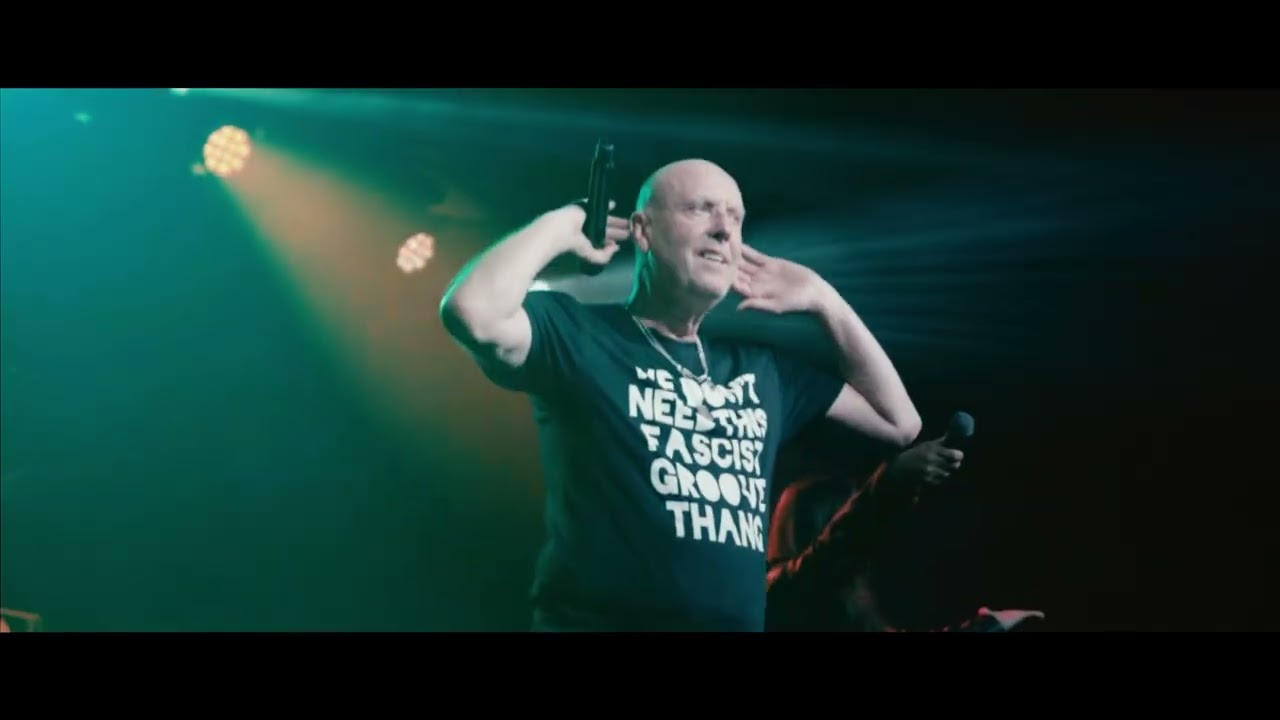
(We Don't Need This) Fascist Groove Thang was Heaven 17’s debut single and became a minor hit despite being banned by the BBC after its release in March 1981.
“It has an important message which unfortunately still resonates today, we were like the Nostradamuses of synth pop,” Martyn says. “Looking back, I’m eternally grateful to Virgin for putting their faith in us. With Penthouse and Pavement, we were a slow-burning act even though we didn’t have any big hits on that first album, we were in the top 40 for 45 weeks. They took a gamble on us and it paid off.”
Their follow-up, The Luxury Gap, followed in 1983 with much of the record demoed at home as the portastudio had just been released. The demos were then taken to Air Studios and transformed into their bigger, completed versions.
“You couldn’t get a greater contrast between a four-track cassette, then working at Air, one of the most heavily-equipped studios around. We had unlimited resources for the best session players and orchestras and I remember thinking it felt like all our birthdays had come at once.”
The city of Sheffield was also an essential ingredient in the primordial soup of Heaven 17. As was discussed in the recently-released documentary film, Heaven 17: The Last Temptation.
While their tastes always leaned towards experimental electronic and futuristic sounds, Martyn and his musical companions immersed themselves in the local scene.
“We were going clubbing to hear dance music imported from the US, then blues clubs too where we’d hear plenty of dub,” Martyn remembers. “Cabaret Voltaire were also a major influence, although this was more in their spirit than their music. We were great friends though and their relentless experimentation was so inspiring.”
Sheffield’s steel industry has often been cited as shaping the city’s music-makers with the sounds of the forges and factories somehow becoming embedded in their minds, then funnelled into their machines, synths and productions.
“At the time, we didn’t know anywhere else, so I first thought everywhere was like Sheffield,” says Martyn. “It was only when you’d go elsewhere that you realised how different it is - you don’t walk through the city centre and hear grinding sounds? Or the sound of the drop forges coming down the valley?
“It’s a big influence when you’re younger. As someone who grew up in this environment, I love it but I guess people who grew up in a bucolic environment, they like the quiet of the countryside. But the countryside freaks me out – there’s not enough noise!”
As Heaven 17’s story continues to be told via their current live tour and future projects, Martyn is grateful for how he was able to take advantage of opportunities when they came his way during the band’s early days.

“At the moment, it feels like we’re in a more fearful zeitgeist about everything, no one knows where the future is going,” Martyn says. “When I grew up, we had nothing to lose, industry had collapsed, there was big adult unemployment - so for us, it was all about experimenting and giving things a go.”
For those starting out in electronic music now, Martyn suggests aiming for productions to be close enough to you to capture what your identity is all about.
“Try and be authentic to your own muse and believe in yourself, you can play by your own rules,” Martyn states. “Those who succeed are different and stand out from the crowd. It’s not just about talent, it’s about how you forge opportunities and how daring you are. Try to ignore anyone cynical and do things because you believe in yourself and your music.”
For more info on upcoming Heaven 17 tour dates check out the official website.
