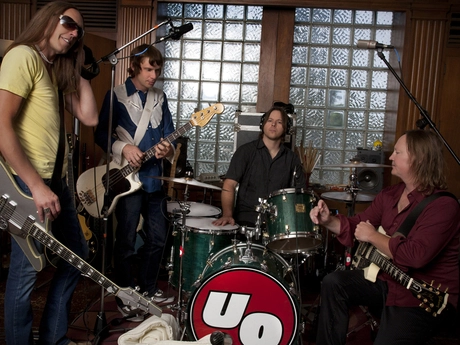

Feeling the Urge once again are bandmates (from left to right) Nash Kato, Mike 'Hadji' Hodgkiss, Brian 'Bon' Quast and Eddie 'King' Roeser.
"There's so much to Urge Overkill that hasn't been said," claims singer-guitarist Eddie 'King' Roeser, "so we finally decided to say it. It might have taken us a while to make a new record, but we're really happy with what we've done, and we can't wait for everybody to check it out."
That will happen on 10 May, when Rock & Roll Submarine, Urge Overkill's first CD in 15 years, hits stores, digital outlets and everywhere else people manage to grab music from these days. Released on the band's own UO Records label, the disc reunites Roeser with his original Urge partner, singer-guitarist Nash Kato, and sees two new faces entering the fold, drummer Brian 'Bon' Quast and bassist Mike 'Hadji' Hodgkiss.
Brimming with stomping songs such as Effigy and Niteliner and remaining true to the Urge signature sound, a restless blend of power pop, punk, with a hint of soul, Rock & Roll Submarine is a satisfying listen. Whether it restores the Chicago-based band to its mid-'90s glory days, when they were riding high on the success of Girl, You'll Be A Woman Soon, their Neil Diamond cover that figured prominently in the zeitgeist that was Pulp Fiction, remains to be seen.
There's much baggage in the land of Urge Overkill, and according to Roeser, "it took us a while to get rid of all the emotional weight." Once touted as the Next Big Thing, the Windy City trio (which also consisted of drummer Blackie Onassis) had scored critical hits on a series of indie releases produced by the likes of Steve Albini and Butch Vig. A mega-bucks move to Geffen Records should be been Urge's ticket to global dominance, but 1993's Saturation and 1995's Exit The Dragon failed to deliver the multi-platinum. And then came Pulp Fiction.
The band's two-year-old cover tune worked like a charm in a pivotal scene in a movie that was full of them. But the Pulp Fiction success, combined with Onassis' heroin addiction, exacerbated the growing tension that was already brewing between Roeser and Kato, and in 1996, Roeser split. "Something had to give," Roeser says, "and in the end, it was me."
Flash-forward to 2011 and Roeser and Kato are making nice again. The expanded Urge lineup has played a series of recent warm-up gigs, and last December they even revisited their Pulp Fiction past by playing at a Friars' Club Roast of Quentin Tarantino in New York City. MusicRadar caught up with Roeser to get the skinny on the Urge reunion and to pose that all important musical question...
So Eddie, do we call this a comeback?
[laughs] "You can call it anything you want. A comeback? That would be nice. We're just hoping to have a career and not have the kinds of problems that we once had. Stability would be cool."
You left the band in '96. What were the reasons for your exit, and how did you and Nash finally agree to put the group back together?
"At the time, we were at the height of our career. We had done Exit The Dragon, which we were very proud of. Already, though, there were problems. We were told by Geffen that our previous album, Saturation, was going to break us big. But what happened was, a couple of groups that they weren't planning on - Weezer and Counting Crows - started settling records.
Suddenly, Urge Overkill, which was a priority at the label, started looking like a tough sell. People were wondering why we weren't selling records like Weezer. So we did Exit The Dragon, and there was a bit of enmity between certain members of the band. Also, there were drug problems, which were far worse than I was led to believe at the time..."
Are you referring to Blackie?
"Yeah, yeah. We were shooting a video for $300,000 and certain members don't show up because they need their dope. That kind of thing doesn't sit well with the other band members - and it doesn't endear you to the label, either.
"All bands fight, but for me, it all came down to ill feelings on many levels. I was upset that Blackie couldn't function. Things then became strained between Nash and me. The environment became very dark. I felt like I had to get away. I was feeling lost.
"Nash and I sort of half-heartedly pursued other projects, but we never really found anything stable. Time kind of heals all wounds, as the saying goes. We were offered a show to do. I was skeptical, but we did it, and it was a lot of fun. There was great support from friends in Chicago. Nash and I started to experience the good feelings about playing together again. Then we got Hadji involved - he was living with Nash - and eventually the band built itself back up."
You're now officially a four-piece. How's that working?
"It's working out fine. I've always played guitar, but when Urge was in its infancy, it was kind of a trio arrangement, so I had to pick up the bass out of necessity. But I always played guitar on the records. With Saturation, we were touring as a four-piece, even though we were officially a trio. This lineup feels good."
You've played a few warm-up shows. How's the band vibe?
"The vibe is strong. We've actually been playing as a band, under the radar, since about 2004. So this has been a long time coming, us making a new record and kind of announcing to the world that we're back. We took our time to make sure that we were up to the challenge of making a record that was on the level with our other ones. Our drummer is quite a good engineer, and we're very happy with him. Playing is a real joy now, and it didn't used to be."
Back in the day, Steve Albini made some disparaging remarks about Urge when you signed with Geffen. Did that sting?
"Yeah, that was strange. We used to be these pot-smoking losers sitting on his couch, but we had these dreams and aspirations of making music for a living. For whatever reason, Steve thought that was a bogus notion. It wasn't punk. So he thought we were a bunch of unrealistic fools. He even told us, 'You'll never make a profit from being musicians, guys.'"
What was it like working with Butch Vig? I assume he was a much different producer than Steve Albini.
"He was very different. Steve didn't care about hearing the vocals, whereas Butch thought you should hear everything, especially the vocals. We certainly weren't opposed to that. At first, we got some flack from people: 'You guys are going to sound like a pop band with Butch Vig.' Which is a joke, of course. He didn't make us sound like a pop band."
Let's deal with the elephant in the room: Pulp Fiction. To many people, that song broke you guys. Blessing or a curse in some ways?
"Pulp Fiction was a mixed blessing for us in certain ways. The popularity of our version of that song did play into some of the things that drove the band apart. Nash and I were feeling like we should go in different directions. But we were really in a bind. Saturation was supposed to be our big hit, so when that didn't become this smash on a worldwide scale, the label started getting nervous about us.
"Then, Quentin Tarantino heard our version of Girl, You'll Be A Woman Soon, which we had recorded a couple of years earlier for an indie EP [Stull, 1992], and he put it in Pulp Fiction. Before you knew it, we were part of the biggest film in the world. That was fine on some levels. We got to travel to all of these countries and play. We had a hit song. The only problem was, our hit wasn't really our hit."
Last year, Urge played the Friars' Club Quentin Tarantino Roast. I take it you've come to grips with your part in Pulp Fiction's legacy.
"Yeah, we have. You know, not a lot of rock bands can go out and do a song that involves crooning. We're fine with our little place in history. And Quentin is cool. Doing the roast was a lot of fun. Quentin came right up front and got into it. Would we have preferred one of our own songs to have achieved such notoriety? Sure. But you can never predict these things.
"We still do the song live sometimes. It's a nice change of pace. We'll do our big rock set, and then we'll do the cover tune. It works, and we don't mind playing it. At this point, as you said, it's become part of our legacy."
Let's talk about the band's sound. With a lot of groups, one can hear a heavy metal influence or blues. You guys have always been a little hard to pin down - you're all over the place.
"I think you're right. I like metal, and I dig all kinds of shit. It's almost like, track for track on this new record, the Urge Overkill sound is impossible to define. We've always been a musician's band, a group you have to really listen to more than once. If you don't get where we're coming from, that's OK, as long as you like what we're doing."
Talking about the new album, did you have any specific goals in mind?
"I think Nash and I had a few things we were thinking about. I really like stripped-rock rock, and he's really good at instrumentation and adding all the bells and whistles that some kind of rock and pop songs call for. We tried to keep a balance of both things on this record. It doesn't sound sterile, and it doesn't sound like you did it in your garage, either. It's got a lot of life to it. It's exciting, I think."

Sharp-dressed men: Quast, Nash, Roeser and Hodgkiss.
Well, it starts out kickin' with Mason/Dixon, and there's the song Niteliner, too - both of which sound like some of the best KISS songs KISS never recorded.
"Well, I have to plead guilty. I kind of grew up in the prime of the whole KISS thing. It wasn't my goal to sound like KISS, but I'll take what you said as a compliment songwriting-wise. I think KISS suffered from a lot of bad production, if you want to know the truth."
Are you are Nash singing together on those songs?
"Yeah. Nash is really good at singing to himself on a lot of the ballad-type songs. On the songs that rock more, you'll either get the two of us or me by myself. We try to have a couple of vocal parts of each song, but sometimes you can't. It's always been a Lennon and McCartney thing with us - whoever comes up with the song is usually the main guy."
Which brings me to Effigy, on which you sing lead. Did you write that on your own?
"Yeah, pretty much. Some things are hard to pin down. The first two songs, we both came up those, the two of us sitting down together. There's a song called Poison Flower, which has these neat guitar arpeggios, and that's pretty much all Nash. On the lead guitar stuff, that's usually me. If you hear a really stupid guitar solo, that'll probably be Nash. [laughs] I'm not putting him down when I say that. He does a solo in a song called She's My Ride, and it's great."
In writing for this record, how did you demo the material?
"We went down with our drummer, Bon, who's got a really good tape machine, and we did a pile of stuff with him. Then we went to a demo studio to do some other things. A few of the things were from the sessions we did with Bon, although we wound up redoing vocals. We're not like bands nowadays who do their songs on GarageBand and things like that. We still like the magic of working in a studio."
What kind of guitars and basses do you play?
"I have an SG Junior, which has a really big thick sound. I also have an old Les Paul SG from 1961 - that's what they were called back then - which is a really desirable old guitar. It sounds terrific, and I think it goes for a lot of money, so I probably shouldn't be telling you all this. [laughs]
"Bass-wise, I'm using a Fender Precision and a Jazz bass. We used one of those old Acoustic tube amps from the '80s, and it worked really well. Whether we were going for something clean or really kind of shitting sounding, it did the job. In a way, it doesn't matter what we play. You give us a bunch of guitars and some drums, and we sound like Urge Overkill. Equipment can't kill us. At this point, nothing can."
When you listen to the new album, would you say the band has matured?
"I just have to say that the record represents where we were when we recorded it. We already have another album in the can, and I just hope there's a good response to Rock & Roll Submarine so we can put that one out. I guess we did mature. On the other hand, it's called 'rock music,' and I don't know if the word 'maturity' should ever enter into the equation. We do what we do, and at the end of the day, that's that."
