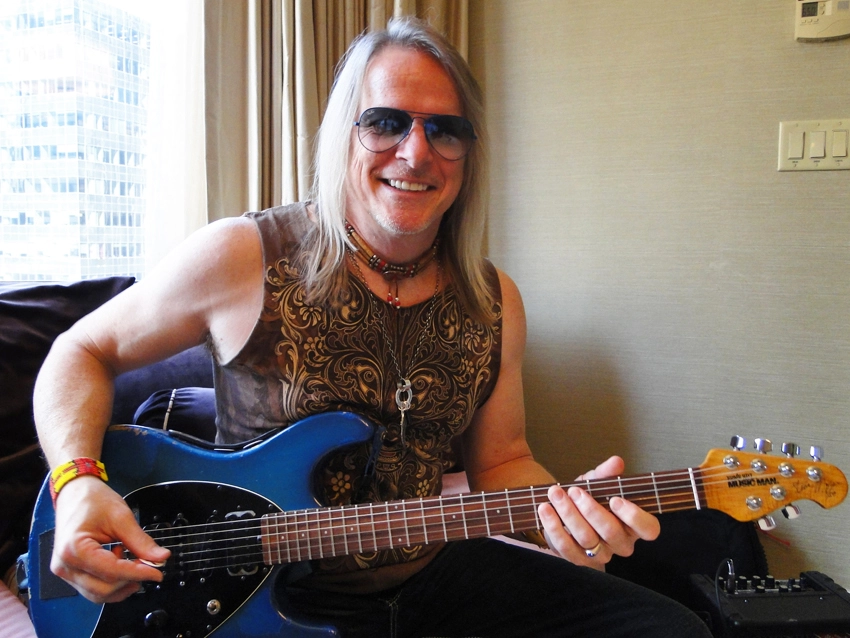
Steve Morse likes to play the guitar. No - he really, really likes to play the guitar! Seated in his tour manager's room at New York's London Hotel, the venerated Deep Purple axeman noodles, shreds and races his fingers up and down the fretboard of his "number one" Ernie Ball Music Man signature model, plugged into a small practice amp, for the duration of our interview.
He's not being rude or aloof, mind you - in fact, he's charming and witty, answering each question with thoughtful, measured consideration. "I just feel more comfortable when I'm playing the guitar," he explains. "I hear these other guitarists say they can go two weeks or a month without playing. Not me. If I'm not actively doing something physical, I play the guitar. I practice every day, too. There's always room for improvement."
That last statement is bound to drop jaws and raise eyebrows amongst Morse's legion of fans across the globe, who have marveled at every note he's plucked since debuting with his band The Dixie Dregs in 1976. Throughout his career with The Dregs (they shortened their name in 1981) and on numerous solo releases, and even in his brief tenure in Kansas, Morse effortlessly mixed rock, jazz, country, bluegrass, blues - you name it, he can play it - to create that rarity in music, and all of art, for that matter: a style all his own.
So it came as a bit of a surprise - OK, a shock - when he accepted an invitation to join the veteran British hard rock band Deep Purple in 1994, after the mercurial Ritchie Blackmore split for good a year earlier. (Joe Satriani played a handful of dates with the group and almost became a full-time member, but his record contract at the time prevented him from doing so.)
"That did throw a lot of people," Morse says. "Many of my fans see me as something of a lone wolf or a band leader, like I have to control every aspect of everything. The truth is, I love being part of a group and not having to make every decision. This situation is the best of both worlds. When time permits, I still do my solo stuff. And with Deep Purple, I get to play great music. To me, it's a cake with lots of icing."
And right now, it's a triple-layer job served with extra frosting and candles as Deep Purple (which also includes "classic lineup" members Ian Gillan on vocals, bassist Roger Glover, drummer Ian Paice and "new guy" Don Airey on keyboards, who signed on in 2001) are currently touring the world with a 38-piece orchestra backing them up on such hits as Smoke On The Water, Highway Star, Space Truckin' and countless other songs you know by heart.
In addition to discussing the behemoth tour, Steve Morse talked to MusicRadar about his role in Deep Purple, how he's been able to carry on in the shadow of Ritchie Blackmore and the band's plans for a new studio album. What's more, he even detailed his two Ernie Ball Music Man Steve Morse signature models (see the above video) and demonstrated the "correct" way to play the oh-so-recognizable but much-mangled riff to Smoke On The Water (see page two).
You're now the longest-serving guitarist in Deep Purple history. Did you go into it thinking it would be a career gig? Also, did you have any trepidation stepping into the shoes of Ritchie Blackmore?
"I have been through something like this before when I replaced Kerry Livgren in Kansas, so I was sort of prepared for what the experience would entail. You go in knowing that a certain percentage of fans will just hate it, no matter how well you play or what you do. A lot of fans like a band only one way; another guy comes in, they don't like it. It doesn't matter who it is, what songs they write, or even if they're better than the guy that came before - some fans will just fold their arms and go, 'I don't like it.' I understand that.
"Still, when I joined Deep Purple, it was a chance for me to really bring something to the table. As a fan of the band, I felt as though they needed something. They did the organ and the keyboards thing really well, but with the guitar stuff, a lot of which was blues based - and I realize that's their meat and potatoes - I felt like there needed some stepping up, a different kind of attitude.
"Actually, I did have some trepidation. They asked me to join the band, but I'd never even seen them play live. They played all over the world, but they didn't play a lot in America. I didn't know what they'd be like, whether they were a band just living of their name and not into new ideas - all those things. So my manager, Frank Solomon, set it up Deep Purple's manager that I would play four shows with the band. That way, it was an easy get-out-of-jail arrangement on both sides if we were unhappy.
"I didn't know what to expect, but during my first rehearsal with the band, which was only a couple of hours before we were supposed to do a gig, I was blown away by how great they were. I think we were all surprised at how good things sounded and how easy the chemistry was. Within an hour, we were laughing and slapping one another on the backs going, 'All right, this is gonna work!'"
Even though you play Music Man guitars and, of course, have your own signature line of Steve Morse models, did you ever consider a Strat to get a truly "Blackmore-ian" tone?
"No, not really. I've seen this time and time again, and I'm sure you have, too: You get two guitar players, give them the same guitar, same amp, same setup, you can even give 'em the same pick [laughs]…and they'll sound totally different. Equipment has very little to do with it; it's all about the player and his feel and approach to music. It's just like acting: two actors can read the same words from the same script, and you'll get two completely different performances.
"In truth, my attitude about my guitar was more based around what the band wanted, and what they said to me flat-out was, 'Don't copy Ritchie.' They told me that right off. They could've picked from plenty of people who wanted to be just like Ritchie Blackmore in Deep Purple. That's not what they wanted. They wanted somebody with his own persona - and not only that, but a strong persona.
"If I would play a Strat, everything would go right out the window and I'd be entering into that land of parody and emulating Ritchie Blackmore. I respect him totally, but I don't want to be him in a Deep Purple cover band."
Of course. However, when you perform the classic Deep Purple songs on stage, how close do you feel you have to stick to what Ritchie Blackmore played on record?
"I feel a certain obligation…to a point. You know when you watch a sitcom on TV and a band is playing a cover song? They could be singing 'Na-na-na-na-na-na-na' - whatever. But then there's that moment when they get to the hook, and they play the hook exactly the way you know the song. That's how I go about it. There's the hooks and melodic parts that Ritchie did that everybody knows by heart. And they're great parts! I have to play those parts, and that's fine. The songs wouldn't be the songs without them. But there's a lot of leeway in and around those sections."
Over the decades, Deep Purple have seen members come and go. Yet this lineup has remained constant for 10 years now. Do you feel that you've had something to do with this stability? Are you the "glue" that was missing?
"Well, I think the fact that I've been in a lot of bands and have seen lots of situations, and just being a very flexible person has really helped. I'm a very patient 'can do' kind of guy. [smiles slyly] But now that more than half of my life is over, I'm starting to lose that patience. You never know. I could explode at any minute. [laughs] I'm just kidding."
Of all the classics in the Deep Purple catalogue, what are your favorites to play?
"Well, I really love to play Highway Star. It's very busy, with lots of changing parts. Plus, it has that awesome keyboard solo, which is an absolute work of art. If you were to say to me, 'Name me one of the greatest examples of classical meets rock music,' I wouldn't have to think too hard. And the guitar solo is a lot of fun to play. [He plays the solo flawlessly] I mean, what could be cooler than that? Not much. If you're a guitarist and you don't like playing that…" [shrugs and laughs]

Look at this guy! He can shred while answering questions. Talk about multi-tasking. © Joe Bosso
The band is currently working on a new record. How far along are you with things?
"We've got the music pretty mapped out for the majority of the recording. The goal on this album isn't to stretch out to new heights; it's more about revisiting the roots - riff-oriented blues rock. Heavy stuff, you know?"
I know you said the band encouraged you to be yourself on stage, but when writing with the group, is the atmosphere the same?
"No, writing for Deep Purple is much different than playing with them on stage, and it's very different from writing for a Steve Morse solo album. I think it's good for musicians to understand the particular situation they're in and what's expected of them. The band wants me to come up with lots of ideas, the vast majority of which never get used.
"My way of doing that has been a bit of a shotgun approach: I just hit them with tons of ideas and see what really sticks. One thing I like to do - and I've encouraged the rest of the guys to do this, too - is to only bring in snippets of things, not finished tunes, because people might only like this bit or that bit. They might not like an entire song. Giving them sections is a cool way for everybody to contribute and truly make a song 'Deep Purple.'"
Right now, the band is touring with…what do call it, a "symphony"? An "orchestra"? A "lot of other musicians on stage"?
[laughs] "It's definitely not a symphony; it's probably more like an orchestra, or the amount of musicians that Broadway musicals would use. We have strings and horns... It's a lot of people, but it's not unwieldy.
"We don't tour with the same musicians - that wouldn't work on so many levels. Like tonight in New York City, we have musicians coming in from all the different boroughs and New Jersey. Same thing happens when we play the next gig in another state. Our conductor works with the musicians, hands out the parts and gives them the cues. It changes a bit, but it's been really terrific. Using strings and horns and orchestras in rock music certainly isn't new - it was done way back in early pop and soul music. A lot of bands just don't do it live every night, and I can see why!" [laughs]
Musically, what do you get out of playing with Deep Purple that you're able to transfer to your solo work?
"Playing with Deep Purple and recording with them, I've learned so much about phrasing, how to begin and end a phrase. On my solo records, I'm given the freedom to do whatever I want for as long as I want. But with Deep Purple, I have to edit what I do more, and that's taught me the importance of saying more with less, how to have a faster kind of impact."
Tell me something, have you ever had any contact with Ritchie Blackmore? Has he commented on your playing?
"I've had no contact with him, but he has made some comments which I thought were remarkably…restrained. He's certainly had perfect opportunities to say whatever he wants, negative or otherwise. I realize I could be one giant target for him. And not just Ritchie, but for many, many fans out there. There's still lots of people who want the band to be the original guys. I understand all of that.
"But I'm really relieved that he hasn't said anything harsh about me. The most he ever said, and I'm paraphrasing, is something like, 'This guy plays very well and does a lot of different things. I'm not sure if he's right for Deep Purple…' He said something to that effect. But you know, how can anybody replace Ritchie Blackmore in Deep Purple? You can't. All you can do is come in, do what you do and change the band here and there. You can't be a clone…and you're shouldn't. What Ritchie did has been done. I do what I do. There you go!"
