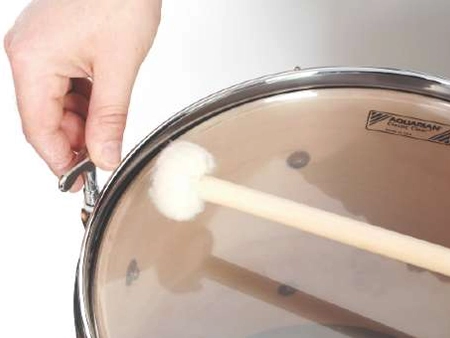
When tuning drums, the general approach should be to promote tone, resonance and projection. Unfortunately, tom tuning seems to provide the biggest headache for the vast majority of drummers… until now.
• How to tune a snare drum
• How to tune a bass drum
Here's how to tune your toms to perfection, in eight simple steps…

1. Seat the heads
Once again, we're going to begin by seating the heads, a process that is arguably more important on toms than on any other drum type. Take your new head and place on the drum, refit hoop and tension all rods to finger tight. Press firmly in the middle (vary the amount of hand you use depending on the drum size) and look out for those wrinkles.

2. De-wrinkle
Work round the drum a little at a time (remember, we don't need to use the criss-crossing method) until all the wrinkles have been removed. Give the head a good stretch by pressing against it quite firmly a few times. Once you have done this, press in the middle again and check to see if any wrinkles appear (they quite often do on larger toms) and adjust the rods as necessary.
3. Tension in half-turns
To complete the seating process fully, take two drum keys and, working in opposite pairs, tension the head in half-turns, taking it up to a level of tightness that would be way above what most players would use. Quickly check that the head is roughly even all round and then leave for several hours. Overnight is good if possible…

4. Loosen up
Loosen the tight head by detuning the tension rods in opposite pairs in the same way as we tightened them in the first place. Now make them all finger tight again and you are ready.
When tuning, it's a good idea to start with both heads detuned back to slack, regardless of which head you're replacing. Why? Because the chances are that the bottom head will have detuned slightly since we last checked it, and if you are putting a new batter head on, it will be slightly different from the previous one, even if it is the same model.
5. Start at the bottom
On toms, the bottom head is the most important one. The vast majority of drummers don't seem to realise this and can spend hours tweaking away at the batter head. The problem is, this very rarely solves the problem in question, or means that the drum never sounds as good as it could.
Focus on optimising the sound of the bottom head (after all this is the head that affects tone, sustain and projection) and if you get this right, tuning the batter head almost takes care of itself.

6. Match your heads
Make sure you pick your bottom head wisely - thin resonant heads (7 mil) are not a particularly good idea in most cases, despite being widely supplied on kits. For maximum resonance and sustain, try matching the weight and thickness of top and bottom heads appropriately.
For example, if you are using a two-ply batter head, a thin (7 mil) resonant head will often appear to choke the tone of the drum. If that's specifically what you want, cool. If not, go with a standard medium weight single-ply head (10 mil) and you'll soon hear the improvement in sound.

7. Make it sing
Once again, press the centre and, moving round the drum, one lug after the other, tighten and remove all the wrinkles. Check that the head is of even pitch. At this point we can stop pressing in the centre and start using our ears. Continue in even smaller turns and notice how the head starts to sing.
What we are looking for here is a nice tone that, after tapped lightly, decays with a smooth, even note. The pitch you choose is up to you, but in general, a nice even tone is a good place to start. In the case of most toms, you will find that there is a place where the head will suddenly spring into life and sing evenly and openly all across its surface. If you are lucky, your drum may have two or more levels at which this happens.

8. Turn to the top
Contrary to what you may have heard, try tuning the batter head of your toms 'in situ' - in other words attached to their stands, bass drum, whatever. That's how we play them and that's where they should sound their best. Make sure all rods are finger tight, remove any wrinkles and move round the drum as before, only this time use very small turns - maybe a quarter of a turn, or even smaller.
Each time you turn a rod, tap the centre of the drum and check the sound. Keep doing this until you get the sound you want. Always go for pitch and sound first, then feel.
Now read 7 simple steps to tuning your bass drum
Get MusicRadar news delivered straight to your inbox
The free MusicRadar newsletter serves up the week's biggest artist and product news stories alongside exclusive tuition and gear reviews. Sign up for the free weekly
Follow MusicRadar on Twitter for bonus updates
